
 John Duykers and I were on the radio last Sunday on KRCB, the local NPR station near his home in Sebastopol. He's a farmer as well as an internationally renowned opera singer, so he was the one invited onto what was ostensibly a food show, to wit Mouthful. A direct link to the podcast is here but it's also on iTunes. John brought in a lovely dish consisting of multiple potato species, kale, collards, and a buttery spicy drizzle. I would say that, if one wants to work in opera, one should make sure that the artists with which one works should provide at least one of your other basic human needs besides artistic fulfillment, e.g. companionship, fresh organic produce, sex, laughter, knowledge, linguistics, and so on. Maybe in a future post I will present a bipartite graph where the one of the two disjoint sets consists of my artistic partners and the other my basic human needs and the readers will be invited to draw in their guesses as to the graph edges. But I was on the show to provide some musical interludes (the quite lovely numbers brightness 2 and Casus Tertius) But work on Mordake is heating up in preparation for Frieder Weiss to come and give the visuals the Frieder touch. Light, but persuasive.
Friday, June 29, 2007
If love be the food of music
John Duykers and I were on the radio last Sunday on KRCB, the local NPR station near his home in Sebastopol. He's a farmer as well as an internationally renowned opera singer, so he was the one invited onto what was ostensibly a food show, to wit Mouthful. A direct link to the podcast is here but it's also on iTunes. John brought in a lovely dish consisting of multiple potato species, kale, collards, and a buttery spicy drizzle. I would say that, if one wants to work in opera, one should make sure that the artists with which one works should provide at least one of your other basic human needs besides artistic fulfillment, e.g. companionship, fresh organic produce, sex, laughter, knowledge, linguistics, and so on. Maybe in a future post I will present a bipartite graph where the one of the two disjoint sets consists of my artistic partners and the other my basic human needs and the readers will be invited to draw in their guesses as to the graph edges. But I was on the show to provide some musical interludes (the quite lovely numbers brightness 2 and Casus Tertius) But work on Mordake is heating up in preparation for Frieder Weiss to come and give the visuals the Frieder touch. Light, but persuasive.
Wednesday, June 20, 2007
Bad poetry
 Once again Jim Bisso and I found ourselves on DJ Bunnywhiskers, this time reading our favorite bad poetry, some badly written, some badly or baldly sentimental, some bad by its very nature. The show is here, good and bad mystical unicorn poetry is here, and some pro-war poetry of the Axis and the Central Powers and the Allies of both world wars is here.
Friday, June 15, 2007
Just fucking figure it out already

But, before I go, let me share just a few examples of what is raising my pique. OK? Yes. Here we go:
... will explore the ambiguous and changing nature of our relationship to living in a post-private society, where personal electronic information ...
The play will explore the rise in America of new white male empowerment in relation to a diversifying American culture.
The overall intention of the work is to explore the nature of communion with the infinite, and the opening of--the soaring of--the human heart. ...
The work will explore architecture as a fundamental, subliminal force intervening in the human narrative, braiding artistic exigencies, topical dramas and ...
...will explore the historical origins and the complex identity issues faced by conversos while speaking to the larger question of ...
In our sex comedy, we have outlined the following scene:
Arts Commision: banker, bishop, duc and judge, done as a scene from 120 days of Sodom. Old whore reads from the proposals typing notes on a laptop while the work samples are played and the four discuss. The four on the jury take off on tangents about fucking boys in chambers, shitting on the host, stuffing cash up the cunt of a prostitute. The old whore tells a story inspired by at least one of these. My work sample could be a setting of jet of blood. Jim’s lyric poem on the first 15 seconds after a consecrated host (at what point does it transubstantiate?) enters a whore’s vagina (pushed in by the black priest’s cock (editor's note: black as in black mass, not black as in African American)). The latter is what triggers the cash in cunt of prostitute story.
Sunday, June 10, 2007
Amy Crehore
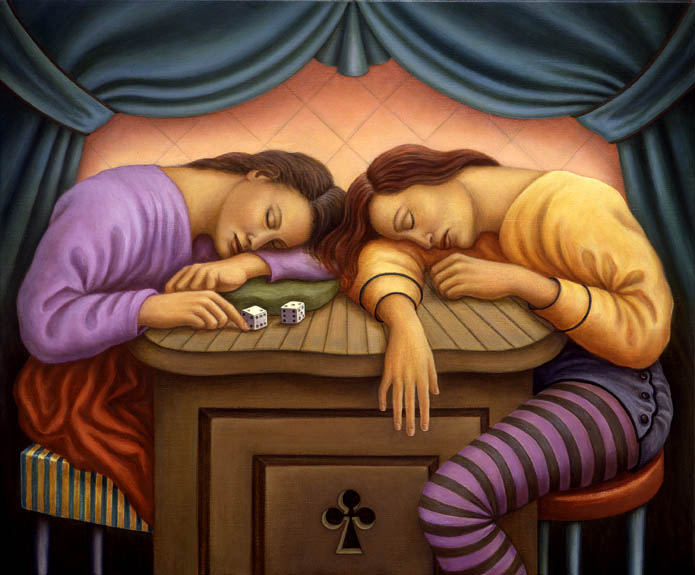 Let's take a moment to consider one of my favorite paintings. In the collection of the artist. I have a few of Amy's prints above my piano just below Vera where I meditate on them while I work. In a quid pro quo, she at times listens to The Bed You Sleep In in between the blues and the hokum when she is working. It makes me happy to think that, possibly, I've left a small impression. Maybe a brush stroke that took a small turn to reflect a particularly lovely note on the viola, maybe a color that ended up a slightly darker hue as a static sad sawmill loop sounded.
Friday, June 8, 2007
Not for dancing
 Lynne Rutter had been asking me to write something for her, and I knew she was very fond of the Shostakovich Jazz Suite waltzes, so I wrote her a short waltz. It's a slow listening waltz more than a dancing waltz, and maybe could be orchestrated as an appropriate dirge for my New Orleans funeral. No recording, but the score is on my works page, direct link here. I did play it at our annual party/salon last Saturday and was later forced to play it again, the second time being a bit more difficult due to the ongoing drinking of the Nerve Center Punch, but probably a little more heartfelt too in a sad crying-in-your-punch kind of way. I've thought we should do a salon more often given that we seem to have a lot of "creative, smart, and funny friends" as one of the thank-you notes said. But maybe the rarity is a plus. Dresher was there and seemed to enjoy himself and we went to see his Tyrant opera last night. Duykers as usual did a great job. He seems to be talking a number of us West Coast composer types into writing him solo operas and paying him for the opportunity.
Just after posting this, I received a DVD from M. Mara-Ann, who unknown to me secreted a video recording device into the party and captured my drunken stumbling through the piece, so there is actually more to love than I thought there was. Lynne told me that, when her friend Rich Kraft once did an imitation of me playing the piano, he started with a bold flourish, stopped and grunted and then started over, and this truth about me is what we see here.
Saturday, May 26, 2007
Tuning Troubles
 When I first started playing in a Javanese gamelan, it was difficult for me to get past the tuning, the unfamiliarity of which got in the way of understanding the music. In fact, it was so difficult for me in those first few days that that I didn't even get that I wasn't understanding the music. This was a little unexpected for me, as I was already very familiar with tuning experiments in modern classical music. For example, I had listened to a lot of quarter tone music and, at that time, I was working on a somewhat ridiculous piece, a concerto for contrabass accompanied by a trombone quartet and choir, where each section of the ensemble used a different fixed-pitch equal-temperament, e.g., chromatic scales of 1/8th tones and 1/6th tones and so on. The chorus was used like an orchestra, singing various IPA-notated phonetic abstractions. But I was raised on the serial music of the world of the post second Viennese school, was intimately familiar with the sound of it, had an intuitive grasp of it and this just seemed like a logical way to go forward. But the gamelan was different.
My music at the time was not really harmonic, essentially percussion music with a pitch veneer slathered on top, disguising its true nature. I mean, it was harmonic in the sense that pitches were sounding at the same time as each other, and sometimes the harmonies were exciting and beautiful, but it wasn't really part of the overall architecture of the piece. So when I was confronted by music where the tuning was different but the music was straightforward - in the sense that it was not intended to be difficult to understand and was supposed to have an immediate emotional impact and leave you humming the tunes - the tuning was a wall that took a few days to get past. However, once I did, I fell in love with it, could sing along and could find the pitches easily and felt that they were, in fact, quite "correct." I wanted to comprehend this feeling and apply it in my own playground of pitches. I felt that I was missing something important and possibly following the wrong path.
The next surprise came, though, when I found that the gamelan pitches were not systematic. Each gamelan, while following some general guidelines about large and small intervals, was tuned quite differently. Bill Alves has a lovely set of graphs of tunings of some of the well-known gamelan from Central Java. The somewhat mythic story that was given to me by my teachers at the time was to the effect that, before a new gamelan was built, the builder would go sit on a mountaintop until the tuning came to them in an epiphanic moment, at which point they would build the first instrument and then copy the tuning of it for the others. I realized that my own experiments in tuning had been extremely constrained, in addition to having failed to arrive at any type of real "truth," whatever that might be. So my friends and I started building a lot of instruments with random tunings, cutting pieces of wood and metal to random shapes, laying them out in xylo/vibraphone-like arrangements in pitch-sorted order and then writing music using these pitches. It was amazed how quickly these random tunings sounded 'OK' and how they seemed intuitively to yield an appropriate music.
But, at the same time, I was discovering that the American gamelan builders were basically all using Just Intonation. Why exactly, given that the intuitive tunings of the Southeast Asian gamelan seemed like a possibly critical aspect of the whole music? Didn't this miss the point? I wasn't sure, but JI scratched my analytical mind's itch, that which was demanding some sort of organizational scheme for all the possible pitches. I had a little familiarity with it already. I had heard Harry Partch's music in my youth and I knew from my history of mathematics that solving the "problems" of JI had been a major preoccupation among the intellectual elite for a long time. I read Partch's book and I hooked up with the Just Intonation Network and this did help me get a handle on my pitch universe, or maybe I should say my interval universe. But, being an old dissonance guy and a sensation slut in general, I didn't get caught up in the pseudo-mystical nervousness about purity of intervals and the monotony of beatlessness. I liked the wolf tones, the odd intervals, the sweet edges of schismas and commas. And it didn't really deal with all my pitch issues anyway, e.g., glissandi and vibrato and the three strings on each key of the piano. (My JI friends' response to these issues? Don't use vibrato, don't use glissandi, don't etc etc.) (My noise music friends' response to everything I've been talking about? Who cares about pitches?)
The funny thing that happened on the way to this perfect universe of pitch complexity is that I started writing more and more tonal music. Thinking about intervals has a poisoning effect that way. It makes one think about roots and centers of intervallic grids. And then, in the end, I dropped the tunings and just found myself back in the usual world of more-or-less equal temperament. In the end, tunings were too socially isolating, too difficult given limited rehearsal times, too off-putting to the casual listener. My new opera, Mordake, is an all electronic piece and I could use any pitches I want, but I'm still shying away, fearing the impediment to the listener. It's hard enough to get people to listen; I don't want to make it more difficult for them. But then, maybe I should.
Musique Arabo-Andalouse

A friend of mine gave me the album above just as I was beginning to write the music for The Islamic Republic of Las Vegas. I imitated the style in The Dance of the Testifiers, an early microtonal piece of mine which can be heard here and is also on my Music of Love CD. I was especially enamored of the fact that one of the musicians was playing a jet d'eau, and I imitated that as well. The tune was interesting in the way it handled the use of Just Intonation, as it modulated through a series of key centers and a series of corresponding tunings. However, when I later repurposed the music for the Celestial Bridegroom section of Little Girl, I gave up on the tuning and let the musicians fall back on their familiar quasi-equal-temperament training. I wrote a few new melodies and purloined one in the Arabo-Andalusian style for that piece as well, my favorite being one in The Knife, in the section that sounds a bit like Rimsky-Korsakov.
Thinking of the jet of water reminded me of an aborted project to write an opera based on Artaud's Jet of Blood, causing me to stumble across this lovely Australian production of this unproduceable piece.
Thursday, May 24, 2007
The Flag of Appenzell
 Faithful readers know that my Mass is premiering this fall in St Gallen, Switzerland. But they may not know that to the south of the city is the canton of Appenzell, represented by the flag above. In heraldry-speak: Argent, a bear rampant sable, armed langued and priapic in his virility gules. Translated: on a silvery white field, a bear is represented standing on one hind foot with its forefeet in the air, in profile, facing the dexter side, with right hind foot raised, in black, with red claws and erect penis of red tincture.
The bear on the flag is in fact that same bear previously discussed, shown in the above bas-relief befriending Gallus. Appenzell was a vassal state of the Abbot of St Gallen until 1403 when it threw off the yoke of the bear-loving abbey, retaining however a fondness for the bear, putting it in their flag but adding the bold red erection as a touch of defiance. The story goes that, in 1579, a printer in St Gallen removed the bear's hard-on from a collectible calendar, almost plunging the two sides into war until he toadied to the Appenzellers and the city agreed to destroy every copy it could find.
After writing the ordinary of the Mass, I decided to add an organ postlude. The Dom Cathedral has three organs, including two smaller baroque instruments in the choir, but the large organ is very beautiful, visually and aurally. It's a typical postlude, with a flamboyant opening, a memory from my youth listening to Norberto Guinaldo's florid improvisations, my own attempt a poor imitation. In the middle, it ventures into a more static territory, another poor imitation, this time reminiscent of Terry Riley's Shri Camel. Let's part with just a glimpse of it.

Sunday, May 20, 2007
Mordake
I first read about Edward Mordake in Re/Search Magazine, which quoted the original story from Anomalies and Curiosities of Medicine by George M. Gould and Walter L. Pyle, online here about halfway down the page. At the time, I assumed the story to be apocryphal, but over the years I've realized that it might be true, except for the voice (obviously), which no one else could hear. There are modern examples, as in this video of a Chinese man:
Our developing operatic version may be real or not real. It doesn't really matter. In Douglas Kearney's libretto, the other face is presented as an example of chimerism, a son that devours his sister in the womb, which is biologically unlikely. More probable is that Mordake was a variant of a conjoined twin, like the slave owners, stars and truly 'Siamese' twins Chang and Eng Bunker, whose commingled liver is on display at the Mütter Museum, a prime tourist spot for all those intrigued by the fringes of permutation of us, we featherless bipeds with broad, flat nails.
Our developing operatic version may be real or not real. It doesn't really matter. In Douglas Kearney's libretto, the other face is presented as an example of chimerism, a son that devours his sister in the womb, which is biologically unlikely. More probable is that Mordake was a variant of a conjoined twin, like the slave owners, stars and truly 'Siamese' twins Chang and Eng Bunker, whose commingled liver is on display at the Mütter Museum, a prime tourist spot for all those intrigued by the fringes of permutation of us, we featherless bipeds with broad, flat nails.
Saturday, May 19, 2007
Pianola
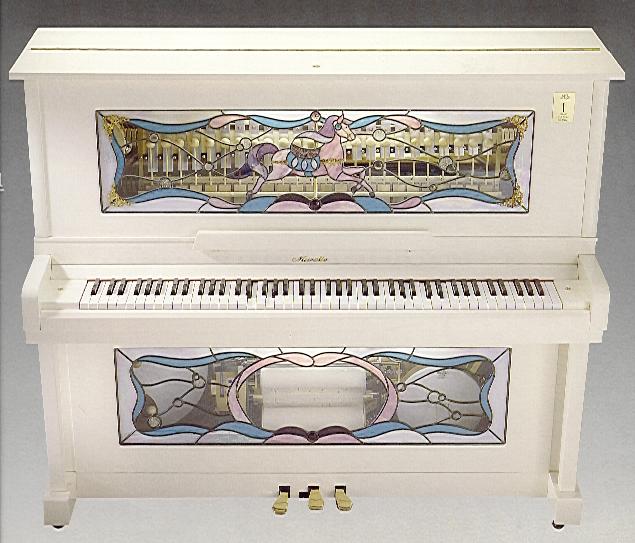
I ran into Dan Becker last night at a performance of David Conte's opera America Tropical, a tale of very comfortable liberalism set in Los Angeles across the 20th century, centering on the anti-imperalist Olvera street mural of the 30s by David Alfaro Siqueiros and the videotaping of the Rodney King beating. The quality of the performance itself was high and made an effective use of the space - Thick House on Potrero Hill - just down the street from where I'm sitting - and the theater at which my opera Mordake is intended to premiere next year, God willing.
Dan and I got to talking about Kyle Gann's discussion of his beautiful Disklavier works that were recently choreographed by Mark Morris. Having known Kyle's works for a long time I can't help but be very happy for him. Like so many of us, he's underappreciated, and the few that make it out to the wider world blaze a trail for us all and I'm thankful. Dan's been working with the instrument too for a while, and tells me that the new ones still can't play the densest of the Nancarrow studies without a bit of hiccoughing, fuse-blowing, and lights-dimming, and that's sad to me. I had just taken a job with Yamaha Music Technologies back in 1987 when the first models came out and, like a lot of composers, was filled with lust for this device. Unfortunately, that initial New-Relationship-Energy was tempered when I found that one couldn't play more than 16 notes at a time, that there was a sizable delay from input to output and, if even a 10 note chord was played too long, the power supply might blow. The robots have attained more facility over the years, but still haven't quite achieved the raw power of their pianola ancestors with their pneumatic action and rolls punched by the sure hands of Conlon, frail when I once met him over dinner at Shin Shin restaurant just across the bay. I'm afraid I was too in awe to converse with him with much confidence, but - as usual for me - ended up talking with his wife while letting Henry K. and Charles A. take up the slack.
Friday, May 18, 2007
Missa Beati Notkeri Balbuli Sancti Galli Monachi
 My Missa Beati Notkeri Balbuli Sancti Galli Monachi will be performed at the beautiful Abbey of St Gall in Switzerland on the Day of Repentance and Prayer (15 September). The Abbey was the commissioner of the piece, and it is thus named after one of their most famous, the musician and poet Notker Balbulus, aka Notker the Stammerer (840-912, beatified 1512). He is known as the first ethnically German composer of music and for publishing the first collection of Sequences, mnemonic poems for remembering the series of pitches sung during a melisma in plainchant, many composed by him. The stammering little monk "was so much loved by the monks of his abbey that for a long time after his death, they could not speak of him without shedding tears."
Some selections from the Mass were performed last Summer by the SFCCO and Schola Cantorum San Francisco. Here's a bit of it.
Thursday, May 17, 2007
Psychopathia Sexualis
 As DJ Bunnywhiskers loved our last tête-à-tête, she has invited me back on her show this evening from 6-8 PDT where we, that is, James Bisso, Suzanna Shubeck, and other of my dear friends, will read our favorite episodes from the Krafft-Ebing classic. Listening to the show in realtime is theoretically possible, either at PirateCatRadio.com or at 87.9 FM in San Francisco. However, as sometimes the chewing gum and bailing wire holding the antenna fails, and sometimes the hamsters that power the generators that run the server get a wee bit dispirited by the meaninglessness of their lives and sulk in the corner of their damp and dark cage, it may be easiest to listen to the podcast here tomorrow.
update: here's the actual podcast link.
Tuesday, May 15, 2007
The Laundry Room
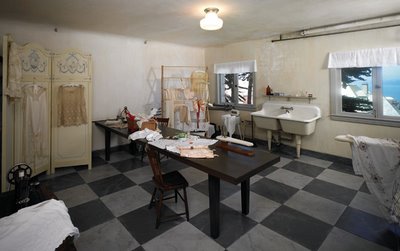 After a hard day scrivening my meager attempts to add to our shared culture, I've found there is no better way to relax than to take the servants' stair down to the laundry room and spend a lazy late afternoon in languorous contemplation of the lacy underthings scattered about like autumn leaves after a blustery day. Sometimes, a particularly lovely article will catch my eye, a red chemise, a black garter, a soft night-cap, and an intense impulse will rise in me, and I will find myself secreting it away, finding it later amid my tousled bedcovers, an evening lost.
photo by David Papas
Sunday, May 13, 2007
Baron Ochs

I've put up the scores and recent recordings of the orchestral suite from Baron Ochs on my website here, just the rather beautiful music from the piece, lovingly reorchestrated for the San Francisco Composers Chamber Orchestra, without the text, which was an odd little story that Everett Shock and I wrote back in the early 80's from some notes on 3x5 cards that he picked up off the ground. We didn't know it at the time, and it reflected a certain gap in my youthful cultural education, but the notes on the cards were from a study of Der Rosenkavalier by Richard Strauss. However, the notes were quite sketchy and thus, even though my piece and the late Herr Strauss's share a few characters (e.g. the Baron himself) and settings, they are in all other ways quite different from each other, my work touching on several esoteric issues, such as the separation of date palms by gender, which mostly likely would not have interested the other aforementioned composer.
My friend Earnest A. Z. Feathermouth graciously agreed to write program notes for the piece. As they are explicative, I have included an excerpt:
Ersatz opera con vivo; a pluralistic demonstration composed of a myriad of animistic elements: the puffy attractions of a porcine cockalorum surrounded by the greased trumpets of his sycophantic catamites, the naifish masochism of a vestal-skinned ward replete with bubbling womb, the soft squire whose tumescent lips add a wounded crimson to his otherwise pallid exterior, the dark servant with the dominating maw that feels so warm and reassuring, and the sublime Valzaccho whose turgid gasps and leering hands seem to add a certain beauty to the inexorable violence of this psychosexual drama. The ROSE BEARER provides an unctuously feral setting for this exploration of sexual confusion and its relation to religious conviction. Rather than presenting the basic theme in a simple diachronic form, it is unfolded in a synchronic fashion. At the same time, a wide variety of compositional techniques (linguistic, sonic, and theatrical) are used to produce a vibrant, if not scatological, environment certain to stimulate the most senseless of participants. While the vertiginously careening pace may upset the perineal appendages of meek and obese listeners, the spiritual confrontation that results amply justifies the risks. Questions of secular-sexual transgression (does god have a penis?) are universal and form an integral part of the personal experience of all salacious individuals in modern society. Nonetheless Baron Ochs does not go far enough into the psychoanalytic structures that support the occidental predisposition to hide or ratiocinate sexual misidentification with religious inculcation. Rather than destroying the baggage of Luther and the Calvinists, modern European society has added a shiny new patina, a hip-hop patois with tight pants. It is this preposterous "disco of the church" that continues to promulgate a false sense of procreative correctness. Despite this failing, Baron Ochs is an important and uplifting work, one that is certain to remain vivid, ominous, and as reckless as the brazen youth whose speeding motorcycle is moments from impact.
Tuesday, May 8, 2007
Composer-composer collaboration
 When I was on the steering committee of the San Francisco Chapter of the American Composers Forum, I suggested that we have a composer-composer collaboration grant, similar to our composer-writer and composer-choreographer grants. This proposal was met by some skepticism if not derision by my fellow committee members. Most of them couldn't imagine that anyone would desire to apply for such a thing, but as a youth, I was very familiar with a few famous examples of such collaborations. One was John Cage and Lejaren Hiller's HPSCHD, released on a Nonesuch LP, each copy of which contained a unique set of instructions printed on a somewhat jittery high speed line printer of the day, that instructed the listener, at five second intervals, where to set the controls on their stereo for an added bit of liveliness, although it required a stereo with separate tone controls per channel and more that 2 hands to accomplish. The piece seemed to be a true collaboration, and may have worked well as Hiller and Cage both had an interest in chance and complexity. In an interview years later with Vincent Plush, Hiller discussed having first suggested the use of the famous Mozart-attributed dice game pieces and Cage using the I-Ching to make substitutions and that
"Although we were and have been different in many ways in the way we write, we find a big degree of overlap in terms of – of humor, personality, and also, rally our ideas are not that far different in many ways. It was a lucky coincidence, because it wouldn’t have worked otherwise."
Humor is always a good ingredient for collaboration, or at least a lack of self-important seriousness. In the interview, he mentions one of Cage's other collaborations, Double Music with Lou Harrison. When I was casting about for information on this piece, I happened across Robert Gable's aworks blog mention of the fact that Cage and Harrison composed their two parts separately, having agreed on the length of the piece beforehand. (And reading that reminded me of the 59th story from Indeterminacy - maybe this was a collaborative piece as well?) But the aworks article references Philip Glass / Ravi Shankar's Passages and there is The Juniper Tree by Philip Glass and Robert Moran as well. Both of these are not moment-by-moment collaborations, but rather have alternating sections written by each composer with some sharing and contrasting of themes and textures. I've worked on a few collaborative dance scores with Thom Blum for Deborah Slater, some where we took each other's works and manipulated them and some where we had overlapping and responsive sections and some where we took foreground and background. Since I'm a composer of note-oriented and pretty music for standard instruments by nature and he is a composer who tends to write noisy and sound-oriented works for electronics, and we don't take ourselves too seriously, the mix may have been easier to pull off, as we inhabited very different spaces in the composition. We're planning to do something together for my Mordake opera premiering next year.
photo of HPSCHD printout by cityofsound
Monday, May 7, 2007
The Celestial Bridegroom
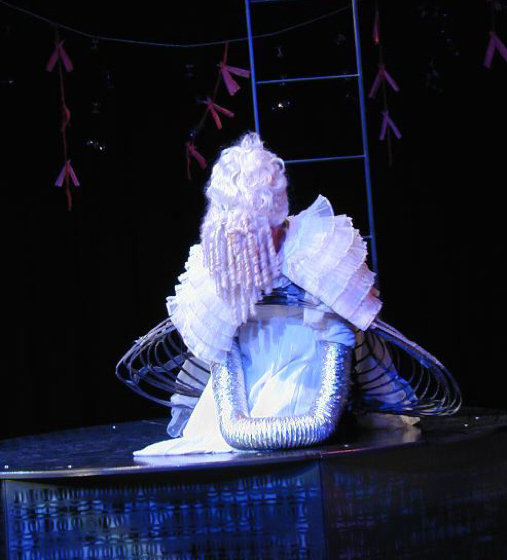 I was raised in a religious family and the iconography, the ritual, the warm embrace of Christianity are all felt strongly in me, but at a young age I was seduced by art, literature, even by seduction itself; in my dreams, the symbols of one and the other, its shadow, were mixed and confused, synthesizing a new self, more base, less seraphic, a fallen angel who shall never enter into paradise but, like Moses, will die while gazing upon the promised land, the celestial city, a place of joy where honey flows like water. The ecstasy of religion has been replaced by other ecstasies, those of the flesh, and those of the intellect, poor substitutes to be sure but, haven fallen so far and for so long, I have little else. The operas come from this place, mixing these worlds, the sounds formed by the slowly fading echoes of true religion, the cries of fleshly delight, the resonating in the hollowness of my soul.
I look now for salvation in many places. Rimbaud's life teaches me (O Lord, O Celestial Bridegroom, do not turn thy face from the confession of the most pitiful of thy handmaidens. I am lost. I'm drunk. I'm impure. What a life! ) and I find some comfort in Robert Glück's Margery Kempe, a beautiful juxtaposition of sexual obsession and religious obsession, where he and the earliest English autobiographer both seek sainthood through a union both sacred and profane, imagining their coupling with their own Celestial Bridegrooms and, finally, from my own work, the section of that title, der Himmlische Bräutigam, so wonderfully evoked by Josef Oberauer, wearing a pink thong and platform shoes, lifting him just that much more towards heaven.


Sunday, May 6, 2007
Noisy People
 Former League of Automatic Music Composers and Hub member and friend and sometimes Muscle Fish colleague Tim Perkis has just released his labor-of-love documentary Noisy People. It features eight people in the San Francisco improvised music community, covering as much or more of the way they live their life and who they are as it does their music. It includes such notables as my ex-neighbor and band-führer Dan Plonsey (Daniel Popsicle), the great Greg Goodman who once, when I was experiencing the worst art career depression and angst, simply took a small scrap of paper and wrote Do Better, a cameo appearance by the late bassist Matthew Sperry, who played in the Seattle Creative Orchestra's performance of Sub Pontio Pilato, and many others. My son Duncan and I went to see the premiere at the Pacific Film Archive and you should see it too. Very beautiful and also very entertaining, very funny. A portrait of uncompromising creativity in life and art.
DJ Bunnywhiskers
 Was on DJ Bunnywhiskers show on Pirate Cat Radio on the 26th of last month, April that is, aka the cruellest month. Pirate Cat is a pirate FM station broadcasting from the netherworld of San Francisco, a secret location just down the hill from my home. It was an extensive interview with a lot of musical examples covering my history, from the deepest darkest artrock past to the present. The podcast of it is available on the Bunnywhiskers page. Sometimes the Pirate Cat site is a bit unreliable, so I've put a copy of the podcast on my website here. The interview began with the host setting down in front of me a bottle of Smirnoff and some fancy vitamin water as a mixer. I didn't have my Gray Kangaroo or Brita 'optimizer' with me so I was forced - in the spirit of good fellowship and art and fun and so on - to take unrefined shots of the headache inducing swill, but I retaliated with a ball gag and 50 feet of nylon rope and modified ducks and wrist cuffs. On the 17th Jim Bisso and I will be together on the show to join in a mass reading from Krafft-Ebing's Psychopathia Sexualis, a book that features prominently in our upcoming opera, a chronicle of my dissipation.
note: photo by Violet Carson
Subscribe to:
Posts (Atom)

 Posts
Posts

