Saturday, July 31, 2010
more on The Ten Days
Sunday, March 30, 2008
Desire Line

Tuesday, November 27, 2007
The Bed You Sleep In: A Warning
A favorite moment from The Bed You Sleep In, where Thomas Morris as the oracle has just hinted at Ray's impending doom. He recites a bit of Revelation 14 and we head off on one of Jon's landscape love-ins. Jon told me that the location of a story was as important to him as plot or character and deserved equal time. The music that starts about one minute into the clip is almost entirely derived from field recordings that Josh Rosen and I made of the local sawmill in Toledo, Oregon, now closed down because, as they discuss in the movie, you can't get any of the big trees anymore. (And why not, you ask? Because they really did clearcut the whole state and ship the uncut trees off to Japan.) But the sawmill was a beautiful aural environment. Walking through it was like listening to a futurist symphony and the raw recordings were beautiful, but of course I felt like I had to prettify it all a bit, and I think I was successful in that. I've bumped up the volume of the music in the clip so that it is a bit more intense, but you can hear the original music here or on the full soundtrack recording here.
Friday, June 15, 2007
Just fucking figure it out already

But, before I go, let me share just a few examples of what is raising my pique. OK? Yes. Here we go:
... will explore the ambiguous and changing nature of our relationship to living in a post-private society, where personal electronic information ...
The play will explore the rise in America of new white male empowerment in relation to a diversifying American culture.
The overall intention of the work is to explore the nature of communion with the infinite, and the opening of--the soaring of--the human heart. ...
The work will explore architecture as a fundamental, subliminal force intervening in the human narrative, braiding artistic exigencies, topical dramas and ...
...will explore the historical origins and the complex identity issues faced by conversos while speaking to the larger question of ...
In our sex comedy, we have outlined the following scene:
Arts Commision: banker, bishop, duc and judge, done as a scene from 120 days of Sodom. Old whore reads from the proposals typing notes on a laptop while the work samples are played and the four discuss. The four on the jury take off on tangents about fucking boys in chambers, shitting on the host, stuffing cash up the cunt of a prostitute. The old whore tells a story inspired by at least one of these. My work sample could be a setting of jet of blood. Jim’s lyric poem on the first 15 seconds after a consecrated host (at what point does it transubstantiate?) enters a whore’s vagina (pushed in by the black priest’s cock (editor's note: black as in black mass, not black as in African American)). The latter is what triggers the cash in cunt of prostitute story.
Sunday, June 10, 2007
Amy Crehore
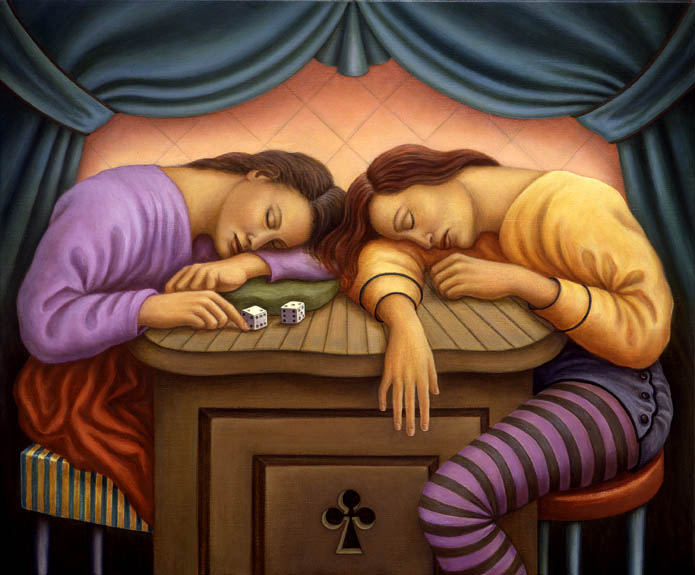
Let's take a moment to consider one of my favorite paintings. In the collection of the artist. I have a few of Amy's prints above my piano just below Vera where I meditate on them while I work. In a quid pro quo, she at times listens to The Bed You Sleep In in between the blues and the hokum when she is working. It makes me happy to think that, possibly, I've left a small impression. Maybe a brush stroke that took a small turn to reflect a particularly lovely note on the viola, maybe a color that ended up a slightly darker hue as a static sad sawmill loop sounded.
Sunday, May 20, 2007
Mordake
Our developing operatic version may be real or not real. It doesn't really matter. In Douglas Kearney's libretto, the other face is presented as an example of chimerism, a son that devours his sister in the womb, which is biologically unlikely. More probable is that Mordake was a variant of a conjoined twin, like the slave owners, stars and truly 'Siamese' twins Chang and Eng Bunker, whose commingled liver is on display at the Mütter Museum, a prime tourist spot for all those intrigued by the fringes of permutation of us, we featherless bipeds with broad, flat nails.
Tuesday, May 8, 2007
Composer-composer collaboration
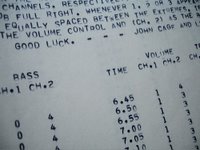
When I was on the steering committee of the San Francisco Chapter of the American Composers Forum, I suggested that we have a composer-composer collaboration grant, similar to our composer-writer and composer-choreographer grants. This proposal was met by some skepticism if not derision by my fellow committee members. Most of them couldn't imagine that anyone would desire to apply for such a thing, but as a youth, I was very familiar with a few famous examples of such collaborations. One was John Cage and Lejaren Hiller's HPSCHD, released on a Nonesuch LP, each copy of which contained a unique set of instructions printed on a somewhat jittery high speed line printer of the day, that instructed the listener, at five second intervals, where to set the controls on their stereo for an added bit of liveliness, although it required a stereo with separate tone controls per channel and more that 2 hands to accomplish. The piece seemed to be a true collaboration, and may have worked well as Hiller and Cage both had an interest in chance and complexity. In an interview years later with Vincent Plush, Hiller discussed having first suggested the use of the famous Mozart-attributed dice game pieces and Cage using the I-Ching to make substitutions and that"Although we were and have been different in many ways in the way we write, we find a big degree of overlap in terms of – of humor, personality, and also, rally our ideas are not that far different in many ways. It was a lucky coincidence, because it wouldn’t have worked otherwise."
Humor is always a good ingredient for collaboration, or at least a lack of self-important seriousness. In the interview, he mentions one of Cage's other collaborations, Double Music with Lou Harrison. When I was casting about for information on this piece, I happened across Robert Gable's aworks blog mention of the fact that Cage and Harrison composed their two parts separately, having agreed on the length of the piece beforehand. (And reading that reminded me of the 59th story from Indeterminacy - maybe this was a collaborative piece as well?) But the aworks article references Philip Glass / Ravi Shankar's Passages and there is The Juniper Tree by Philip Glass and Robert Moran as well. Both of these are not moment-by-moment collaborations, but rather have alternating sections written by each composer with some sharing and contrasting of themes and textures. I've worked on a few collaborative dance scores with Thom Blum for Deborah Slater, some where we took each other's works and manipulated them and some where we had overlapping and responsive sections and some where we took foreground and background. Since I'm a composer of note-oriented and pretty music for standard instruments by nature and he is a composer who tends to write noisy and sound-oriented works for electronics, and we don't take ourselves too seriously, the mix may have been easier to pull off, as we inhabited very different spaces in the composition. We're planning to do something together for my Mordake opera premiering next year.
photo of HPSCHD printout by cityofsound