In this picture, we see an effigy of the late Adolf Hitler about to be decapitated, or maybe just before the nails were driven into his heart, all in the dark days of January 22, 1941, just a few days before my negative 17th birthday, a picture sent to me by way of a link to a Life magazine article written contemporaneously to the event, a black mass against the well-known embodiment of evil, by one of my foreign correspondents, the regal Bunnywhiskers, AcA, ABe, TEP, DDC, ordine dell'anatra d'oro, and too many other honors to mention.
Unfortunately Satan, or whoever they were calling to action, wasn't as receptive as s/he was hoped to have been, and the war dragged on, Adolf very much alive for the next few years, leaving those at the end of the conflict to wonder what the fuck that was all about. Maybe if the Germans had just gotten all those occult magic weapons built in those secret mountain redoubts under Peenemünde.
But back when I wrote the Missa Beati Notkeri Balbuli Sancti Galli Monachi, I thought I should write a black mass to somehow counterbalance the white one, to keep in the universe in order, and to hedge my bets in the afterlife. The thought process went something like so:
"Hey Erling, weren't you into all that Aleister Crowley and OTO and Psychic TV and Re/Search stuff?" "No, I think that was Mark Dippé, even though I would look over his shoulder and sometimes we would dress the same and then there was that ritual branding stuff." "But I'm sure I saw all those books on your bookshelf the last time I was over at your house." "Well, I've always believed in being well-rounded."
But my favorite of the Black Mass stories was that which came to light during the trial for the Affair of the Poisons, held for the mistress of Louis the XIV, where she, as the testimony went, laid down on the altar in a space made up as a simulacrum of a regular old Catholic church, but usually seen without the naked mistress of the king as the focal point, in this particular instance balancing the chalice on her naked belly. When my Mass toured to Jona (Switzerland), I remember being tempted to pick up a few consecrated hosts, wondering if they would ever come in useful-like, although I don't really know whether Timmy the Customs Wonder Pup would actually have allowed them back into the USA, and then finding the cabinet behind the altar locked tight, and thinking that, oh yes, right, they probably do that so really awful people like yours truly aren't tempted to do something really so awfully bad as stealing some consecrated hosts and possibly putting their immortal soul in mortal danger, like super 9th circle of hell danger, where the demons have really big cocks and don't think twice about using them. Anyway, so the mistress of the king, Madame de Montespan, talked her friend Catherine Monvoisin and the local not-totally-against-the-black-mass padre Guibourg into doing this thing, something they both came later to regret, he tortured and dying in prison and she burned to death in the place formerly known as Place de Grève, a pretty spot on the river, but a place to be watchful of your wallet and not to get too distracted by the young girls who need help translating a letter.
But in her naked perfection, stretched out on a long piece of black velvet over the altar, she, as the story goes, listened while the padre, dressed in a pretty fancy outfit with magical silver characters embroidered in, chanted some blasphemously altered version of the Latin Mass, and, as was mentioned above, set the paten and chalice on her naked belly and, in the hope of keeping the King's love - ok, this is where one might wonder exactly why this particular ritual was deemed the proper ritual for stoking the possibly fading embers of the King's love, but - a woman assistant to the priest held out an infant whose throat was then slit, dripping blood into the chalice and onto the aforementioned naked and most likely quite fetching body of the mistress of the King.
You know, this is so like scenes from those really cheeseball English dubbed but probably made in Italy or Spain horror movies I used to see as a child, when as son of the local Lutheran pastor I was able to get into the theater for free to get pretty titillated at the naked breasts with theatrical blood washing across them from the vampire bites or knife slashes or other general mayhem, but, according to Catherine Monvoisin's daughter, who testified at trial, "The corpse was handed to la Voisin, who flung it callously into an oven fashioned for that purpose which glowed white-hot in its fierceness" which sounds a little like it was written for her, the whole mess being political in the best sense of the word, meaning who knows what really happened.
But I never did write the other mass, and the texts that I could find were pretty stupid anyway, and I doubt it would have worked for much except maybe remembering those heady days with the branding ceremonies and public piercings. Which wouldn't have been all that bad.
Showing posts with label nazi. Show all posts
Saturday, February 22, 2014
Sunday, March 31, 2013
What we worry about when we worry about Kitsch
Adorno, in a well known quote, said that Kitsch "is the beautiful minus its ugly counterpart," a kind of purified beauty without a vision of the other - what I suppose might be called the real world - with Hundescheiße and all. Now there is nothing innately wrong with this, and if I were able to somehow tap into a stream of pure beauty in my own meager compositions, I would gladly make use of it, as whatever small respite one can give an audience in this brief life is worth grasping.
However, Kitsch, when loved in its unadulterated and unironic form, has become negatively associated, and has become a word used to deny the validity of whatever the speaker doesn't care much for. The most obvious examples of the genre, for example the twee Hummel figurines that my friends' parents collected so avidly, and that made me vaguely queasy even as a child, are easy targets for those of us who aspire to the world of ultra-high art. But the point here is more subtle. The notion of Kitsch has something to do with its commodification, packaging up a subject in a manner which is easily digested, gratifying the desires of the viewer-to-be. It is this aspect which I find the most troubling personally.
Adorno is famous for another comment as well, made in an interview which touched on the anti-war songs of the 60s:
And I have to say that when somebody sets himself up, and for whatever reason (accompanies) maudlin music by singing something or other about Vietnam being unbearable...I find, in fact, this song unbearable, in that by taking the horrendous and making it somehow consumable, it ends up wringing something like consumer qualities out of it."
I think this strikes at the heart of art-making whenever it seeks to be a commentary on the horrors of the real world. In a review of Extremely Loud & Incredibly Close, Manohla Dargis comes up with one of my favorite lines: "[Kitsch...] tries to make us feel good, even virtuous, simply about feeling." Now this is a cornerstone of the Hollywood palace of culture, well-evidenced by the immeasurable collection of movies profiteering on all tragedies past and present, from personal misfortunes to those unimaginably horrific. I've often wondered why there is no outcry, given the various institutions dedicated to the preservation of the real memory of the Jewish Holocaust, to the massively vampiric way Hollywood fills its pockets with sweetly sentimental and boffo-at-the-box-office stories concerning it. Stanley Kubrick, who worked for years on treatments of a film about the Holocaust, decided that it simply couldn't be contained in a movie, and made the point that Schindler's List and the others really weren't about the Holocaust at all.
But, fundamentally, I fail to see how any digestibly evening-length piece, created for purposes mercenary or self-aggrandizing or otherwise, can contain any tragedy. If my own Certitude and Joy attempts to do that, then in that regard it is a failure. At best, it's an essay, one more bit of ink spilled, one more personal comment on the fringes on the subject and subjects related to it. At worst, it is insidious, a piece that pretends to be real, that plays on the emotions, that allows an audience to believe that the artist has conveyed to them something of the truth, but that sets them outside an hour later on their way to buy another donut. Maybe the middle ground is somewhere in between, a show of light and spectacle and music that uses some tricks to make some points, some of which are interesting; and which is enjoyable sensorially, and which may, if it is lucky, make one think about one's own life.
The curious reality of Sister Hummel is that, even though the figures given her name are labeled as shining examples of Kitsch, they capture more of the truth of tragedy through their existence than any artwork looking back from our comfortable present is able to. The figurine pictured is based on her watercolor - The Volunteers - which enraged Hitler, who banned her art, an SA mouthpiece writing "There is no place in the ranks of German artists for the likes of her. No, the 'beloved Fatherland' cannot remain calm when Germany's youth are portrayed as brainless sissies." But even after this, and under Nazi persecution, she continued to produce her works under terrible conditions in an unheated cell with little food, covertly placing in them Stars of David, menorahs and other subversive imagery, dying of tuberculosis before the end of the war.
Labels:
art,
beauty,
certitude and joy,
composition,
hitler,
music,
nazi,
opera
Saturday, March 19, 2011
Berlin Diary (2011)
A few days ago, I returned from Berlin and environs with my newlywed wife visiting friends and touristing. Being who I am, it is difficult to cruise the area without thinking of those things that were, and, given the touristic elements of the city that cater to such thoughts, this difficulty must in fact be common among those of a certain age. The Reichstag, famous for the fire that helped to launch the Thousand Year Reich, Checkpoint Charlie, which, when I last saw it, was a junkpile, the checkpoint itself knocked over amidst a scatter of fragments of the wall and MIG fuselage.
Monday 28 February
Spent the day watching Irving Berlin videos, The Spy Who Came in from the Cold, the Star Trek TOS episode about the Nazis, rereading bits of Shirer's Rise and Fall and the Stasi Archives, plus studying the Werner Klemperer accent in Hogan's Heroes in preparation for the trip.
Tuesday 1 March
Spread chemtrails agents responsible for delusional parasitosis, matchbox sign, and increased boron concentrations over Northern Canada. Increased carbon footprint for the year severalfold. Rough flight over the North Atlantic. Fantasized about bombing runs coming in over Rotterdam, heading into the heart of Germany.
Wednesday 2 March
Cab driver accepted credit card driving us to Charlottenburg, arriving late at Ron Kuivila's sabbatical home, where, for 7 days and 7 nights, we are fed and pampered and entertained. An amazing meal by Bobbi Tsumagari, Ron's wife. Waddling after. Blog-o-media back home filled with old news, recently rediscovered due to John Galliano's pro-Hitler anti-Jew declarations, of Françoise Dior's Nazi sympathies.
Thursday 3 March
First tourist stop, Sans, Souci, in Potsdam. Why is there a comma between the two words? Pictures of decorative painting, much gilding. Golden Chinese house. Ron's calimari specialty in the evening.
Friday 4 March
Breakfast made by Bobbi. Charlottenburg, more photos of decorative painting. Fell in love with the little Ostalgie DDR car models in the gift shop. Seeing pictures of the dome blown to bits, fantasized again about bombsights and the poor civilians below. Met with the director Stefan of the Opera Video and the singer Jennifer Lindshield.
Saturday 5 March
Breakfast again by Bobbi, fried Turkish bread, man! Back to Charlottenburg castle for more photos, as it goes on and on. Bought postcards showing the bombed out Reichstag, the visit of JFK (Ich bin ein berliner), the East German guards. Wrote pithy comments on the back, began a long search for a post office. Multichoir walkthrough installation consisting of popsong fragments, just down the street from checkpoint Charlie, then dinner across the street at the Italian restaurant, another of the Axis powers.
Sunday 6 March
8 am call for the video shoot. Stefan speaks a different language to everyone there it seems, a mix of German, Swedish, English, maybe some others. I am confused as not an actor, but editing can work magic. Sometimes I am told to start walking, but to where and how far I am not sure. In the video, I give the attractive bathroom attendant a 100 euro tip and then offer another, for sex I assume, but she, being a chaste and virtuous lady, refuses. Puh. I am forced to go back to my table of sycophants and drink champagne. Although promised much making out, none occurs. I complain about this with Sirje Viise, one of the other singers and find that she was promised this as well, and was also left without. Considered offering her some making out right then and there but worried about the almost sure rejection to follow.
Monday 7 March
Bobbi breakfast. Lazy day. Lynne and Bobbi shopped while I worked and imagined myself as a citizen of the world, telecommuting from my garret. Dinner with Stephanie Kaiser, Frieder's helpmeet and housemate. Frieder unfortunately was in Long Beach working on the production of Akhnaten by the Long Beach Opera. See entry on 14 March.
Tuesday 8 March
Breakfast again. First, Sigmar Polke show at the Berliner Akademie der Künste, saw the machine to revolve a potato around another potato, great political posters. My favorite (see above): "Deutsche Arbeiter! Die SPD will euch eure Villen im Tessin wegnehmen" (German workers! The SPD wants to take you your villa in Ticino!) Wondering why we don't spend our family home evenings making political posters that we glue to banks and corporate headquarters so that we can be arrested and beaten and held in company-run underground jails for months and months, starved, kept from sleeping, cold water poured over us. Then, wandering through the embassies, the Brandenburg Gate, cleaned of its shrapnel and bullet marks, into the holocaust memorial, where Ron and I, fresh from the Polke, reminiscing on fluxus, came up with a horribly incorrect image of bathing beauties in bikinis, one each perched on each monolith of the memorial. Please shoot us so these thoughts do not infect our youth. Continuing on, to the symphony hall, remembering our favorite Nazi conductor, von Karajan, who gender integrated the orchestra only because he was fucking someone he wanted close by, or something like that anyway. In the evening, went to Radialsystem 5 to see Solistenensemble Kaleidoskop. Their artistic work did involve making out, with messy extra lipstick, see entry on 6 March. And they performed La Monte Young's Poem for Chairs, Tables, Benches, etc, reinforcing the fluxus thoughts earlier, along with Cage, the Bach Children, Purcell, others. They are very tight players, a joy to watch. The acting in between the pieces, although charming, needs more rehearsal or maybe will just never be as good as their playing.
Wednesday 9 March
Train to Dresden, rebuilt, thought of Slaughterhouse 5. The rebuilt sections are so new, beautiful, but like cartoons or matte paintings when seen in the distance against the portions of the city that still remain. Beautiful view of the city and the river as the sun is setting. Train to Prague. Next to our hotel, American style table dancing. Never went in although wanted to, as I am a whoremonger.
Thursday 10 March
Prague sightseeing. Stopped in to the tourist center of the chamber of deputies and was pounced on by the woman working there who clearly gets no tourists. Wanted to show us everything, kept asking why we were there. Backed out slowly, kept hands visible, ran up the hill to the Prague castle, got there too late, resolved to come back in the morning.
Friday 11 March
Taxi back up the hill as we are wimps, Prague castle very fine, clearly we need a larger house, and a chapel and pipe organ, and a family symbol / icon / crest - the whole branding package. Then, the Jewish synagogues. Lynne fuming over no-photography policy in the Spanish Synagogue, which was awe-inspiring. Back to Berlin, moved in with Tracy and Eric and Vigo.
Saturday 12 March
Vigo's birthday, so thrown out of the apartment, sat in the Пастерна́к cafe watching the lights change over the wasserturm across the street all afternoon, hot chocolates and then food and then more food and then more chocolate. While walking there, found several post-automats, but couldn't get them to work.
Sunday 13 March
Lynne helped Tracy and Eric priming the new apartment while I worked, then visiting Stefan for his birthday and Jennifer and all, watching the rushes of the video. Oh my. See entry 6 March re Erling not an actor. On the way, found a post office, but closed Sunday.
14 March
Neues Museum, Nefertiti in her beautiful room, Akhnaten. Remembering the end of the opera: the monotheist and his failed city (see entry 7 March) which Bisso and I emulated at the end of Sub Pontio Pilato. The painting on the bust of Nefertiti is really beautiful. So much painting lost: Egypt, Greece, the columns of cathedrals. Everyone thinks that the ancient world was devoid of decoration but in reality it was as loud and gaudy as a Peter Max poster. More walls riddled with holes. Not as many as '93. They've done a great job rebuilding the museum. It was fabulously painted from top to bottom, then blown up during The War, and the rebuilding treats it like an archeological site, preserving the bits that survived with minimal restoration, then filling in the holes with modern construction, keeping out the rain. Walked across the river to the Neue Wache war memorial, searching for the Tajikistan tearoom, then finding it only to discover that it had been reserved for a women businessperson's inspirational lecture or somesuch.
15 March
Worked during the day, as franticness increasing with approaching deadlines. Met all our hosts at Schlögls in the Mitte for one last German food blowout, Schnitzel's all around.
16 March
Up at 4 to catch flight to Heathrow, then on to SFO. Finally mailed postcards in the postbox around the corner.
Labels:
german jews,
germany,
nazi
Saturday, August 7, 2010
The Etymology of 'Nazi'
During a recent yet extended convalescence in my musty sanatorium supraspinatum, post ch
rurgia, in the prolonged traction of my UltraSling™II, my thoughts turned naturally to the black, and to those naturally redheaded, and the whispers coming from the dark bowels of this blackness. During that time, a time requisite of time while-awaying, hours were spent floundering through my favorite tomes: Bodyguard of Lies
, The Rise and Fall of the Third Reich
, the books relating a time better than our own, a time of clarity, of good v. evil, of men that were men. I fantasize about being a man that is a man but I am so far from it: an effete milquetoast-ette, a mama's boy and a milksop.
But in this morning's epost a letter arrived from our foreign correspondent, a man who is a man, our dear ***redacted***, who was passing along some esludge from the net. May I quote a significant part of it?
rurgia, in the prolonged traction of my UltraSling™II, my thoughts turned naturally to the black, and to those naturally redheaded, and the whispers coming from the dark bowels of this blackness. During that time, a time requisite of time while-awaying, hours were spent floundering through my favorite tomes: Bodyguard of LiesBut in this morning's epost a letter arrived from our foreign correspondent, a man who is a man, our dear ***redacted***, who was passing along some esludge from the net. May I quote a significant part of it?
Long before the rise of the NSDAP in the 1920s, people in at least southern Germany could be called Nazi if they were named Ignatz, or came from Austria or Bohemia (where they apparently had lots of Ignatzes); it was supposedly also used as a generic name for soldiers of Austria-Hungary, like the German Fritz or Russian Ivan. It had to be used with caution between friends, though, since it could also mean "idiot" or "clumsy oaf". That's how it found it's way into politics; the fact that Adolf came from Austria (not Bohemia, though) could have made the pun even better. The Nazis supposedly made attempts to include the N-word in their own vocabulary in order to make it less derogatory, but unsuccessfully; since such a maneuver requires a sense of humor as well as irony, it was probably doomed to fail.Yes, this maneuver does require a sense of humor, but fortunately we have buckets of that here in San Francisco and thank G-d that all my friends, members of so many persecuted minority groups, have reclaimed all the names hurled at them and taken them to heart, formerly sensitive designations desensitized and reavailable for use by all.
Labels:
death,
depression,
nazi
Thursday, November 26, 2009
Greater America
Had dinner with my dear friend and librettist Jacobus Byssus Zanomensis and his lovely and talented wife V_M_ last night. As usual, talk turned to the German Question and how close our American Empire is keeling towards fascist imperialist disaster. On their last trip to the banks of the Meuse, one of his good German friends reminded him of the second stanza of the German National Hymn, which during the Great Hole of Modern Germany History was more or less the only stanza, topped off with a bit of this and that about shooting dead the enemies of the SA, but the section of interest runs as follows:Von der Maas bis an die Memel,
Von der Etsch bis an den Belt.
meaning that the borders of the true Germany run from the Meuse River (more or less OK) to the Memel River (which, ahem, is way past Poland) to the Adige River (which would give Germany a nice warm water port in the Adriatic) to the strait of the Little Belt (which might require slaughtering a few troublesome people to the North who voted the wrong way in the Schleswig Plebiscites).
Of course, the concept of a border is a bit quaint in these days where the skies are filled with drones piloted by young brainwashed boys with close haircuts enforcing the limitless extent of the American Empire, part of a troubling stew into which we pour a bit of joblessness, hopelessness, rampant Fundamentalist and Patriotic pseudo religion, served up hot with Hellfire missiles, not to mention the heavy trod of the shock troops of the capitalist hordes, kevlar replaced by power tie.
Sunday, October 18, 2009
Of nieces

I was eight years old when I first became an uncle, in this case to a niece, the scion of my brother and his wife, themselves begotten of so and so, the seemingly infinite regress of humanity, and I felt suddenly so much older, rushed into a maturity for which I was not quite ready. One of my first memories of the little tyke is a scene that would evoke a sense of responsibility in any parent: her standing still in the doorway to my bathroom, not quite making it to the goal, an outpouring of urochromic fluid rushing from under her skirt, not sure to go forward or back but stuck in place. But as she got to be an actual kid, I was more of a big brother than a parent, looked-up-to in that way, required to tease and frolic and rassle and horse about as kids do, a play preparation for one's true transition to adulthood through the wrestling which creates us all.
Two years after I achieved this coming-of-age, I discovered what, at that time, was called modern music, through the vehicle of Stanley Kubrick's 2001, and was taken up by it. Although Ligeti sued, and rightly so, as his music was irreparably damaged, turned to kitsch (as he pointed out), it led me to all his other music, to the music of his colleagues and others, burning much of my paper route money over the years on vinyl and leading me to my chosen profession. And, as I don't want to be misunderstood, I want to say that I loved the movie too. In fact, I went back to see it again and again, and each of Kubrick's films over the years held sway over me during their reign, and each was a revelation. I remember my poor preacher father, forced to escort me to A Clockwork Orange and, as we were late to the theater, walking in at the moment of the first rape, followed soon after by the dancing Jesus scene, but as I was so earnest and excited, he stayed with me, watching it all, even allowing me to stay to see the beginning again so I would not miss a moment. My original artistic desires, in fact, veered toward film, and that interest in the great film auteur and his gesamtkunstwerks is surely why I've chosen music-theater, a live synthesis of all the arts, akin to movies, cheaper and more ephemeral.
When I mentioned to a friend that I was working on a new piece, they asked whether it dealt with the Nazis. It's a sensible question given my interest, an interest that I also shared with Kubrick, as he tried a number of times to develop movies about the war and about the Holocaust, deciding eventually that the latter was uncapturable, and all this even more interesting given that his wife, Christiane, whose artworks appear in a number of his films, and whom he met while filming Paths of Glory (she plays the German girl who sings at the end and reduces the soldiers to tears), was born Christiane Susanne Harlan, the niece of Veit Harlan, most beloved of Joseph Goebbels, the maker of the infamous and notorious anti-Semitic propaganda vehicle Jud Süß. An aside from theauteurs.com website:
The pornographic element is apparent early on, when a cheering woman at the Duke's inaugural parade loses her top, to the Duke's leering satisfaction. One is reminded of all the women who bared their breasts at Hitler, a strange phenomenon hinting at the hidden psychosexual nature of fascism.And this one, the most famous of them all, the younger Schicklgruber, carried his romantic fascination with his niece, the even younger Geli Raubal, much further, and so many stories have been floated about his complicity in her apparent suicide that it is hard to discriminate fact from fact. It is true that she was found dead in her room, locked from the inside, shot through the lung by his gun, a Walther, that she had been dead since the previous day; but it is not so clear that she was arguing with Hitler, that she was pregnant by a Jewish art teacher in Linz, that he was jealous, angry; but it again is clear that he was devastated by the death, that he threatened suicide, that he stopped eating animal flesh forever after, that he was in love.
Wednesday, August 12, 2009
Bletchley Park etc
As a former mathematician and reputed engineer, I've shared the recent nerdish interest in the true idea that World War II was really won by the boy and girl geeks who prodded and cajoled roomfuls of vacuum tubes and who lovingly sharpened their No. 2 pencils and who, on their long walks home, flirted and kissed furtively against romantic revival gingerbreaded walls, and that we Anglo-Americans, by our braininess alone, knew all the Axis powers' plans and played the war like a great chess game, not through the efforts of the poor filthy pawns who slogged through the mud and death and blood to capture and hold bits of land, captives of that distasteful space.The reality is somewhere in between of course, although I did always wonder why it took so long for the engineers' roles to be understood. The truth was quite slow to arrive, and not until the 70s did the British government allow publication of Bletchley Park's breaking of the Enigma codes, for many reasons, my favorite of which is the fact that the Brits had sold the rotor machines to their former colonies throughout the world and hoped to continue to read all their diplomatic traffic. The secret business is a set of wheels within wheels, and there is great fascination in the work of statisticians deciding which bits of intelligence to follow and which to ignore, which will show the enemy too much knowledge of our knowledge and which can be safely hidden, possibly in other obfuscating and pointless missions, and who will be allowed to be killed by enemy attack, and who will be saved.
Outside of the rarified air of Bletchley Park there were also other, lower tech operations, some chronicled in the fascinating book Between Silk and Cyanide by Leo Marks, who tells stories of encryptions in the field, used by operatives behind enemy lines, some using bits of one-time pad sewed into bits of silk parachute material, others using memorized poems, the most famous of which is his own romance The Life That I Have, perhaps made more poignant by the context, where Nazi handlers may have beaten this poem and others like it from those they captured, turning them as agents to work against the land and people they loved:
The life that I haveIs all that I haveAnd the life that I haveIs yoursThe love that I haveOf the life that I haveIs yours and yours and yours.A sleep I shall haveA rest I shall haveYet death will be but a pauseFor the peace of my yearsIn the long green grassWill be yours and yours and yours.
Labels:
cryptography,
engineering,
nazi
Saturday, June 20, 2009
Serb Cutter
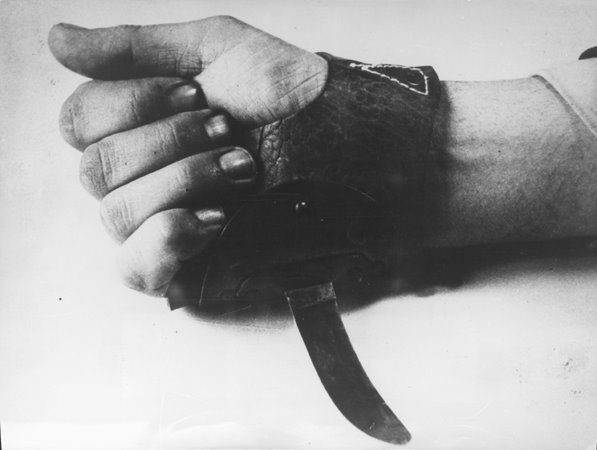
My beloved foreign correspondent sent me a note this morning reminding me of some of the more brutal of the brutalities of the last Great European war. He found it as he was researching a new novel which has something to do with the concentration camps in the Balkans, but it also reminded me of a story. Around the time when the event more recent troubles began in the region, my friend Mark Dippé was visiting some Serb friends in Sarajevo. At the moment they heard that their Serb brothers and sisters had launched a campaign of slaughter against their Croat brothers and sisters, he said that they, seemingly modern and reasonable people up to that point, literally jumped up with joy at the opportunity to grab their weapons and get to killing. It is of course hard for us, civilized with our mountains of McDonald's and hundreds of channels of TV, to understand such depth of hatred, but my correspondent's link did explain just a bit of it. It's just a small thing, the above device, a Srbosjek, or "Serb cutter," but it represents so much, and was invented by the Ustaše - Croatian Revolutionary Movement - as a way to efficiently slit the throats of captured Serbs, of which there were very very many, while engendering in the murderer as little fatigue as possible.
Labels:
competition,
nazi
Saturday, June 13, 2009
The Artist as a Young Whore
I was asked to participate this morning in a paid interview - in cash, in the form a single piece of currency: the bill with the drunken general and the corrupt president - by the San Francisco Foundation, and it got me to thinking about my whorish nature, a term I use with the ultimate in positive connotations, as many whores are counted among my best friends, and I can only aspire to such clear thinking and take-charged-ness.
Anywho, getting to the point, it's clear that artists have always been quick to leech onto whomever is in power, regardless of their goodness or badness, in order to live their lives of dissipation, shrouding their selfish wants in pseudo-mystical-art-feeds-the-soul bologna. I'm reminded how, in de imperio tertio, we find the same willingness to suck at the monied teat of the all-father to further one's career, although, in the case which came to mind, it may not have been the best choice career-wise. Heinrich Hoffman, who became more-or-less the official photographer of the Führer, took the photograph above and many others, note especially those Hitler suffering the little Aryan Children to come unto him, but who, after the war, was imprisoned for profiteering and who had all his photographs seized and put into the US National Archives, the images themselves consigned to the public domain.
Leni Riefenstahl, shown naked above, who also had all her work expropriated by the incoming GIs, was never quite able to lie her way out of the stigma of being infatuated with the Nazis and Nazi ideals and, even though she was clearly one of the greatest aestheticians in the early days of the new art form, she was rejected by the world she and her friends had abused, project after project denied after the war. But she saw the slaughter of the Kinsk civilians, she chose the particular slave Gypsies for her films, she allowed them to be shipped to Auschwitz, she knew what was to happen to them but she litigated against all who said so, indefatigably, during her long long life. And who can forget Albert Speer, the one who apologized, but who was also only to eager to be seduced by the power and the money and the evil structure of which he became a part.
But I suppose the difference is that the artists of the US of today are happy to take the blood money and spend it biting the hand that fed them, and feeling entitled to the privilege all the same.
Friday, May 15, 2009
"But at least they dressed well"

As a young boy on the Great Plains, gorged on a constant diet of WWII war movies and television, my friends and I would get together with our BB guns and cherry-bombs to be mini-reënactors, and, in our innocence, who would we vie to be? The sloppy GI with perpetual cigarette hanging out of his mouth, unshaven? Hardly! No, we fought for the right to click our heels, to salute, to wear the smartly trimmed Hugo Boss designed and built SS uniforms, to carry an imaginary Feldmarschall's baton, and to speak in a clipped Germanesque pidgin, the hint of a saber cut on our cheek, the monocle, the goose-step.
As children, we could be forgiven, having no idea of the signification of our choice. But many elect to continue this into adulthood, as its very taboo nature titillates and appeals, from the Korean ad above (video here), to Nazi themed restaurants, to the Nazi Chic, to those too interested in the paraphernalia of the Reich. What to make of these fallen and so foolish fellow humans? Have they forgotten or merely never learned that the fascist path, while seeming to wander along an alpine meadow, dotted here and there with some wildflowers, leads to the cliff or to the bear or to both?
Friday, April 24, 2009
Geburtstag
My follower Milky chided me last evening at the Throbbing Gristle event here in San Francisco for somehow not paying proper obeisance to the event of A.H.'s birthday last Monday, but it's actually quite important for me that this set of notes on a particular cultural preoccupation doesn't become what it purports to analyze, a fetishistic love-fest of a brutal regime, ending in a place I can only just imagine: where the cleaning lady finds me one day, swinging by the neck, raised aloft by an elaborate pulley system, cold to the touch, wearing only a pair of vinyl briefs and a gas mask, surrounded by pornographic magazines open to their most German images. We'll leave that end to those who really do enjoy such things, the likes of Motor Racing Bosses and Princes of the Realm. But, while on the topic, we find here:
A report by Ofsted, which expressed concern that secondary pupils were repeatedly studying Hitler is part of a wider debate about the nature of Britain's enduring obsession. Those concerned at the ubiquity of the Third Reich in the history classroom and beyond to the nation's bookshops and living rooms fear it stunts understanding of other periods and leads to an unhealthy personality cult.And to which I can add only that it is difficult to run out of unimportant issues as well.
On the opposite side of the argument there are those who point to the monstrosity of the Nazi regime and its leader, arguing that it is difficult to run out of important issues relating to Hitler to highlight to the wider population.
Saturday, March 28, 2009
Henry Ford
Stephen Ambrose, in his Citizen Soldiers, tells of how upset the GIs were to see the enemy coming toward them riding Ford trucks (and Opel trucks and planes, a wholly-owned subsidiary of GM). Henry Ford has a number of troubling connections with the Nazis, many of which have been well publicized, from the inclusion of excerpts of the Protocols of the Elders of Zion in the glove compartments of new cars to his outspoken admiration for Hitler to his acceptance of the Grand Cross of the German Eagle in July 1938, four months after the Austrian Anschluss. As the Washington Post points out in a detailed article, worth reading, on the deep connections between the two, when one thinks of Ford, the image is of baseball and apple pie and not that Hitler had a portrait of Henry Ford on his office wall in Munich, which he did. Company documents found when the German Ford slave-labor factories were liberated spoke of the "genius of the Führer." The final insult, most amazing to consider, came after the war, when both GM and Ford petitioned the US Government for reparations for their German facilities due to Allied bombing. And, although one might simply think to laugh off such a ludicrous proposal, GM was in fact paid $32 million, a cool $380 million inflation adjusted.
Labels:
henry ford,
hitler,
nazi
Thursday, March 26, 2009
Third Reich in Ruins
I came across a cornucopiæc website of photos then and now, comparing locations in Nazi Germany at the end of the war - the abovementioned 'in ruins' - to the same locations in our current and fully de-Nazified Germany. It reminded me of my first trip to Nürnberg in '95 at the 50th anniversary of VE day, when the city had placed billboard-sized photos of the urban landscape from early 1945, smoke still rising from the rubble, sited so as to duplicate the view I had standing in front of each: one view mere piles of debris, one the beautifully reconstructed Disneyland of the old city.Soon after, I headed out to the Zeppelinfeld, site of many a Party rally, where my friend and sometime colleague Jon Jost had, standing near the dais, watched as an elderly German gentleman walked by, looked quickly from side to side, then made a small, furtive, but definite salute. Old habits die hard.
Thursday, March 12, 2009
Münchausen
Ruining it for everyone
The Nazis did a lot of really bad things, and tainting the swastika in the West forever and always was one of them, leading even to the current attempts in the EU to ban the symbol, although it's really unclear how one actually bans a simple figure that has been in use for at least three millennia, spans cultures, is currently seen around the world, is part of ornamental borders and floors and temple columns, included in books on tessellations and origami, the logo of charitable organizations, etc. Lynne Rutter saw the lovely example of a decorative manji at the Sensoji Temple in Tokyo a few days ago. However, even there, the Nazi stigma still is felt as, since the war, all the new Buddhist manji in Japan are of the left-handed variety, not the right-handed isomer favored by the historical evil. Below, from a Tokyo shrine near Shibuya:Monday, March 2, 2009
Greater East Asia Co-Prosperity Sphere
Here in Tokyo for a few weeks, capital of one of the signatories of the Tripartite Pact, meditating on the global nature of WWII and the support the Nazis had from a number of other militaristic and dangerously jingoist societies. Interesting to find that, even though the Japanese were similarly brutal to all their perceived-as-inferior neighbors, they didn't share the antisemitism of the Nazis, at least not in quite the same way. Although books repeating the canards of the Protocols of the Elders of Zion sold millions of copies in Japan, they had funded their earlier war with Russia with money from the prominent Jewish financier Jacob Schiff, and also allowed a number of Jewish refugees from Europe to settle in Japan for a curiously mixed-up set of reasons under the Fugu Plan. I've never quite understood how the Germans, in their search for a world dominated by perfect Aryan-ness, could settle into a marriage with the most un-Aryan Japan, a country which had even fought against Germany in the Great War that rankled Hitler so much. But it was a relationship that lasted until the end for both short-lived empires, from the outside at least warm and congenial, with none of the obvious cracks that threatened the Nazi's other marriages of convenience.
Wednesday, February 25, 2009
Wenn ich Kultur höre ... entsichere ich meinen Browning
A popular and oft-parodied line from the play Schlageter by Hanns Johst, where the soon-to-be-martyred and immortalized Albert Leo Schlageter is exhorted by his comrade Friedrich Thiemann to fight: I know all about that garbage from 1918 ... brotherhood, equality, and freedom ... Beauty and worthiness! Then, right in the middle of it, they say Hands Up! You're disarmed ... you're the voting swine of the Republic! -- No to hell with this whole ideological smorgasboard ... I shoot with live ammo! When I hear the word culture ... I release the safety on my Browning!
The last line is a good one, and Herr Schlageter did derail some trains and was executed by the French Occupation Forces between the wars and was taken up as a hero by the Nazis, who built many memorials all over Germany including the one pictured, shown as part of a Hitler Youth field trip. Some were destroyed and some erased as part of the Allied Denazification of Germany after the war.
Labels:
martyr,
nazi,
schlageter
Monday, February 9, 2009
der barney klingelt
I have been sent two important missives, in video form, from a deep-cover operative and thus, I present them here.
Episode 2? There’s another one of these out there?
And while we’re at it: Heil Honey I’m Home.
Episode 2? There’s another one of these out there?
And while we’re at it: Heil Honey I’m Home.
Wednesday, February 4, 2009
Die Welle
Friday, January 30, 2009
Birthday
M. Josh aka fognozzle sent me the following greeting today for my birthday. I have not yet today received quite this level of adulation, nor a shovel-salute from a bevy of topless and tow-haired boys, seen near the end of the video, just before the windows open on the bright and glorious future of the Fatherland.
Editor's aside: it seems to be impossible to use the word Fatherland, translated literally from Vaterland, without conjuring an image of the Nazis. The German word was used to innocuously mean homeland, although some in my country find an uncomfortable connotation in that word in the title of the US Department of suchsame Security. And there does seem to be a parent-gender-role association that colors Fatherland vs. Motherland: that of the stern dad who argues with his fists vs. the mom that coos and suckles at her teat. Although the Russian/Soviet use of Rodina-mat, translated to Motherland, still gives me a sense a hawkish xenophobia. I have to admit I come from a certain hippy-dippy-we-are-all-one background that bristles at the thought of God and the Kindly Ones choosing any particular people and/or country over any other and so may explain my overreaction. Homeland, motherland, fatherland, ancestral home and land of my birth. Creepy.
Subscribe to:
Posts (Atom)