Before this, we were treated to a series of showcase works that highlighted quite a different dance aesthetic from what I have seen in the US. A couple of the pieces were quite sparse, with some dangerous moves, e.g., climbing up a series of stacked tables and then rolling off the top to land on all fours like a cat; falling onto the top of the head from a kneeling position with an audible whack, then slowly un-scissoring to lie on the belly. The final piece was the most memorable and, even though it is quite impossible to capture in words, let me ask the reader to imagine a young woman afflicted with a mild case of St. Vitus' Dance or other neurological disorder, following the spoken instructions of a self-help meditation recording that has had a large number of silences edited in, no other music, in front of a small black wall, a very simple white spot with a diffuse edge lighting her as she slightly vibrates through the simple postures, and then, after a small adjustment of the furniture, changing her shirt from green to orange, taking her meds, then merely sitting on an ottoman-like object quietly while the tape, still filled with silences, plays again, the whole process using up the better part of 3/4 of an hour.
Thursday, March 5, 2009
TPAM day 2
Before this, we were treated to a series of showcase works that highlighted quite a different dance aesthetic from what I have seen in the US. A couple of the pieces were quite sparse, with some dangerous moves, e.g., climbing up a series of stacked tables and then rolling off the top to land on all fours like a cat; falling onto the top of the head from a kneeling position with an audible whack, then slowly un-scissoring to lie on the belly. The final piece was the most memorable and, even though it is quite impossible to capture in words, let me ask the reader to imagine a young woman afflicted with a mild case of St. Vitus' Dance or other neurological disorder, following the spoken instructions of a self-help meditation recording that has had a large number of silences edited in, no other music, in front of a small black wall, a very simple white spot with a diffuse edge lighting her as she slightly vibrates through the simple postures, and then, after a small adjustment of the furniture, changing her shirt from green to orange, taking her meds, then merely sitting on an ottoman-like object quietly while the tape, still filled with silences, plays again, the whole process using up the better part of 3/4 of an hour.
Wednesday, March 4, 2009
TPAM day 1
Met with the curator at the Setagaya Public Theater, a powerful institution doing major work with strong community connections, centered in a helpfully well-off suburb of Tokyo. Saw a bit of the piece to the left through the window of the control booth as they readied it for its premiere tomorrow and it was gorgeous. Hoping to get snuck in to see it before I leave, although it's been sold out for a while. TPAM day 0
I had dinner with Yutaka Kuramochi-san last night, a playwright working at the Japan National Theater, winner of the Kishida Drama award and many other accolades, but let's take a quick look at just the beginning of the scenario of his latest:The protagonist, Ayumu Aoi, is obsessed with sending in postcards to try to win sweepstakes prizes and is so absorbed in his mania that he can hardly find time to sleep. He fills out the postcards in detail, believing that adding information not even requested he increase his chances of winning. Eventually he begins borrowing the names of people around him to increase his number of applications, spending all day in his solitary room creating false hobbies, character traits and family members to fill in his imaginary applicants’ postcards with.
Monday, March 2, 2009
Greater East Asia Co-Prosperity Sphere
Here in Tokyo for a few weeks, capital of one of the signatories of the Tripartite Pact, meditating on the global nature of WWII and the support the Nazis had from a number of other militaristic and dangerously jingoist societies. Interesting to find that, even though the Japanese were similarly brutal to all their perceived-as-inferior neighbors, they didn't share the antisemitism of the Nazis, at least not in quite the same way. Although books repeating the canards of the Protocols of the Elders of Zion sold millions of copies in Japan, they had funded their earlier war with Russia with money from the prominent Jewish financier Jacob Schiff, and also allowed a number of Jewish refugees from Europe to settle in Japan for a curiously mixed-up set of reasons under the Fugu Plan. I've never quite understood how the Germans, in their search for a world dominated by perfect Aryan-ness, could settle into a marriage with the most un-Aryan Japan, a country which had even fought against Germany in the Great War that rankled Hitler so much. But it was a relationship that lasted until the end for both short-lived empires, from the outside at least warm and congenial, with none of the obvious cracks that threatened the Nazi's other marriages of convenience.
Thursday, February 26, 2009
Off to Japan
The day after the waltz, I'm heading off to Japan for the Tokyo Performing Arts Market to hook up with some of my artist colleagues across the pond - the other pond in this instance. My agent Kyoko Yoshida has done a lovely job of translating up a brochure and writing some kind things about me along the way. Wednesday, February 25, 2009
Wenn ich Kultur höre ... entsichere ich meinen Browning
A popular and oft-parodied line from the play Schlageter by Hanns Johst, where the soon-to-be-martyred and immortalized Albert Leo Schlageter is exhorted by his comrade Friedrich Thiemann to fight: Wednesday, February 18, 2009
The International
Went to see the thriller The International a few days ago. Caught a glimpse of my old friend Thomas Morris playing Chief Inspector Reinhard Schmidt. Here he is above as the fulcrum, the Angel of Death (or something to that effect) in Jon Jost's The Bed You Sleep In, stealing the scene, backed by my favorite music from the film.
Monday, February 9, 2009
der barney klingelt
Episode 2? There’s another one of these out there?
And while we’re at it: Heil Honey I’m Home.
Wednesday, February 4, 2009
Die Welle
Sunday, February 1, 2009
They Are There
Kyle Gann has been blogging the Ives Vocal Marathon at Wesleyan. where I just was a month and a half ago, bad timing, but at least I have Kyle's inspiring and uplifting infectious excitement about the whole deal to thrill me from afar. Happened across the above and must share. Don't watch, just listen.
Friday, January 30, 2009
Searching for Fast (formerly notes on the tape music concert on my birthday)
First night of the SF Tape Music Festival tonight. My colleague Thom Blum premiered a fantastically beautiful and nuanced piece, a state of grace. Aaron Ximm, recent father and former director of my favorite concert series in San Francisco, presented a painfully lovely modification of recordings made of Southeast Asian orchestras. Birthday
Saturday, January 24, 2009
The Wehrmacht Pope Speaks
There are several circumstances that help fuel my Nazi-interest addiction: (1) the fulsome record-keeping, film-making, accounting and cataloguing of the Dritte-Reichists themselves (2) the dumping into the public domain of the above by the Allied conquerors (3) the hundreds of thousands of post WWII memoirs by and interviews with and trials of combatants and non-combatants. So we do really know what happened, OK? Thursday, January 22, 2009
Natzweiler
Today the hotel has recovered its prewar fame. Its dining room is in demand for fancy wedding parties by the elite of Strasbourg and surrounding towns. A visitor sees wedding parties drive up to the hotel and park in front of the gas chamber. The wedding guests walk into the hotel dining rooms, sparing not a glance for the gas chamber, clearly marked only a few feet away. And they dine and celebrate a new marriage - so very close, so very, very close to that spot where many human beings lost their lives. Hotel guests during the war had perhaps a more unnerving experience, because the men and women to be gassed stood nude outside that plain building across from the restaurant, in full view of the luncheon patrons and the visiting professors. The victims' screams in the gas chamber were easily heard in the hotel and provided the background noise for the diners and sleepers.
Saturday, January 17, 2009
February 28th 2009, Van Ness & Sacramento, SF 8pm
Friday, January 16, 2009
Seven of Nine
My enviably witty friend Dave Ginocchio of the Russian River Wine Co (highly recommended), upon hearing of all this during this last Xmas season, replied "Feliz Nazi Blog," a saying I wish I had invented, but also made me promise to, at some point, connect Seven of Nine to the Nazis, not actually that difficult since the Star Trek franchise is such a sprawling monstrosity that it has touched on just about everything, and the reference is already there, ripe for the picking, from the Voyager series (VOY to those in the know):Wednesday, January 14, 2009
Auf der Heide blüht ein kleines Blümelein

re: Nazi Blog
Are you aware of the nazi sweetheart march "Erika" ,1939, by composer Herms Neil (was the marching song of the Waffen SS)? I feel it needs a place in your blog as it has such a forceful & catchy refrain.
here are video links (montages, etc):
www.truveo.com/Erika/id/2182569962
German Military Composer Herms Neil blurb:
www.tomahawkfilms.com/herms.htm
Lyrics in English:
1. On the heath there grows a little flower
And its name is Erika
A hundred thousand little bees
Swarm around Erika
Because her heart is full of sweetness,
Her flowery dress gives off a tender scent
On the heath there grows a little flower
And its name is Erika
2. In the homeland lives a little farm maid
And her name is Erika
This girl is my true treasure
And my luck, Erika
When the flower on the heath blooms lilac red,
I sing her this song in greeting.
On the heath there grows a little flower
And its name is Erika
3. Another little flower blooms in my small room
And its name is Erika
In the first rays of the morning and in the twilight
It looks at me, Erika
And it seems to me it speaks aloud:
Are you still thinking of your little bride?
Back home a farm maid weeps for you
And her name is Erika
Name "Erika" had been derived from the heather plant (German: Heide, Erika; Latin: Erica). Vast heather-yards are one of the proud symbols of German natural heritage.
Just thought I'd bring this to your attention.
Tuesday, January 13, 2009
Waltzes
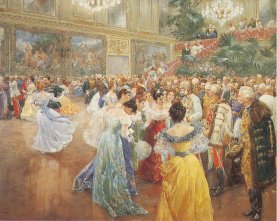
After a weekend's nose-grindstoning, I dashed off a second waltz and an OK orchestration of both: the Ludmilla Waltz and the Empress Waltz, named after two of the formal natures of the most lovely and admirable Lynne R. It was easier to orchestrate the new one since it was conceived from the start as an orchestral being, whereas the older one had gotten into my head a bit too much as a piano work with its piano sensibilities and pianistic tendencies. But the two together are a good match. Once again, I had a grand plan to write of every moment of the great creation, but that again proved elusive. I'm in a difficult-to-verbalize place when I work, and each decision seems either too small, too arbitrary, or too suddenly insightful. And it's hard to glean something that is good enough to pass down to the younger generation. But I have discovered one thing: the more I write these chamber orchestra pieces, the more I yearn for the subtler timbres of a larger orchestra, a much larger orchestra.
Sunday, December 28, 2008
whitebread stomach division
A point of historical interest, from a freelance correspondent:
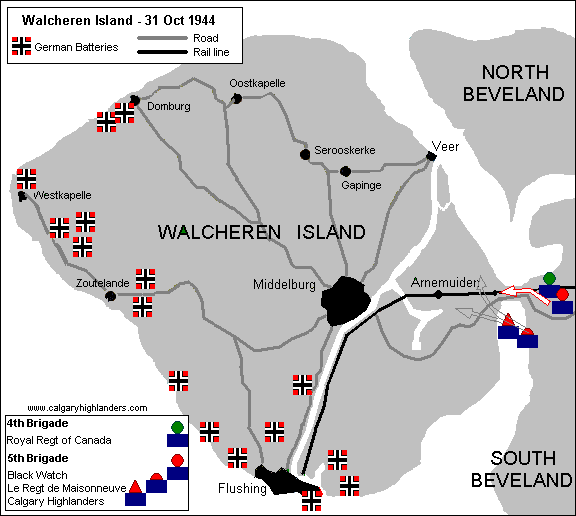
Walcheren Island in the Netherlands: the Romans called it Vallacra, and there was a temple to Nehalennia there, but towards the end of WW2 it was the scene of the Battle of Walcheren Island. Where, what? I must admit: I am a fan of WW2, battles or otherwise, but, you know, I’d never heard of this battle before. Perhaps it’s because the Canucks were to blame or thank for it ...
The savage fight for Walcheren Island, key to Antwerp, had an almost comic ending when fussy little Lieut. General Wilhelm Daser, commander of the Wehrmacht’s 70th (White Bread) Division, suddenly made up his mind to surrender.
Some 250 British and Canadian troops, ready to drop from battle exhaustion, stumbled into 15th-Century Middelburg to find that Daser had paraded all his available troops—more than 2,500 of them —into the square and ordered them to squat down for the night. Then individualist Daser wrapped himself in a yellow patchwork quilt, retired to his bedroom with quantities of aspirin and Veuve Clicquot champagne, refused to go through with the formal details of surrender before dawn (link).
These quotidian images are disturbing, n’est pas?
Saturday, December 27, 2008
die nazisau
Another missive from a foreign correspondent:
The Mel Brooks video of the previous post reminded me of another contemporary take on the musicality of Adolf, this time hunkering down in his bunker. Walter Moers, a German author, created this great take on the absurdity of Hitler in today’s world.
2B ∨ ¬2B
One of my foreign correspondents sent me the following, and so I quote:
Has it really been a quarter of a century since Mel Brooks re-made Ernst Lubitsch’s To Be Or Not To Be? Here’s a little hip-hop number of the same title with Mel Brooks qua Josef Tura qua Adolf H.
Friday, December 26, 2008
Valkyrie
I had intended to discuss the new Tom Cruise epic in terms of its pro-Prussian nationalist blinders and its rather ridiculous implication that Claus von Stauffenberg was some kind of hero to the world for merely coming to the conclusion that, after six years of doing his darnedest for his beloved leader and his beloved leader's inestimable awfulness, that maybe the way things were going wasn't the best for the future of his beloved Deutschland and maybe he and some of his cronies better off the guy in charge before he did any more damage. Not to the world, mind you, but to Germany and especially to its officer corps. But Roger Friedman has already done it for me, better than I could have, in a beautifully lilting and scathing review, from which I quote a choice passage:It’s kind of galling to allow now, in 2008, that von Stauffenberg et al were either totally unaware of this, or that they felt their mission superceded it. In “Valkyrie,” at the expense of making a joke, they are almost like Franz Liebkin, author of Mel Brooks’s fictitious “Springtime for Hitler.” His famous line in “The Producers” is: “War? What war? We vas in the back. We didn’t see a thing!”
A good list of Hitler assassination attempts is here, some by people less reprobate. Many involved in the German resistance were less bloody-handed than von Stauffenberg: for example the leader of the anti-anti-Semitic Confessing Church in Germany, Dietrich Bonhoeffer, hanged with piano wire during the post-Valkyrie purges, and the Weisse Rose, all beheaded by the Gestapo in '43.
Wednesday, December 24, 2008
Stalags

Nazi exploitation films such as Ilse, She Wolf of the SS fueled my youthful groping endeavors, and similar imagery has tentacles throughout American culture, including the "Men's Adventure" pulp fiction post WWII, but the weirdest and most Freudian-ly complex conjunction is the immense popularity of the Stalag among Israelis of the second generation post Holocaust, a "peculiar Hebrew concoction of Nazism, sex and violence," no doubt bred in large part by the Israeli culture's repression of the horrors of recent past. In these books, the protagonists are typically Allied soldiers who act out a series of power exchange exercises with jackbooted female SS-Helferin, ending in a rape-snuff orgy where evil gets its due.Sunday, December 21, 2008
Feliz Nazi Blog
My literate writing time recently has been spent primarily on the blog I started with my sometimes librettist and always friend Jim Bisso, the explanation for which is somewhat difficult but is revealed by the gestalt of the postings en masse. UPDATE: this blog is no more, but its core has been folded into the E.W. blog hierarchy.Saturday, December 20, 2008
Indulgence
Conversation
Erling (explaining things to Bruce): I'm not actually pro-Nazi, I'm just fascinated by the Nazis.
Bruce (in simulated conversation, mockingly): voice 1: Oh, I don't actually like chocolate, I'm just fascinated by chocolate. voice 2: Oh, really, what is it that fascinates you? voice 1: The taste!
Erling: point.
Jim (in response): Oh, oh. I think we, and our age cohort, were inoculated with a dirty Axis needle. All those movies, TV shows, cartoons, and other ephemera. But I know what he means, whenever looking into any of this stuff online, I run across both ends of the spectrum (from Holocaust to Neo-Nazi sites), but it's the ones in the middle that usually give me pause. Those U-Boot, Axis military history, Waffen-SS, Iron Cross medal winners, that profess a fascination (phallic gazing) with but protesting an utter horror of Nazis.
Wednesday, December 17, 2008
Toothbrush with a Smile
The fact that Basil Fawlty can simply put his finger over his upper lip and flick his combover over his brow to evoke the greatest evil of all time shows the intensely iconic nature of these most simple of facial features, notably The Mustache, AKA the Chaplin, the Hitler, the Toothbrush. And in The Great Dictator, Mr. Chaplin exploited his aforementioned painted-on mustache in his excoriating portrayal of the title character, the familiarly fascist and anti-Jewish dictator of Tomainia, made to look so very terrible and ruthless but also somewhat funny and maybe even just a bit understandable, as don't we all just secretly want to be a little bit of a dictator ourselves, and not merely a tinpot one, but the next one up, like way up, because we agree with the following, one of my personal favorite quotes:Part of our heritage is Prussian German. Also our eyes are blue, and Prussian Blue is just a really pretty color. There is also the discussion of the lack of "Prussian Blue" coloring (Zyklon B residue) in the so-called gas chambers in the concentration camps. We think it might make people question some of the inaccuracies of the "Holocaust" myth.
Sunday, December 14, 2008
my german question
From Anonymous Admirer: The historian Peter Gay (né Peter Fröhlich) wrote in the preface of his poignant memoir, My German Question: Growing Up in Nazi Berlin (1998),And so I asked myself, Why didn’t we pack our bags and leave the country the day after Hitler came to power? It was an agonizing question that I am going to ask again and again in these pages. I came to believe that I could appear as a witness as well as taking satisfaction from unsparing self-examination—and, I hope, giving satisfaction as well. Whether I have succeeded is not for me to say. But if I had thought I had failed I would not have published this book.
Gay was born and raised in Berlin and lived there until, at age 16 and just after Kristallnacht, he and his family left for the United States via Cuba.
Propaganda
There is quite a wonderful archive of German propaganda from the Nazi years and beyond at the Calvin College website. Propaganda works quite well, and the average person basically accepts it either whole or half heartedly, and so it's worth a look to see something of the point of view of the Germans during the conflict. As an example, the cartoon on the right is quite enlightening. The context is the (from our point of view) accidental bombing of Switzerland, a 'neutral' country (more on that in a later post). The guilty airman is being questioned as to why he made the mistake and his response is that the flags of Switzerland and the Red Cross look so similar. To understand the humor of this cartoon, you have to know that it was a common belief in Germany that the Allies were deliberately bombing hospitals and Red Cross vehicles and facilities. Maybe we were, maybe we weren't. In Chunk Yeager's autobiography, he describes being given an order to go to a particular mile-square grid location in Germany and kill every living thing in it: person, animal, etc. He says he didn't feel too good about it, but he did it because that's what you did when you were given an order, the classic Nürnberg defense. Luckily for him, there are two major requirements for being a war criminal: one is committing the atrocity and the second is losing the war. Victors so write the history books as we know.
Saturday, December 13, 2008
The German Problem
In the afterword to The Rise and Fall of the Third Reich, William Shirer looks back at the unexpectedly overwhelming response to his book, positive in the former Allied countries and decidedly defensive in the former Axis. In recalling the attack on the book by the then-chancellor Konrad Adenauer, he points out that the Germans simply could not face up to their past, i.e., rampant adventurous conquest and slaughter. It is in this context that he discusses, as he calls it, 'The German Problem:"Friday, December 12, 2008
die untertitel sont erronés.
Also from an anonymous admirer: The film Der Untergang (2004) has spawned a slew of viral videos. One scene in particular. Deep in the Führerbunker, Hitler (Bruno Ganz) has realized that his house of cards is about to collapse. While the German soundtrack remains the same, folks have added new subtitles with alternate content. The first one I saw involved Hitler’s car getting jacked. The meme has just about run its course, but recently a sort of meta-meme has arrived on the scene. Quotha: Bad subtitles are sweet. All our base are belong to you.
That is the fucking benchmark, not this shit.
"
take your daughter to work day
Wednesday, December 10, 2008
New Music Theater
Went to The Cell Theater in New York tonight to see a panel discussion of the book on the left. Eric Salzman also wrote Twentieth Century Music, which many of us read as children, and this latest is coauthored by Thomas Desi, whom I met at NewOp, I think in Amsterdam, which is how I met Eric as well. Eric and Thomas are both talented composers and impresarios, and the book looks great. It's waiting for a read after The Piano Teacher. Afterwards, dinner with the two authors and Grethe Holby, who danced in Einstein and started American Opera Projects. Eric doesn't like using "opera" or "chamber opera" for what we all do, as he thinks it carries too much baggage and too much of a connection to the opera singer voice of the 19th century. "Music Theater" is his preferred term, although I think that term is usually confused with American Musical Theater, and I kind of like taking back the Opera word. It sounds highfaluting and pompous but it's all meaningless to the person on the street anyway.Tuesday, December 9, 2008
Polish Anti-Nazi Art
Too Big
Cold Comfort
Monday, December 8, 2008
Die Aktphotographie
Hey, it's funny
Saturday, November 22, 2008
the rights...