 Continuing with the treacly investigation of romance and its elations, its euphoric pleasures, begun with Two Orchestral Waltzes for Lynne, the current work, Sweet Encumbrance, makes manifest, in sound, the joyous warmth, the sweet iron fetters and the small panics which flow from hogtying oneself together with one's chosen helpmeet and companion. In this piece, it is demonstrated in some detail how much one can gain in life simply by giving up one's philandering, and, while still given license to strut and flirt and still authorized to play the dandy, one must now, for the foreseeable future, festoon one's costume with the leash and collar and electronic ankle bracelet, sometimes visible but most often invisible, like the line that one might be enticed to cross save for the memories of the previous attempts' resultant truncheoning and electric shocks. But let us not dwell on such past pains, but please to look to that bright future world illumined by the brightest and whitest of most pure light where, joined in glory and set upon one's throne just to the right of the Empress, in a new Sagrada Familia, happily holding court, happily holding the hand of the one most beloved.
Saturday, September 26, 2009
Sweet Encumbrance
Continuing with the treacly investigation of romance and its elations, its euphoric pleasures, begun with Two Orchestral Waltzes for Lynne, the current work, Sweet Encumbrance, makes manifest, in sound, the joyous warmth, the sweet iron fetters and the small panics which flow from hogtying oneself together with one's chosen helpmeet and companion. In this piece, it is demonstrated in some detail how much one can gain in life simply by giving up one's philandering, and, while still given license to strut and flirt and still authorized to play the dandy, one must now, for the foreseeable future, festoon one's costume with the leash and collar and electronic ankle bracelet, sometimes visible but most often invisible, like the line that one might be enticed to cross save for the memories of the previous attempts' resultant truncheoning and electric shocks. But let us not dwell on such past pains, but please to look to that bright future world illumined by the brightest and whitest of most pure light where, joined in glory and set upon one's throne just to the right of the Empress, in a new Sagrada Familia, happily holding court, happily holding the hand of the one most beloved.


Sunday, September 20, 2009
Missa fictus Missa ficta
 Jay Cloidt and I have been editing together the two nights' recordings of the Missa. It's tremendously thrilling to create such a fiction, something that never was, weaving the different performances, different microphones, different audiences together into one. We've added a few synthetic overlays where a few notes were missing, even recreating one whole section of the postlude. We've discovered once again the joy of reverb in absolving the recording of a great many sins confessed to us under the harsh scrutiny of his monitors, reverb that Jay had foresworn ever since hearing Blood Sugar Sex Magik.
One interesting set of audio interjections comes from a large belled clock in the sanctuary, which goes off from time to time during the recording, especially during the Sanctus, a highly synchronistic event, as the use of bells during the Sanctus goes back almost a millenium. Bells and the Bible go hand-in-hand, like love and glove, and the union produces such poetic gems as those found in Exodus 28:
And beneath upon the hem of it thou shalt make pomegranates of blue, and of purple, and of scarlet, round about the hem thereof; and bells of gold between them round about:
A golden bell and a pomegranate, a golden bell and a pomegranate, upon the hem of the robe round about.
And it shall be upon Aaron to minister: and his sound shall be heard when he goeth in unto the holy place before the LORD, and when he cometh out, that he die not.
Saturday, September 19, 2009
Teddy's biff
 My cross-dressing Teddy has a new best friend, seen here in her finery, harnessed safe and secure in the bosom of fellow pulse modulator and amateur Ruxpin engineer Mike, with whom I've been corresponding about the ins and outs of our little friend and his/her sensitivity to radio interference. I had planned to take my act to Burning Man a few weeks back to help investigate the Doors of Perception with the various misfits freaks and weirdos of which I am proud to call myself a member, but work in all its aspects has been impeding my fun lately. This must stop of course, and the prevailing winds are beginning to change, to blow to leeward, so soon maybe Teddy and I can appear in public again together. Meanwhile, li'l red above will have to take our place in the world.
Wednesday, August 19, 2009
Tabla lessons with Harihar Rao, with a side trip to Richard Feynman
 One day in tabla class - I studied on the side back in my scientific days at CalTech - some progressive-minded classmates and I, looking for a bit of spice and a bit tired of the (while often interestingly subdivided but still) powers-of-2 meters, goaded our teacher, Harihar Rao (top right), into amusing us with some rhythmic fireworks. Like all Westerners, we were always looking for something new and more exciting than what he was actually teaching us, never really willing to spend the time to learn the details of anything, like dancers seeming to hold their partners close but really looking past, scouting the next liaison across the room. But he had been teaching gringos like us for many years and so was used to this blasphemy and, with a weary acceptance, proceeded to teach us a somewhat complex 7 beat pattern. We then tried, a bit shakily, to keep this going, as steady as we could, as he straddled it with an 11 beat pattern, his beat effortlessly 11/7ths faster. It was a sweaty and joyous bit of concentration, collapsing and coming back together as we tried vainly to hold the two opposing rhythms in our head, to achieve what he could seemingly without thinking.
For the few years I studied with Harihar, I couldn't walk anywhere without tabla rhythms appearing over the pulse of my step. It was an obsession, a compulsion. I would practice the patterns as I walked, like all drummers I have known since, making approximations of the sounds with my body, trying to fly each pattern against 3 beats, 4 beats, and 5 and 6 and on. The important thing - or what seemed so at the time - was to be able to perform it consistently while shifting one's concentration from one pulse to the other, flickering between views as with the Necker cube. Relative prime rhythms were of course the only ones that were interesting, like the relative primes that defined the intervals of which I was just becoming aware, and these rhythmic practices spilled out into my pianism, forcing me to play scales in polyrhythms, to add or subtract a beat or two or three to each measure of the left or right hand parts of just about anything to squeeze or expand them just a bit, a pleasant flurry of notes not quite lining up, like the middle bit of the first of the op. 28 Chopin préludes where the right hand switches from 6 to 5. [A note to the reader trying this at home: better is to move the right or left hand up or down a bit as well, a fifth or a third or whatever, and then, even better, to just stop playing other people's music as it's easier on the stereo anyway.]
I was lucky enough to attend CalTech when Richard Feynman was still teaching Physics X, and my friends and I would hang out there too, asking questions about the Moon and the blue sky and rainbows and gravitation and electron spin and DNA and the structure of the eye, learning more about science and its cousins in the barest refractions of light in the few smallest drops distilled from the great man's essences than in all of our more formal studies. The class wasn't really a class at all, but an informal seminar, held in the basement somewhere, maybe Lauritsen, where the students would ask questions about anything, attempting and failing to stump the great man, and where Feynman would always cut through to the heart of each issue, bringing an oh-so-pleasant shock of illumination and intuition.
CalTech was a strange and insular place, a tremendous opportunity for those who were prepared to take advantage of it, suicidally difficult for others, stocked with children who had been locked away, sequestered from society from birth by the nature of their interests and their antisocial smarty-pants disposition. But, even in that rarified place, where Nobel Laureates were dime-a-dozen, Feynman was an icon who floated a bit above the rest. When he showed up to our tabla class one day, we were suitably star-struck and tongue tied, unable to respond to his easy manner. His bongo playing was well-known to us, and well as some of his other idiosyncrasies - one I remember well is when he showed up at a meeting of the CalTech Christian students simply to point out what idiots they were for believing against all facts and logic - but in the end the instrument was beyond him, and he an old dog trying to learn a few last tricks, the sounds too subtle and he too impatient to coax them out of the hide.
Tuesday, August 18, 2009
This year's CDs
 The compact disc of my Missa, although wholly encapsulating a sad and dying medium of auditory exchange, is at least visually luminous and beguiling thanks to Karen and should be available quite soon, as soon as I can bring myself to go through all the recordings of both performances in some detail and make a final determination of what is the best and what is not. The chalice awaits the thick nectar of the reverb-heavy-laden music decanted, then held to the lips to succor those in spiritual need. Although I have attempted to interest a few of the typical classical music vendors in the product, it will be a vanity press item, made simply for the delight of my fans and so that I can continue to gaze longingly at my own reflection.
The Mordake CD, on the other hand, is mixed and packaged and has obtained the all-important record deal, only now awaiting approval from a thousand bureaucrats, dressed each identically in their identical indigo Mao costumery, soon to be unfettered, alive and on its own in the uncaring world.
Thursday, August 13, 2009
Bunnywhiskers once again
 My dear friend Bunnywhiskers has moved her radio show to a new time and a new location and has asked me to ennoble her and her program by appearing, tonight, the 12th of August, 2009, two days past the Perseid peak, on FCC Free Radio at 107.3 on your FM dial here in San Francisco, or streaming online at the address you just passed over. We will talk of many things, surely including music and love and grace, and read excerpts from favored books and maybe the libretto from my upcoming production, possibly even giving away a free CD. All is possible. For those of you coming across this entry in the future, there may be a link to a recording of the show here.
Wednesday, August 12, 2009
Bletchley Park etc
 As a former mathematician and reputed engineer, I've shared the recent nerdish interest in the true idea that World War II was really won by the boy and girl geeks who prodded and cajoled roomfuls of vacuum tubes and who lovingly sharpened their No. 2 pencils and who, on their long walks home, flirted and kissed furtively against romantic revival gingerbreaded walls, and that we Anglo-Americans, by our braininess alone, knew all the Axis powers' plans and played the war like a great chess game, not through the efforts of the poor filthy pawns who slogged through the mud and death and blood to capture and hold bits of land, captives of that distasteful space.
The reality is somewhere in between of course, although I did always wonder why it took so long for the engineers' roles to be understood. The truth was quite slow to arrive, and not until the 70s did the British government allow publication of Bletchley Park's breaking of the Enigma codes, for many reasons, my favorite of which is the fact that the Brits had sold the rotor machines to their former colonies throughout the world and hoped to continue to read all their diplomatic traffic. The secret business is a set of wheels within wheels, and there is great fascination in the work of statisticians deciding which bits of intelligence to follow and which to ignore, which will show the enemy too much knowledge of our knowledge and which can be safely hidden, possibly in other obfuscating and pointless missions, and who will be allowed to be killed by enemy attack, and who will be saved.
Outside of the rarified air of Bletchley Park there were also other, lower tech operations, some chronicled in the fascinating book Between Silk and Cyanide by Leo Marks, who tells stories of encryptions in the field, used by operatives behind enemy lines, some using bits of one-time pad sewed into bits of silk parachute material, others using memorized poems, the most famous of which is his own romance The Life That I Have, perhaps made more poignant by the context, where Nazi handlers may have beaten this poem and others like it from those they captured, turning them as agents to work against the land and people they loved:
The life that I haveIs all that I haveAnd the life that I haveIs yoursThe love that I haveOf the life that I haveIs yours and yours and yours.A sleep I shall haveA rest I shall haveYet death will be but a pauseFor the peace of my yearsIn the long green grassWill be yours and yours and yours.
Tuesday, August 11, 2009
The youth

from Conversations with Igor Stravinsky, late '57:
I have all around me the spectacle of composers who, after their generation has had its decade of influence and fashion, seal themselves off from further development and from the next generation. Of course, it requires greater effort to learn from one's juniors, and their manners are not invariably good. ... The very people who have done the breaking through are themselves often the first to try to put a scab on their achievement. What fear tells them to cry halt? What security do they seek, and how can it be secure if it is limited? How can they forget that they once fought against what they have become?I have to admit that it is v. difficult for me to learn from my juniors. My typical reaction to the artistic successes of freshly minted composers is envy and jealousy tempered only by rage, depression and frustration, and although, in my case, I really have very little that I am fighting for, except my own self-aggrandizement, as I am an eclectic and polyamorous lover of styles and ideas and threads of artistic development, it's hard for me to get past the pettiness that so pervades my soul. But in deference to the idol of my youth, I resolve to try.
And I was intrigued to recently discover the brief affair between the young Igor and Coco Chanel, now a motion picture, see above.
Saturday, August 1, 2009
More on Teddy

 Since some have asked, here's what I know about reverse engineering the original Teddy Ruxpin®. The original bear used normal compact audio cassettes, but with an opening along the top, where the metal tape indicator tab was later located. This way it could detect the difference between its own cassettes and commercial audio tapes, which would play out the speaker but not control the servos. The Ruxpin cassettes were recorded with a cloyingly mawkish story and music on one of the stereo tracks, the kind of music you can never get out of your head no matter how many emetics you ingest, and a control track comprised of a series of audio-level pulses on the other.
Pictured at the top is a detail of two quasi-periods of the control track, consisting of a set of nine positive-going pulses. Each pulse is about .25 msec wide, actually .27 for the 'blue box' I built so many years ago, and the time between pulses is what controls the servos. That is, the time between pulse 0 and pulse 1 in each group of nine controls one servo, and the distance between pulse 1 and pulse 2 controls the next, and so on. The time between pulses from a fully open to a fully closed servo varies from about 1.25 msec to 2 msec, measuring from leading edge to leading edge. The leading edge of pulse 0 of next group of nine is about 6.5 seconds from the leading edge of the last pulse of the previous group of nine. The total period of the groups is not fixed - you can hear the overall pitch change as they move. My main bear is one of the two servo variety, and for that animal the interval from pulse 1 to pulse 2 controls the eyes and from pulse 2 to pulse 3 controls the mouth. Later bears had a separate control for upper and lower jaw, and if you hook Teddy to Teddy's friend Grubby®, a pleasantly disgusting and seemingly out of scale and of a different cartoon aesthetic big grub-like creature, you will find that the other pulse to pulse modulations come into play to control him as well.
Originally I sent the control signal in using a CD to cassette adaptor and then recorded actual cassettes, but as I've resurrected the project in more recent days I decided to do some surgery (note crime-scene-like photo above) and bypass the heads on the crappy built-in cassette player. I attached a mini phone jack directly past the play heads and it seems to work to send the signal in from a dime-a-dozen mp3 player. One has to be a bit careful of the levels - too high or too low on the control track and the bear becomes subject to a variety of muscle spasms or alternately is sent into a catatonic state. Also, running the low-level wires out of the bear makes it subject to radio interference, and cell phones held close to the bear can also elicit the abovementioned palsies. I went a little further and hooked up battery powered amp/speaker combination inside since the built in speaker is also pretty bad. It's meant to be heard by a small child sitting in a quiet room alone with the somewhat scary bear toy and is not quite up to entertaining a packed opera house.
Thursday, July 23, 2009
Duncan Wold's score for In Residence
 My son, showing that he is a child of the same Adam, has constructed a heavenly collection of musical fragments, a Soundscape for a Nonexistent Motion Picture, but which, by its synopsis, makes one strongly wish for its actual production:
This haunting film is not for the faint of heart — or the claustrophobic. We are presented with Jane, an artist who begins a residency at a strange home filled with junk. Her goal is to fashion the detritus into a piece of artwork speaking to the theme of recycling and ‘green’ building practices. But things get twisted when the junk compels her to construct an elaborate and, at times, beautiful trap for herself, which she slowly begins to realize is locking her in, pressing her downward into infinite, interlocking chambers. Even as she becomes more entangled in the web of the house, it begins to provide her with sustenance necessary to continue her work.
— Dina Bloomberg, Down the Rabbit Hole Zine
Wednesday, July 8, 2009
I have nothing to wear and I am wearing it
 and that is poetry, in this case the poetry of Bunnywhiskers resting her tired coney body after a day's hunting and being hunted, me the eternal gentleman.
Saturday, July 4, 2009
Teddy
 I have been fortunate enough in my career to have a few people get very excited about a few works of mine, an heartwarming occurrence. Although, two people that I respect awfully have chosen atypical and offhand works of mine from the mid 80s as their favorites. One was a theatrical work based on a game between the San Francisco 49ers and the Denver Broncos during the Joe Montana glory years, written with Everett Shock, and featuring a recitation of a declaration, aided by an overheard projector on which the declaimer laid out an Xs and Os play-by-play, in the style of the Declaration of Independence (a memory fitting this day of all days), but commencing with the line "when, in the course of a football game, it becomes necessary for one team" and so on.
 But the other venture, which has been favorited by more than one of my erstwhile fans, was a small piece done in a small venue in Oakland, where I performed a duet with a Teddy Ruxpin® which centered on themes of objectophilia and robot sex in the modern world. In fact, the exact animatronic doll sitting on my desk today in the photo above being prepared for a comeback tour of sorts next month. You can see the blue pulse timing modulation box I built back in my 'maker' days to control its servos and to allow me to make my own, more sophisticated control tapes. My son, who was about 2 at the time, loved it, although it's possible that some of the themes may have gone over his head. He giggled all through the preceding performance that evening, in which a topless and somewhat buxom young butoh dancer, powdered in white, completed, in about ten minutes, a short walk down an incline.
Since the script was quite short, I reproduce it here for your amusement. As my wife was the voice actor for the bear, I performed a small transgendering of Teddy to Trary, and put a bit of ribbon in his hair.
I would very much like you to meet one of my very good friends. Say hello to everyone, Erling.
Um, why did you bring it up?
(pause)
I think I am in the mood to sing a song for all the people here. Could you accompany me on the accordion, Erling?
ERLING Sure. (Trary and Erling perform The Second Prayer from A Little Girl Dreams of Taking the Veil.)
Saturday, June 20, 2009
Denisova-Kornienko Duo
 I met Elena and Alexei when they performed in the 2001 Austrian production of A Little Girl Dreams of Taking the Veil, Alexei on the podium and Elena covering the viola, my favorite bit of which is the brief and registrally displaced but oh so beautiful solo here:
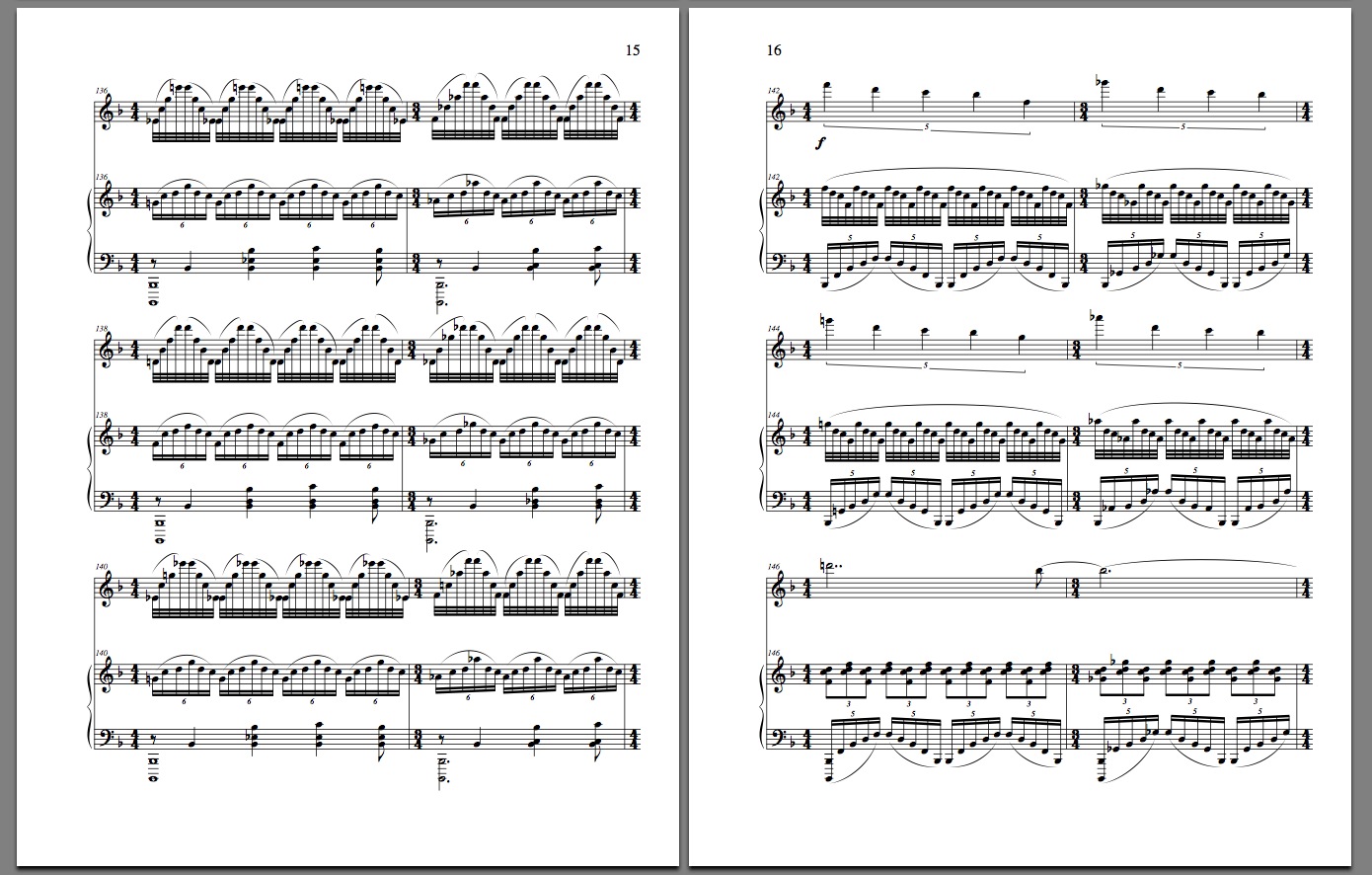
I had promised them a piece in their roles as the members of a violin-piano duo, and this for many years, giving them only one small number that was a simply bit of program music, an old man dies, a vision of my own death as an old man, gasping for breath but all the while still dreaming of a breast, the iconic breast of a woman. However, I finally forced myself to sit down and write something, not asking them if they still cared or wanted the heavy responsibility of another piece dedicated to them, this one not quite so simple. This spicy opus, The Secret of Success, a reference to a blog entry here by the same name, is subtitled a chaconne, because it is, at least a bit, and in the modern meaning as a set of variations on a repeating harmonic progression, in this case a series of chords rooted on Bb, a combinatorial set that treads between major and minor, similar to those I have used before: once in The Bed You Sleep In and once in the Cotter episode in Queer. The piano plays incessantly, often verbosely, and typically the harmonic changes happen right on the measure line, one per measure, violin and piano almost always changing together, something that Kyle Gann would probably find crazy making. From a recent post of his that was on my mind while I was scribbling:
When I see a kid composing in units of measure, measure, measure, with a new impetus, new phrase, new harmony on every downbeat, I start in with my wheedling tone (every experienced composition student will recognize the sound): "How about a triple upbeat to start that melody off a little more gracefully?" "How about we vary the harmonic rhythm here?" "You think the audience can't hear where your bar-lines are if you don't accent every one?"
Serb Cutter
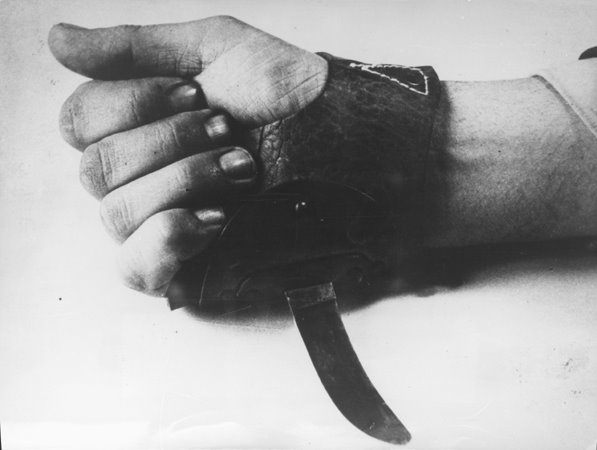 My beloved foreign correspondent sent me a note this morning reminding me of some of the more brutal of the brutalities of the last Great European war. He found it as he was researching a new novel which has something to do with the concentration camps in the Balkans, but it also reminded me of a story. Around the time when the event more recent troubles began in the region, my friend Mark Dippé was visiting some Serb friends in Sarajevo. At the moment they heard that their Serb brothers and sisters had launched a campaign of slaughter against their Croat brothers and sisters, he said that they, seemingly modern and reasonable people up to that point, literally jumped up with joy at the opportunity to grab their weapons and get to killing. It is of course hard for us, civilized with our mountains of McDonald's and hundreds of channels of TV, to understand such depth of hatred, but my correspondent's link did explain just a bit of it. It's just a small thing, the above device, a Srbosjek, or "Serb cutter," but it represents so much, and was invented by the Ustaše - Croatian Revolutionary Movement - as a way to efficiently slit the throats of captured Serbs, of which there were very very many, while engendering in the murderer as little fatigue as possible.
Saturday, June 13, 2009
Night and fog
 Tonight is the night, and the SFCCO players are sounding good. A few complaints and threatened defections from the orchestra over the fog, but they are into it, what started as a stretch has now become commonplace. And I'm so happy to get my noise self out. Michael Cooke has told me it's his favorite piece of mine ever, and he's heard a lot. It is to go on the shelf with other obscure pieces of mine (the 49ers opera, the Trary Ruxpin accordion duets) that have become my friends' favorites?
The Artist as a Young Whore
 I was asked to participate this morning in a paid interview - in cash, in the form a single piece of currency: the bill with the drunken general and the corrupt president - by the San Francisco Foundation, and it got me to thinking about my whorish nature, a term I use with the ultimate in positive connotations, as many whores are counted among my best friends, and I can only aspire to such clear thinking and take-charged-ness.
Anywho, getting to the point, it's clear that artists have always been quick to leech onto whomever is in power, regardless of their goodness or badness, in order to live their lives of dissipation, shrouding their selfish wants in pseudo-mystical-art-feeds-the-soul bologna. I'm reminded how, in de imperio tertio, we find the same willingness to suck at the monied teat of the all-father to further one's career, although, in the case which came to mind, it may not have been the best choice career-wise. Heinrich Hoffman, who became more-or-less the official photographer of the Führer, took the photograph above and many others, note especially those Hitler suffering the little Aryan Children to come unto him, but who, after the war, was imprisoned for profiteering and who had all his photographs seized and put into the US National Archives, the images themselves consigned to the public domain.
Leni Riefenstahl, shown naked above, who also had all her work expropriated by the incoming GIs, was never quite able to lie her way out of the stigma of being infatuated with the Nazis and Nazi ideals and, even though she was clearly one of the greatest aestheticians in the early days of the new art form, she was rejected by the world she and her friends had abused, project after project denied after the war. But she saw the slaughter of the Kinsk civilians, she chose the particular slave Gypsies for her films, she allowed them to be shipped to Auschwitz, she knew what was to happen to them but she litigated against all who said so, indefatigably, during her long long life. And who can forget Albert Speer, the one who apologized, but who was also only to eager to be seduced by the power and the money and the evil structure of which he became a part.
But I suppose the difference is that the artists of the US of today are happy to take the blood money and spend it biting the hand that fed them, and feeling entitled to the privilege all the same.
But I suppose the difference is that the artists of the US of today are happy to take the blood money and spend it biting the hand that fed them, and feeling entitled to the privilege all the same.
Sunday, May 17, 2009
Intuitionism
 Bath-time this morning was facilitated by an iPhone 3G® in a Ziploc® bag - thanks to my friend Nicole for enlightening me of this wonderful invention - and a circuitous path through those intoxicating days early in the last century where Hilbert and Brouwer led the fight over the non-finitary law of the excluded middle (see photo) and other such issues.
 As a boy, I was so interested in all of this. The issues seemed so important and, later, as I became a composer, I faced them again, feeling a pressure from above to maintain an intellectually rigorous Germanic methodology in all my musical decision making, a certain belief promulgated by my betters that there was a notion of music that existed in a Platonist reality where deep truths live separate from the dirty business of breath and bows and spit and turntables and stylish hairdos, and that compositional progress was in the furtherance of passage toward this Utopian Ideal.
But I was, deep down, more tolerant, and shall we say more Dutch, and believed that music really was purely an act committed by people for their own amusement, that it existed in this world and not the other, and that it had benefits beyond an explication of existence, namely (0) transcendental beauty here on earth (1) encouraging teen pregnancy through passionate embrace (2) a devil-may-care use of drugs (3) hearing impairment in the elderly (4) separation of fools from their money (5) penis casting (6) nonpareil spirituality and mystical joy (7) creative jouissance (8) and so on, and that music was concerned with the grit and chaos and noise of sound, and that it was, at its core, an inexplicable and impenetrable pursuit, evading all attempts to capture it, drop it in the killing jar, and to pin its beautiful wings to the setting board. The theories I learned as a student did not attempt to cover anything except what I found to be the most superficial aspects of music, the voices and pitches and rhythms, and I was left to find the rest myself.
One of the reasons I started writing - English rather than notes - was to try to explain what I did day-by-day during the compositional process, thinking that in so doing I might capture the uncapturable. But I've failed every time that I have tried. I can't really say easily what I do. There is no process to speak of, and the moments spent in the compositional state sneak by unseen to end up in a piece that I no longer feel my own.
Friday, May 15, 2009
"But at least they dressed well"

As a young boy on the Great Plains, gorged on a constant diet of WWII war movies and television, my friends and I would get together with our BB guns and cherry-bombs to be mini-reënactors, and, in our innocence, who would we vie to be? The sloppy GI with perpetual cigarette hanging out of his mouth, unshaven? Hardly! No, we fought for the right to click our heels, to salute, to wear the smartly trimmed Hugo Boss designed and built SS uniforms, to carry an imaginary Feldmarschall's baton, and to speak in a clipped Germanesque pidgin, the hint of a saber cut on our cheek, the monocle, the goose-step.
As children, we could be forgiven, having no idea of the signification of our choice. But many elect to continue this into adulthood, as its very taboo nature titillates and appeals, from the Korean ad above (video here), to Nazi themed restaurants, to the Nazi Chic, to those too interested in the paraphernalia of the Reich. What to make of these fallen and so foolish fellow humans? Have they forgotten or merely never learned that the fascist path, while seeming to wander along an alpine meadow, dotted here and there with some wildflowers, leads to the cliff or to the bear or to both?
Score Directions
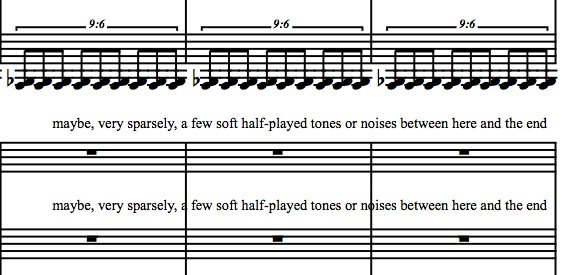 The score is done, the parts have been shipped away once again, and, while usually one for absolute control - a chimera at best - I have abrogated my responsibility as a Komponist to allow the so-called performers a bit of leeway, one arm unbound from the straightjacket, a rest from the hamster wheel, the industrialist lightening for the moment the blows on the backs of the restive workers, but this philosophical change of heart, like most, has come from expediency rather than deep thought, as my compositional laziness seems to increase year upon year. I remember a day in the not so distant past where, to begin the simplest of tunes, I first had to build the instruments, sawing and sanding into the wee-est hours to the ire of my roommates, decide on a tuning, and, locked in my slattering studio, learn to play the aforementioned devices or at the least to coax a sound. But now my compositional life has settled into a pattern: (1) agree to a deadline (2) wait until the last possible moment (3) use every shortcut, trick, careless theft and accident to produce something as quick as possible. I had lunch with my friend and co-producer Paul Dresher the other day and had to hide my head in shame after listening to him describe the months of preparation on Shick Machine, building the instruments, learning to ... yes, you get the idea, everything I had been, and revealing to all the shadow I have become.
Wednesday, May 13, 2009
In the Stomachs of Fleas

We, that is, fognozzle and Erling Wold, present for you a tale of fear, horror, xenophobia, political posturing and denial, all contained within a musical program piece of sorts, a savage delight for the senses and an allegory for today, this and that and the other thrown into the pot of narrative and boiled up into a scenario as follows:
The Australia steamed into San Francisco in 1899, carrying corpses and rats infected with the plague. Between 1900 and 1904, one hundred twenty-six people contracted the disease in San Francisco and environs. One hundred twenty-two of them died while the governor denied the very existence of the plague and the press blamed the Chinese for spreading it.
The plague was brought under control in 1904, only to resurface in 1906 as the great earthquake displaced the human and rat population. The response to this second outbreak was dealt with more efficiently as the causes were better understood, but one hundred eighty people died of the plague in San Francisco between 1906 and 1909.
Fortunately, Xenopsylla cheopis (the Oriental rat flea) never secured a foothold in San Francisco, and our dominant flea remained Ceratophyllus fasciatus, which lacked the deep stomach required for effective plague transmission. Many more people would have died if the reverse had been true.
Unfortunately, the rat-eradication efforts during the San Francisco plague outbreaks did not extend to the squirrels of the East Bay. Through them, the bubonic plague established a permanent foothold in the Pacific Northwest, where it lives on today - in the stomachs of fleas.
SAN FRANCISCO COMPOSERS CHAMBER ORCHESTRA
and Old First Concerts Present:
DREAMS OF THE RESTLESS
Saturday June 13th, 2009 at 8 pm
Old First Presbyterian Church
1751 Sacramento Street/Van Ness, San Francisco, CA 94109
$15 General, $12 Seniors (65 and older), $12 Full Time Students
DREAMS OF THE RESTLESS
Saturday June 13th, 2009 at 8 pm
Old First Presbyterian Church
1751 Sacramento Street/Van Ness, San Francisco, CA 94109
$15 General, $12 Seniors (65 and older), $12 Full Time Students
Tuesday, May 5, 2009
Hitler fascination

Our roving correspondent Milky recently sent to your faithful editor this well-crafted portrait of an idealized and supah sexy Hitler. As I pondered it, daydreaming of a personal yet elusive fame that would cause someone somewhere and at sometime to render me, even in a fleeting imaginative fancy, with such a magnetic physique, I was reminded of the mystical allure that HH held over his people. Thousands of love letters received during his brief time as the duly elected leader of his fawning people are full of amusing quotes:
I would like to make you my little puppy my dear, my eternal, my lovely Adolf.
I am making you keys to my front door and my room. We have to be very careful. So come early, ring my landlady's bell and ask if I'm at home. If everything works out, my parents (they could be your in-laws) say you can come any time, so we can spend the night together at my parents' house!They eroticize the relationship we have to power and fame, of the mystical love we shower on iconic figures, our kings and queens du jour, finding ourselves wishing for a Daniel Day-Lewis or a Mary Kate-Olsen to pin us to the floor, us dressed in nothing but a little leather cap and some latex underpants, bringing upon us an orgasmic religious ecstasy quite like that experienced at full tilt towards a passionate Christ-as-not-only-spiritual-husband by St Theresa of the Little Flowers. Although the photo above shows the young sex-kitten-version of the conquering collective cultural hero cum super-ego, we wonder if, as he aged, he took on the immediate character of the father figure, more directly replacing the father- and husband-protectors lost in the seething tides of the harsh and endless war. And, once satiated, bitten, spanked and altogether sexed-up, we might warmly turn over, spooning, and, our minds drifting, light upon the kitler meme and thereupon sleep the blissful and ne'er to be interrupted sleep of those just and unstained.

Friday, April 24, 2009
Geburtstag
 My follower Milky chided me last evening at the Throbbing Gristle event here in San Francisco for somehow not paying proper obeisance to the event of A.H.'s birthday last Monday, but it's actually quite important for me that this set of notes on a particular cultural preoccupation doesn't become what it purports to analyze, a fetishistic love-fest of a brutal regime, ending in a place I can only just imagine: where the cleaning lady finds me one day, swinging by the neck, raised aloft by an elaborate pulley system, cold to the touch, wearing only a pair of vinyl briefs and a gas mask, surrounded by pornographic magazines open to their most German images. We'll leave that end to those who really do enjoy such things, the likes of Motor Racing Bosses and Princes of the Realm.
 But, while on the topic, we find here:
A report by Ofsted, which expressed concern that secondary pupils were repeatedly studying Hitler is part of a wider debate about the nature of Britain's enduring obsession. Those concerned at the ubiquity of the Third Reich in the history classroom and beyond to the nation's bookshops and living rooms fear it stunts understanding of other periods and leads to an unhealthy personality cult.And to which I can add only that it is difficult to run out of unimportant issues as well.
On the opposite side of the argument there are those who point to the monstrosity of the Nazi regime and its leader, arguing that it is difficult to run out of important issues relating to Hitler to highlight to the wider population.
Sunday, April 19, 2009
JG Ballard, dead today
 Crash, a dance written under his influence, the score for the last section above, a recording of the entirety below.
from the book:
I stood with my feet apart, hands on my breast bone, inhaling the floodlit air. I could feel my wounds again, cutting through my chest and knees. I searched for my scars, those tender lesions that now gave off an exquisite and warming pain. My body glowed from these points, like a resurrected man basking in the healed injuries that had brought about his first death.
Wednesday, April 15, 2009
Sunday, April 12, 2009
Georgic for a Forgotten Planet
 Lynne Sachs showed one of her latest films, Georgic for a Forgotten Planet, last night at ATA, a cultural icon here in San Francisco. The film, like Vergil's Georgic, is a lovely and meditatively poetic paean to agriculture, although, unlike Vergil, the film's focus is on the separation of our citified culture from the husbandry of the earth as well as the separation of our own persons from what surrounds us. I was struck in particular by a number of plaintive shots of the Moon over the city, hardly visible against the streetlights, ignored by those below, a forgotten deity.
 Many of her films center on ecology and our damage of the same and we saw a number of those as well. Also included on the program were the films of her partner Mark Street, including one of his more abstract works titled Winter Wheat, a beautiful bubbling hand-manipulated piece of 16mm art, which took on an environmental urgency in the context of the other films.
But the reason that Georgic is the cynosure of this bit is its use of my first CD in the soundtrack, most noticeably my manipulated music boxes. If memory serves, this is the one that begins the film.
Some of the others from Music of Love are used as well, and some moments of Hagalaz. I'm flattered of course, and happy these sounds have a new life. The actual box, holding the last few guitar picks of a previous life, sits on the piano behind me as I write.
Sunday, April 5, 2009
Alamo!
 A habit I picked up years ago from Ed Toomey, formerly of Neef, who picked up every playing card he saw on the ground - a surprisingly common find - compels me to scan the terrain for interesting bits of detritus. I no longer carry them home to fill filing cabinets and adorn the walls; I merely scrutinize and inspect and leave undisturbed. But recently I came across one of Tony Alamo Christian Ministries' screeds on a New York city street, and was reminded of my colleague Barry Drogin's opera named after the selfsame amusing and intolerant religious leader.
 In the current missive, Alamo is persecuted, like all good Xtian martyrs, but in his case again by the anti-Christ, who has taken the form of the US government, now accusing him transporting minors across state lines for immoral purposes. In Barry's opera, Alamo's persecutor du jour is the Cult Awareness Network, and a particularly poignant moment occurs when Alamo's polemical rant against the Catholic Church suddenly becomes personal, and we suddenly see through a window to his soul, consumed by a deep and pervasive sadness, a frantic desperation of a man trapped and scared and alone, wondering why God has forsaken him. Barry has put up a section of the score and recording, linked to above and here below, respectively.
Update: Barry has informed me that, and I have apologized for:
As per its full title, "Alamo! a scena for a cappella voice and Bible (King James version)," calling "Alamo!" an "opera" is an error in scale - kind of like calling a one-act play a full-length play, or, say, any orchestral piece in one movement a symphony.
Saturday, March 28, 2009
Henry Ford
 Stephen Ambrose, in his Citizen Soldiers, tells of how upset the GIs were to see the enemy coming toward them riding Ford trucks (and Opel trucks and planes, a wholly-owned subsidiary of GM). Henry Ford has a number of troubling connections with the Nazis, many of which have been well publicized, from the inclusion of excerpts of the Protocols of the Elders of Zion in the glove compartments of new cars to his outspoken admiration for Hitler to his acceptance of the Grand Cross of the German Eagle in July 1938, four months after the Austrian Anschluss.
 As the Washington Post points out in a detailed article, worth reading, on the deep connections between the two, when one thinks of Ford, the image is of baseball and apple pie and not that Hitler had a portrait of Henry Ford on his office wall in Munich, which he did. Company documents found when the German Ford slave-labor factories were liberated spoke of the "genius of the Führer." The final insult, most amazing to consider, came after the war, when both GM and Ford petitioned the US Government for reparations for their German facilities due to Allied bombing. And, although one might simply think to laugh off such a ludicrous proposal, GM was in fact paid $32 million, a cool $380 million inflation adjusted.
Irving Fine
 A longstanding jest of mine was to answer, when asked about my career goals, that I wanted to be at least as famous as Irving Fine, he being (in my mind) a perfect example of a composer of some talent who is known by other composers but not well known among the general populace, unlike some of his fellows in the Boston Six, e.g. Lenny Bernstein and Aaron Copland and also due to the rhythmic-rhyming connection between our monikers. Unfortunately this particular goal will most likely not be achieved, but recently I found the late composer and I have some interests in common. From the bio by Phillip Ramey:
Although Irving's sisters frequently used the word "normal" to describe their brother, his first sexual experience was anything but that. He told Verna, who confided it to her daughters many years later, that at age six he had been molested by a twelve-year-old neighborhood girl who was acting as his babysitter. He was sexually active early on, and in his teens sometimes frequented whorehouses in Boston with a friend named Stanley. He also liked to write smutty limericks.Verna recalled that Irving appreciated women with large breasts, theorizing that this might be because his mother and sisters were thus endowed. One summer in the late 1940s, while sitting on the lawn with his wife and Aaron Copland, Irving gave a quiet wolf whistle as an extremely busty female in a revealing halter passed by. Verna, who had average-sized breasts and was used to his ways, said, "Oh, Irving, act your age." Copland, puzzled, asked: "Can you explain to us why you like those ghastly things?" Irving just smiled. All his life he was a bit of a flirt, charming both sexes, although Verna insisted that he had no homosexual inclinations, even in adolescence.
I'll leave it to the reader to decide what features of the above we share.
Thursday, March 26, 2009
Third Reich in Ruins
 I came across a cornucopiæc website of photos then and now, comparing locations in Nazi Germany at the end of the war - the abovementioned 'in ruins' - to the same locations in our current and fully de-Nazified Germany. It reminded me of my first trip to Nürnberg in '95 at the 50th anniversary of VE day, when the city had placed billboard-sized photos of the urban landscape from early 1945, smoke still rising from the rubble, sited so as to duplicate the view I had standing in front of each: one view mere piles of debris, one the beautifully reconstructed Disneyland of the old city.
Soon after, I headed out to the Zeppelinfeld, site of many a Party rally, where my friend and sometime colleague Jon Jost had, standing near the dais, watched as an elderly German gentleman walked by, looked quickly from side to side, then made a small, furtive, but definite salute. Old habits die hard.
Tuesday, March 24, 2009
Richard Grayson
Discovered today to my joy that there exists on YouTube a cornucopia of videos of my first harmony teacher, whose much-more-than-a-parlor-trick is to take suggestions as to themes and composers from the audience and to then improvise a setting of the first in the style of the second. Playing examples in class, he would often wander off a bit in various directions, and was quickly able to show how, say a Bach chorale would progress through historical harmonic developments.
Thursday, March 19, 2009
Wednesday, March 18, 2009
Vanity Press
I remember, as a wet-behind-the-ears naif, being surprised to discover how much of the art world was based on self-aggrandizement, trust funds, vanity press, self-written bios, press-releases and the like. I had so foolishly assumed that there was a way to actually succeed in the arts by doing art, that there was an arbiter in the world that chose the best, that knighted those that deserved it, and that the cream would rise to the top, that you would get the phone call or the letter that said you had made it, that you were now allowed to join the pantheon, loved and fêted by your peers as well as the adulating multitudes.
Hi Erling,
The informal introduction catches me off guard.
My name is [French female name here] and I am writing from the Boston-based production company [whatever].
I’ve familiarized myself with your music and career, very impressive. I listened to your "On the Death of David Blakely" and loved it - emotionally moving piece, full of intrigue and mystery.
I have also attached an article featuring [whatever] and the press release for our formalized agreement with Microsoft to include [whatever] music in Windows. We're in close touch with Microsoft’s Lead Music Supervisors about providing more content in the coming months. Exciting all around!
At this point it is simply embarrassing and we really need to look away. Needless to say, our ensuing conversations, although light and airy and of some social interest, lead in the direction we have foreseen: the deal offered akin to that of prostitute and john, that where she looks away at the moment of penetration, separating herself from her body to avoid feeling the revulsion that is welling inside, and he feels a vague discontent, knowing that it is not what he had hoped.
But soon I discovered the fallacious nature of this belief, that when the ballet or the opera or the symphony or the local new music promoter called you or sent you a letter, it was always merely to ask you for money, to ask you to support their own self-aggrandizement, their own vanity press and their own tenuous careers in the arts.
For example, I recently received an oleaginous letter from a record company, flattering me with silken tongue. Let's take a look-see, some details redacted and some annotations added:
Hi Erling,
The informal introduction catches me off guard.
My name is [French female name here] and I am writing from the Boston-based production company [whatever].
The pretty name opens the heart, allow the knife to enter.
I’ve familiarized myself with your music and career, very impressive. I listened to your "On the Death of David Blakely" and loved it - emotionally moving piece, full of intrigue and mystery.
But here we see already the seeds planted of the doubt to come, a glimpse of the future: the fighting, the recrimination, the tears and blood and shame and hurt.
We have a vibrant release schedule and sessions lined up through 2009 - just this November we produced music for clarinet and piano with Richard Stoltzman in our Boston Studio (I have attached a picture that was taken during the session).
I have also attached an article featuring [whatever] and the press release for our formalized agreement with Microsoft to include [whatever] music in Windows. We're in close touch with Microsoft’s Lead Music Supervisors about providing more content in the coming months. Exciting all around!
At this point it is simply embarrassing and we really need to look away. Needless to say, our ensuing conversations, although light and airy and of some social interest, lead in the direction we have foreseen: the deal offered akin to that of prostitute and john, that where she looks away at the moment of penetration, separating herself from her body to avoid feeling the revulsion that is welling inside, and he feels a vague discontent, knowing that it is not what he had hoped.
Thursday, March 12, 2009
Münchausen
Ruining it for everyone
 The Nazis did a lot of really bad things, and tainting the swastika in the West forever and always was one of them, leading even to the current attempts in the EU to ban the symbol, although it's really unclear how one actually bans a simple figure that has been in use for at least three millennia, spans cultures, is currently seen around the world, is part of ornamental borders and floors and temple columns, included in books on tessellations and origami, the logo of charitable organizations, etc. Lynne Rutter saw the lovely example of a decorative manji at the Sensoji Temple in Tokyo a few days ago. However, even there, the Nazi stigma still is felt as, since the war, all the new Buddhist manji in Japan are of the left-handed variety, not the right-handed isomer favored by the historical evil. Below, from a Tokyo shrine near Shibuya:
Sunday, March 8, 2009
Last day in Tokyo
Ended the last night in Tokyo drinking too much and watching my performing arts colleague Fiume Suzuki and her dance partner (see both above) perform in the difficult-to-find and members-only Sound Bar+ in Roppongi, an unmarked red door just down a small street. We met at TPAM, attracted to each other's similar hairdos, i.e., our current baldness:

Once there, I was able to compare corsets with a friend of hers, whose bound waist was as thick as a normal thigh, and who showed me some lovely photos on her cell phone of corset/kimono hybrids.
But first thing, Lynne and I went to see Shun-kin at the Setagaya Public Theater and it was everything I hoped it would be from the glimpse I caught through the tech booth window. The story was clear even without the English surtitles that were provided at the Barbican, and not understanding the details of the language allowed me to get lost in the beauty of the production. Birds represented by flapping paper, mixed with projections of birds, sometimes moving in sync with kimono catching those projections. The aging of the two main characters was handled in two appealing ways: a series of cast changes for the man and the morphing of a puppet to a real actress for Shun-kin herself, a blind shamisen player who takes her servant as a lover, a sadomasochistic relationship that is resolved only when the servant blinds himself. Ah, Japanese stories seem to always veer toward the heavily fucked up, at least those that make an impact in the west, but that is something that I too find very attractive.
In between, and quite a long train ride away, we went to see Akira Ishigura at the enormous GEISAI art show. He has some craft in his oil paintings of anime crossed with the old masters.

War Crime and Punishment
 On the bullet train to Hamamatsu (pictured to the left), one quickly realizes how much was built or rebuilt after the war. Most of the country in fact. So much of it looks prefabbed and hastily constructed, temporary buildings reminiscent of West Berlin before the wall came down. General Curtis LeMay's firebombing strategy, the results of which were the impetus for this rebuilding, was not in fact that different from what had already been made acceptable throughout Europe by the blitz, the vengeance weapons, the carpet bombing of cities by masses of planes that blotted out the sun, the single-minded development of superweapons capable of wiping out a city in a flash of neutrons, heat and gamma rays. But the paper and wood houses that populated Japan at the time were more susceptible than the stone buildings of Europe and the resulting conflagrations reached temperatures that boiled their victims in the rivers into which they swam to escape. LeMay once famously remarked that it was a good thing we won or he and many other of the Allied commanders would have been prosecuted for war crimes.
 And that is the nut of crimes of war: it's a prerequisite to commit them in order to be guilty of them, but one also has to lose the war.
In his autobiography, Chuck Yeager tells of receiving orders to fly to some particular grid coordinates in Germany and kill every living thing within a square mile. I don't remember the exact quote, but it was something to the effect that he didn't feel good about it, but orders is orders: more or less the Nuremberg defense. The losers don't get a chance to raise the question.
Saturday, March 7, 2009
TPAM day 4
 The high point was performing in Rotozaza's Etiquette with Silvia Mercuriali, one of its two progenitors, a piece where two face each other across a small table, listening to instructions on headphones, following without question these instructions, acting simultaneously as audience, performers and godlike figures manipulating two small toy characters' frightening lives. It was a physical rush, intimate in the real interaction with this real stranger, embarrassing in the pressure to perform, and difficult restraining oneself from responding to the character being played, sticking to the script as it is revealed.
 I wonder if there is a place for 'composition' in this little world.
After that, my agent-cum-dominatrix flogged me through a gauntlet of meetings with art centers and presenters and theaters, a blur of Japanese that I am finding difficult to retain. I handed out a lot of CDs and DVDs and I remember from back in the Yamaha days that the Japanese take these things seriously; once I gave a CD to Kuwabara-san, a member of the Board of Directors, a major position in a company that at that time numbered 14000, and, after a late night of drinking 'in the samurai style,' he buttonholed me first thing in the morning, me in a deep and photophobic hangover, asking insightful questions supported by multitudinous scrawled notes in a mixture of Japanese and English and Music Notation in which he had analyzed and transcribed in detail the microtonal scales and harmonies, asking why and why and why to which I had no good answer. But I accepted DVDs and CDs as well, and now I feel a certain responsibility to respond in kind, to study and peruse and comment and give due attention.
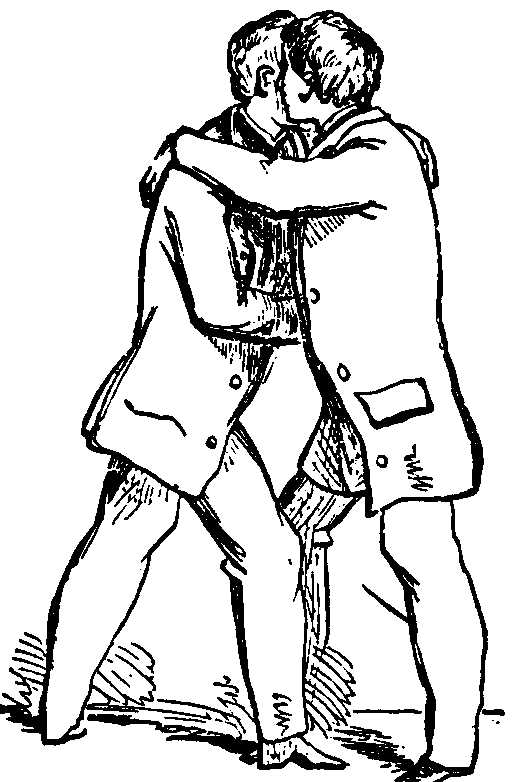
And then, the closing party - unfortunately so soon - in which an Aussie gentleman embraced me in the five points of fellowship (see above), applied the apprentice handshake, and, at the moment when the master and apprentice are mouth to ear, whispered that he is an 'esoteric sex worker,' that he has a special knowledge known only to a few.
Friday, March 6, 2009
TPAM day 3
Met with the Arion-Edo Foundation who put on the Tokyo Summer Music Festival, a group that puts paid to my previously held notion that the music scene here is only conservative. Also met with the 21st Century Museum of Contemporary Art in Kanazawa, very interested in doing new and odd work as well as drawing in the local community. Surprised to find that both were interested in my little operas, although interest and reality are two different things, separated by the gulf of funders' bureaucracies. Also surprised to find how many people knew of the work of William Burroughs, and how much interest there was in Queer, which was not true in Europe. There is something here that resonates in a fundamental way with the beats.
Another dance showcase, this time for the JCDN, which is the Japan equivalent of the National Performance Network in the US. I'm beginning to figure out some of the dance vocabulary that seems to suffuse the work here. One piece stood out for me, a violently sexual pas de deux, appealing for obvious reasons, by j.a.m. dance theatre, Osaka.
Tokyo moment of the day: being crushed onto a JR train car to the point where I wondered if one of the passengers might actually die. As the train moved forward, a young girl leaned her head against my back, quietly sobbing from the pain.
Thursday, March 5, 2009
TPAM day 2
Before this, we were treated to a series of showcase works that highlighted quite a different dance aesthetic from what I have seen in the US. A couple of the pieces were quite sparse, with some dangerous moves, e.g., climbing up a series of stacked tables and then rolling off the top to land on all fours like a cat; falling onto the top of the head from a kneeling position with an audible whack, then slowly un-scissoring to lie on the belly. The final piece was the most memorable and, even though it is quite impossible to capture in words, let me ask the reader to imagine a young woman afflicted with a mild case of St. Vitus' Dance or other neurological disorder, following the spoken instructions of a self-help meditation recording that has had a large number of silences edited in, no other music, in front of a small black wall, a very simple white spot with a diffuse edge lighting her as she slightly vibrates through the simple postures, and then, after a small adjustment of the furniture, changing her shirt from green to orange, taking her meds, then merely sitting on an ottoman-like object quietly while the tape, still filled with silences, plays again, the whole process using up the better part of 3/4 of an hour.
Besides that, more schmoozing, more meetings, lots of bits and pieces of dances too numerous to mention.
Wednesday, March 4, 2009
TPAM day 1
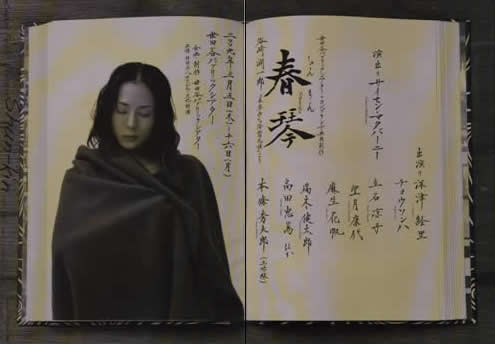 Met with the curator at the Setagaya Public Theater, a powerful institution doing major work with strong community connections, centered in a helpfully well-off suburb of Tokyo. Saw a bit of the piece to the left through the window of the control booth as they readied it for its premiere tomorrow and it was gorgeous. Hoping to get snuck in to see it before I leave, although it's been sold out for a while.
 I was told that the nature of the 'classical' music community here is very conservative (is that different anywhere else?), and that they really aren't interested in doing new work (again, is that different anywhere else?). The curator told me of her husband's CD collection, exemplified by the three complete Beethoven sets, so I gave her a Little Girl CD to improve its balance, at least a bit. There is a Japanese translation of that opera's libretto, would love to reproduce the piece here in what would be its third vulgaris, had a native Japanese opera singer (the marvelous Mariko Wakita) starring in the German production so already halfway there. But was also told a funny story about how they deliberately made the acoustics in their theater unacceptable for music so as to not compete with the real music hall in the vicinity and possibly upset its major corporate sponsors.
The first major TPAM schmoozefest happened today. Met a variety of interesting and genuinely warm and interested people. This was followed by a showcase performance of two singer songwriters, one very calm with somewhat surreal lyrics and the other quite intense, an older Mikami Kan playing electric guitar with an idiosyncratic and quite rhythmically irregular and dynamically angular style. Enjoyed both, but noticed that only one had English translation supertitles. This turned out to be by design as the electric performer's somewhat severe music style was matched by his stories: (1) we are all going to die die die (2) old woman having sex with a much younger man, both kill each other (3) 60 year old man having sex with a young woman, dies at orgasm (4) rape victim goes back to be raped again and again until she drives the rapist away (5) well, that's all I remember. But I do remember him in Merry Christmas, Mr. Lawrence as well.
In the evening, attended a ritual Buddhist performance, a long monodic line passed between a soloist, a choir of 20 and a smaller of 8, punctuated by repetitive hand movements, perfect moments of percussion, candle-lighting. Have just been reading Anthony Burgess's biography where he tells of giving up composing for writing and how the latter is so much simpler, being a single line instead of a complex counterpoint, but interesting to see and remember how rich and powerful a single line of music can be.
TPAM day 0
 I had dinner with Yutaka Kuramochi-san last night, a playwright working at the Japan National Theater, winner of the Kishida Drama award and many other accolades, but let's take a quick look at just the beginning of the scenario of his latest:
The protagonist, Ayumu Aoi, is obsessed with sending in postcards to try to win sweepstakes prizes and is so absorbed in his mania that he can hardly find time to sleep. He fills out the postcards in detail, believing that adding information not even requested he increase his chances of winning. Eventually he begins borrowing the names of people around him to increase his number of applications, spending all day in his solitary room creating false hobbies, character traits and family members to fill in his imaginary applicants’ postcards with.
Just my kind of story, and my friend and agent Kyoko Yoshida is helping bring this play, One Man Show, to Minneapolis in translation for a reading this year.
Monday, March 2, 2009
Greater East Asia Co-Prosperity Sphere
 Here in Tokyo for a few weeks, capital of one of the signatories of the Tripartite Pact, meditating on the global nature of WWII and the support the Nazis had from a number of other militaristic and dangerously jingoist societies. Interesting to find that, even though the Japanese were similarly brutal to all their perceived-as-inferior neighbors, they didn't share the antisemitism of the Nazis, at least not in quite the same way. Although books repeating the canards of the Protocols of the Elders of Zion sold millions of copies in Japan, they had funded their earlier war with Russia with money from the prominent Jewish financier Jacob Schiff, and also allowed a number of Jewish refugees from Europe to settle in Japan for a curiously mixed-up set of reasons under the Fugu Plan. I've never quite understood how the Germans, in their search for a world dominated by perfect Aryan-ness, could settle into a marriage with the most un-Aryan Japan, a country which had even fought against Germany in the Great War that rankled Hitler so much. But it was a relationship that lasted until the end for both short-lived empires, from the outside at least warm and congenial, with none of the obvious cracks that threatened the Nazi's other marriages of convenience.
Subscribe to:
Posts (Atom)


 Posts
Posts