

Showing posts with label electronic music. Show all posts
Showing posts with label electronic music. Show all posts
Thursday, January 13, 2011


Sunday, December 26, 2010
From my deathbed

I was surprised to hear both of them answer, immediately and in chorus, that musical judgment is completely arbitrary.
To set the stage, the conversation had begun with my prediction that "you're" was quickly being replaced by "your", that this trend was clear to see in text messages and Facebook threads, for example the future president's daughters' friends' discussion here. I had also complained that my phone's automatic spell checker attempts always to change "its" to "it's" regardless of the change's grammatical correctness, and it was with these two prologues that the question was posed. To reiterate and expand: is there a way to judge whether a musical moment, an event, a pitch, a sound, a timing, a whatever, is correct in its context? Is there a way to judge the making of one musical choice over another?
Again, these two wise men say no.
As the 'boys' in question, let's call them 'Doug' and 'Thom', are current and past editors of the Computer Music Journal, and as one of them is a composer of Tape a.k.a. Fixed Media music - a species of composition where every detail of the final sound is chosen by the composer and there is no performer intermediary - and moreso is a composer who agonizes over each of these aforesaid details, I was quite surprised. And disappointed too, as in reality I was baiting them, as I knew that they would both inwardly bristle at the aforementioned changes to the language, as much as they know suchlike changes are inevitable, and I thought that the linguistic setup - the bristling - would force them into a conservative proscriptive stance, leading them to take a strong position against the arbitrariness of music and art. This would allow me to then spend the next hour getting the better of them, comfortably chipping away at their position, one which is in reality quite difficult to defend.
So I pressed the point. "But as a fellow electronic musician you must have had the experience where moving an event a few milliseconds made all the difference between a musical passage being successful and not, the musical equivalent of the 'For the want of a nail' proverb?" "Yes," he replied, "but it really is completely arbitrary. The importance of my choice may seem that way to me, but the next person could make the opposite choice and find that to be perfect."
I can't really make a rational argument against this. But I don't believe it passes the common-sense test. While all combinations of sounds may be interesting in some ways, some combinations do appeal, do have value beyond others. In my heart, I know there is a certain rightness to my musical decisions. Maybe I have to think that way. Maybe if I did not, it would call too much into question my whole choice of artistic career and lead me to tuck my head into the oven, a note left behind, upon which is scrawled a crying out against an Existence Too Evil.
But I do believe in the Composer's Hand which, like the Hand of God, touches those things that need to be touched, a Hand that is able to work in a world full of contradiction and pain and randomness but can craft something out of that muck that transcends it. We hear it in the work of performers, where the nuances that separate the merely great performance from the life-changing performance are very small to the oscilloscope, but are very large to the human heart.
A tangential point
When Everett and Brian and I lived together, we built many instruments. A number of these had arbitrary tunings. We scoured hardware stores and the like for scraps of sheet metal of varying thickness and size and arranged these in approximate pitch order - as the pitch of vibrating plates can sometimes lead fair women and men to disagree - placing their vibrational nodes carefully on felt supports. When one began to improvise on such an instrument, certain combinations of tones would quickly appear as meaningful, and sometimes one would feel drawn to a particular sequence, almost as if the allegedly arbitrary tuning would suggest a certain piece of music that was innate in it. Similar statements have been made about pieces arising from particular Indonesian gamelans, each of which feature a tuning that is consistent among the instruments of a single orchestra, but which is always distinct from that of the orchestra down the street.
The winds of history have blown in all of the givens with which we start any piece: the pre-existence of certain sound generators, the limitations of human hearing, the accidents of standards of notation, of performance practice, and maybe those are deeply arbitrary, but from those we must choose, and we must believe we can build.
Sunday, June 20, 2010
walking along the Embarcadero past pier 7 and the flowers

I told myself that I would wait to compose the new opera until we had done something with the words theatrically, that is in a theatrical setting, with the performers and the director, to get a sense of the performance and the direction that those words implied. This I have explained before here, a concept whereby the timings and the delivery of the words, usually fixed by the composer ab nihilo, would instead be approached more collaboratively, and that I would take the results of that process and use it to guide my setting of the words, a fixing in musical form. However, I didn't know what to do with my nervous musical energy, that fever that comes over the artist when the artist has something bubbling up, wanting to burst forth in a spray of brains and blood and to spill itself over the page or, in this brave new world, the computer keyboard.
So I decided to let it out slowly, ever so slowly, and then to allow it to grow in a direction all its own. The result is the piece to the right, a piece for two pianos, a huge blocky dense work of frenetic activity, repetition, some rhythmic intensity. At the moment, I enjoy it, and so I present it here, in a synthetic form, a simulacrum, but one which I have molded carefully, hand carved out, a memory bittersweet of love lived and love lost, for your pleasure, an mp3 here, and a score here.
Saturday, April 10, 2010
The Apollonian Clockwork

In 1921 Diaghilev decided to make his contribution to the socializing of the arts. He rented the Gaieté Lyrique, a small theatre in the workers' district of Paris and managed - through publicity in the neighborhood - to attract the local residents into a theatre which put on mostly operettas. That succeeded nicely. After a few performances, the hall was filled with an entirely different audience from the mundane, chic people who usually attended the Ballets Russes. One evening the wealthy Misia Sert came to a performance. When she arrived at her box, she directed her binoculars into the crowded hall, saw no one well known - only unshaven faces - and said, surprised: `There's nobody here!'But of more interest to us composers are the composerly essays, for the book is really a collection of such, which bring us to desire that more books about composers be written by more composers. Yes, Kyle, your new book is on my to-be-read shelf, unfortunately a linear foot or two in, so be patient. It is such a joy to see the compositional and life knowledge the two authors have accumulated brought to bear on the subject, and the fact that they themselves have had to deal with so many of the same issues, and were influenced in their own compositions and the way they perceive the music that preceded them by the choices that Igor made, adds so much to the cross-generational discussion between composers living and dead.
An example is their brilliant clarification of the prescient nature of the Stravinsky's work, the change-without-change that presages minimalism, the form that follows from the music, the collage cutting back and forth. I've always been aware of the things in some way, ever since hearing Petrushka as a teen, and it's clear that it has informed everything I do, but why was not until this that I really got it?
A thirteen-year-old is capable, while lying in bed ready for sleep, of playing the Schumann Piano Concerto (in A minor) on the record-player of his memory. During the second movement, he will probably fall asleep. If, ten years later, in another bedroom, he tries the same thing with the Stravinsky Concerto for Piano and Wind (`in A minor'), he will, at the very most, if he even gets that far, get stuck at the cadenza of the first movement; or worse, get trapped in a vicious circle of dove-tailing rhythms and snake-like motifs biting at their own tails.This is in fact what I love in the music that I love. I now see that the piece I'm currently tidying up, my Walking along the Embarcadero past pier 7 and the flowers, owes much to my youthful inoculation with Stravinsky's music, which I didn't see so clearly before. And more revelations lie ahead.
Saturday, March 6, 2010
Turing

I for one am happy to be replaced by an algorithm. This would allow me more time to follow my alternate paths to bliss, e.g., drinking myself into an early grave. Regarding such, my colleague Thom Blum once rhapsodized on the movie Leaving Las Vegas, as it represented the story of one who sets a goal for himself and achieves it. Other paths include watching a lot more television, gaining a lot of weight, lying in my own filth, and so on.
I have tried several times to enlist the aid of the computers that have surrounded me since my days at North Star, when I had the energy to solder and code just to achieve some polymetrically imagined wonderland, usually worked at the notelist level, but later at the sound stratum, as the latter has been the source of my bread and water for the last twenty-plus years. I still do from time to time, when I, like Mr. Cope, have been blocked and need a bit of inspiration. But isn't random inspiration just about as good? Remember the Oblique Strategies, now available on the iPhone? Not sure why Cope spent so much effort at the expense of all else just to produce a score. Scores are one thing, but it's easy to confuse the map for the territory. We remember the works of Cage and others derived from star charts and I Ching and we realize those pieces can actually be pretty good. Why? Because composers are just one teeny part of the process that passes through the skill of the performer and sometimes the mixing engineer. And does anyone else worry about his destruction of his databases? Was all of this music really generated just by his algorithms? Hard for someone else to really test that now.
Friday, January 1, 2010
Two New Reviews
 Of Mordake, not yet released:
The music is convoluted and tumultuous yet well ordered in its own fractal logics, the lyrics sung in English in Duykers' heroic exhortations ever attempting domination of the reedlike insinuations and madnesses of his sister, snakily evoked through Korporate Marionettes' devices to produce a mocking hectoring from Duykers' own vocal chords (remember, this is a solo opera!), the result effecting a personality split and schizophrenias effective on more than one level. On top, to the side, and underneath, Wold crafted a welter of environments leaping from harsh urgency to ambient tranquility shot through with muted echolalia—the bridge from Go Get Our Supper! to What Have You Done? being a great example.This daring purveyor of far horizons favors nightmare and the disturbing undermatrix of consciousness in his work, and Mordake is his most impressive evocation of that since Taking the Veil, to my mind stunningly high art…
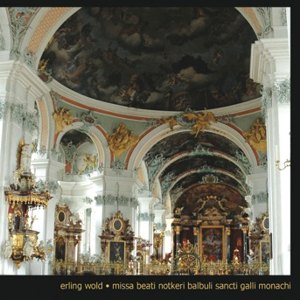 and the Missa, in the online review journal FAME:
The voices are largely female and angelic in the extreme, male counterpoints recessed, with the cathedral's echo providing an expansive golden warmth to the massed encantings, a palpable feel of heavenly dimensions ... There are effulgent passages of Godly sentimentality but also the turbulence of the states between [Him] and man, reminders of our fall from Grace.
Friday, November 27, 2009
Patent Microresonators

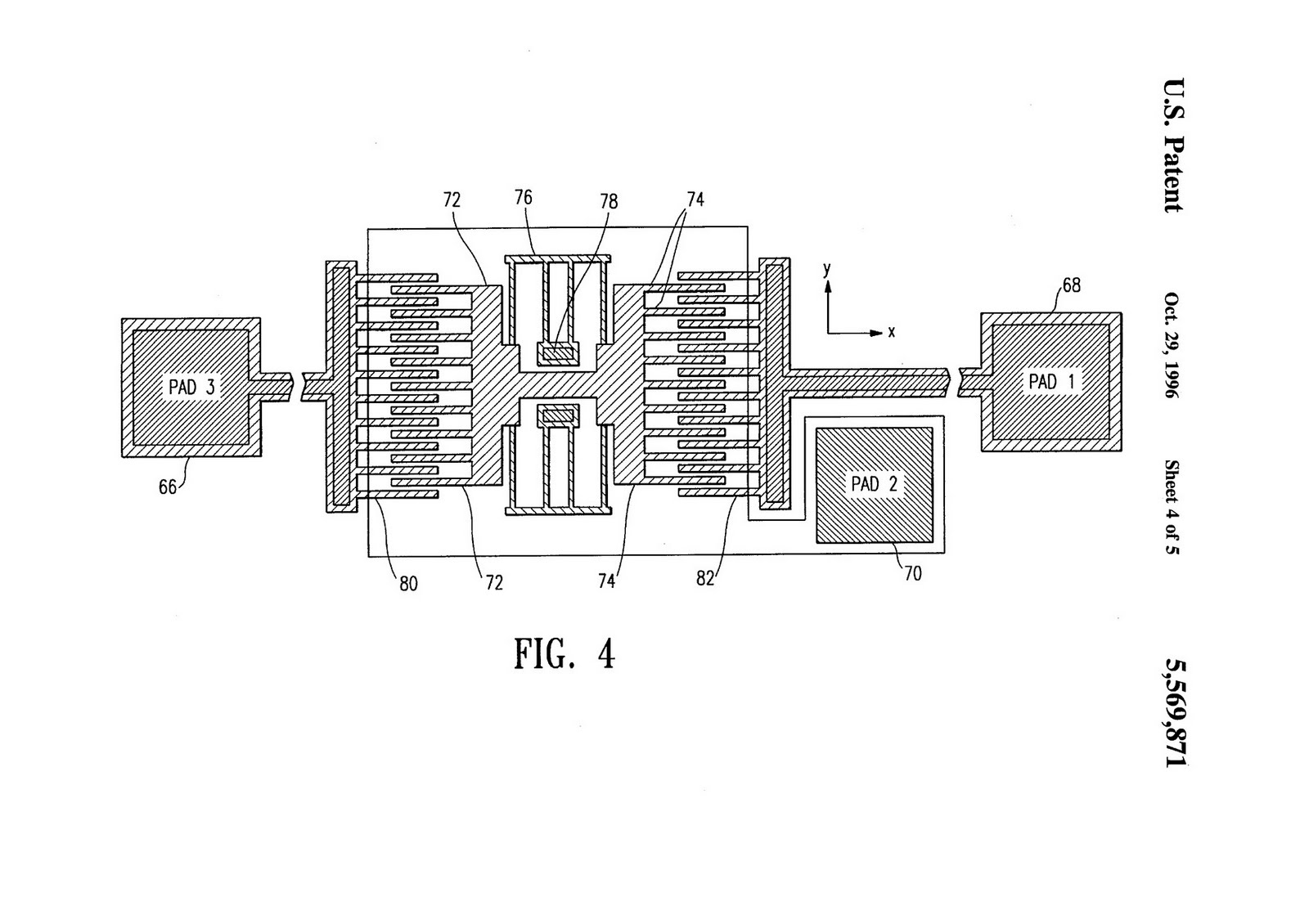
Happened to receive a note from a fellow traveler along the Engineering path, querying about some work done by me and some friends for Yamaha Music Technologies USA back in the days when Japan was in its tech ascendency. Like a number of other bits of the development of the future of music we did back then, our involvement was by the most part a brainstorming exercise, and a bit before its time, in both a good and bad way, a beautiful fantasy about the way things ought to be, but not so much about the way they really are. The figure below is from a patent discussing the a synthesizer that worked by taking the chipmunk sounds of the nano-world and pitch-shifting them down into the range of human hearing - or dog or bird hearing if such was your audience. It's crazy of course and probably wouldn't even work, but patents are no longer about crating up your better stream-driven wristwatch and taking the long coach ride to the US patent office to show them that it really works. That ended a long time ago, when the real patent system that dealt with real objects was replaced by an intellectual property wrestling ring & roulette table & bathroom scale where companies get together to fight over the vaguest of notions. But this device is what intrigued my colleague, who seems to be building something in the physical world which may actually vibrate and buzz.
Some of the bits and pieces we patented were more feasible, and some were even constructed. The picture at the top right shows a quite reasonable XYZ pitch roll yaw-based musical controller from another expired patent, long predating the Wii and its relatives. But Yamaha was out of the controller business, having sold only a few tens of thousands of some earlier attempts, and really was out of the far future business anyway by the time we came along, so little was realized, a few things finding their way into high-end karaoke machines, downloading updates by satellite.
Saturday, July 4, 2009
Teddy
 I have been fortunate enough in my career to have a few people get very excited about a few works of mine, an heartwarming occurrence. Although, two people that I respect awfully have chosen atypical and offhand works of mine from the mid 80s as their favorites. One was a theatrical work based on a game between the San Francisco 49ers and the Denver Broncos during the Joe Montana glory years, written with Everett Shock, and featuring a recitation of a declaration, aided by an overheard projector on which the declaimer laid out an Xs and Os play-by-play, in the style of the Declaration of Independence (a memory fitting this day of all days), but commencing with the line "when, in the course of a football game, it becomes necessary for one team" and so on.
 But the other venture, which has been favorited by more than one of my erstwhile fans, was a small piece done in a small venue in Oakland, where I performed a duet with a Teddy Ruxpin® which centered on themes of objectophilia and robot sex in the modern world. In fact, the exact animatronic doll sitting on my desk today in the photo above being prepared for a comeback tour of sorts next month. You can see the blue pulse timing modulation box I built back in my 'maker' days to control its servos and to allow me to make my own, more sophisticated control tapes. My son, who was about 2 at the time, loved it, although it's possible that some of the themes may have gone over his head. He giggled all through the preceding performance that evening, in which a topless and somewhat buxom young butoh dancer, powdered in white, completed, in about ten minutes, a short walk down an incline.
Since the script was quite short, I reproduce it here for your amusement. As my wife was the voice actor for the bear, I performed a small transgendering of Teddy to Trary, and put a bit of ribbon in his hair.
I would very much like you to meet one of my very good friends. Say hello to everyone, Erling.
Um, why did you bring it up?
(pause)
I think I am in the mood to sing a song for all the people here. Could you accompany me on the accordion, Erling?
ERLING Sure. (Trary and Erling perform The Second Prayer from A Little Girl Dreams of Taking the Veil.)
Saturday, June 20, 2009
Denisova-Kornienko Duo
 I met Elena and Alexei when they performed in the 2001 Austrian production of A Little Girl Dreams of Taking the Veil, Alexei on the podium and Elena covering the viola, my favorite bit of which is the brief and registrally displaced but oh so beautiful solo here:
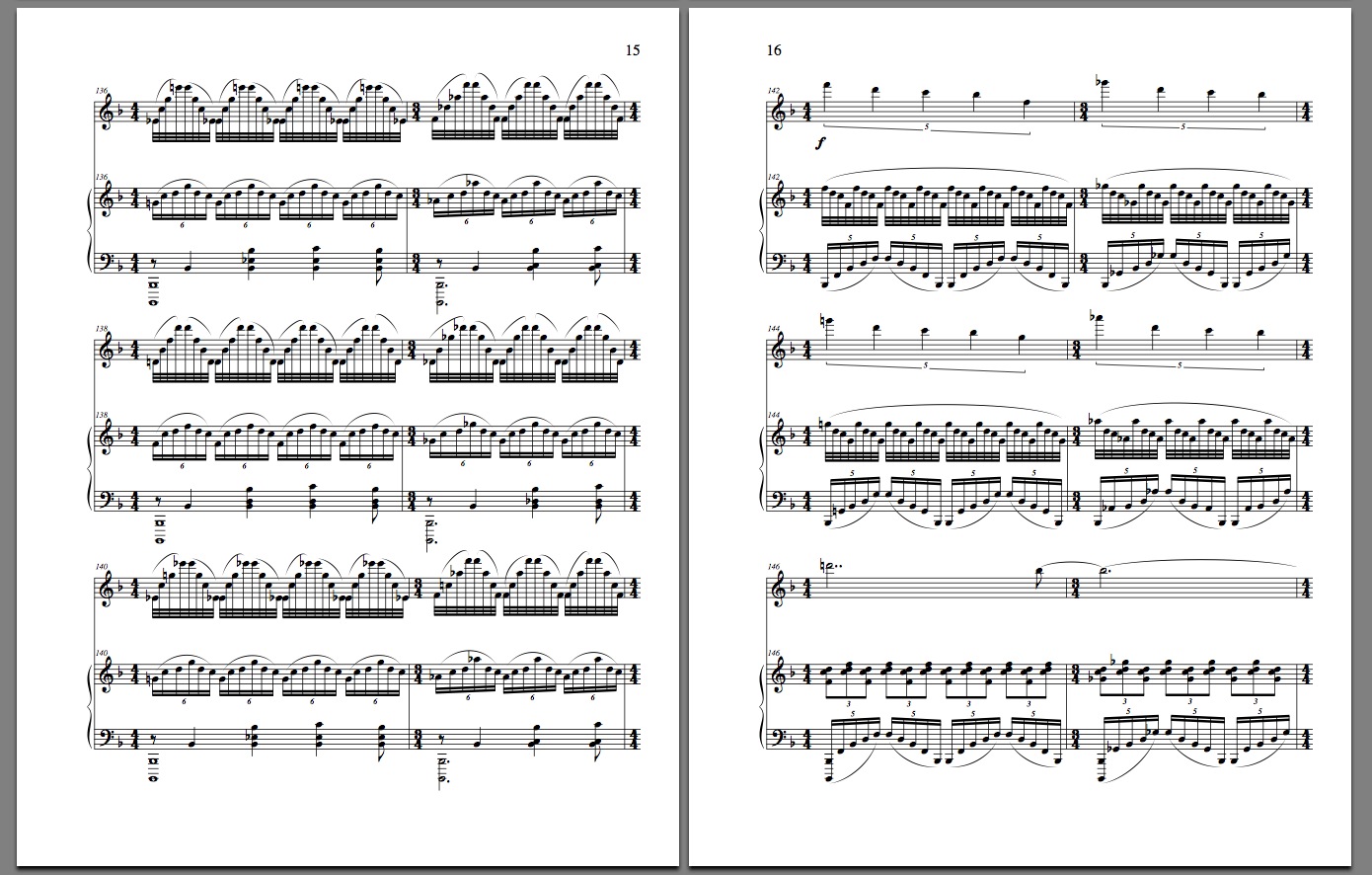
I had promised them a piece in their roles as the members of a violin-piano duo, and this for many years, giving them only one small number that was a simply bit of program music, an old man dies, a vision of my own death as an old man, gasping for breath but all the while still dreaming of a breast, the iconic breast of a woman. However, I finally forced myself to sit down and write something, not asking them if they still cared or wanted the heavy responsibility of another piece dedicated to them, this one not quite so simple. This spicy opus, The Secret of Success, a reference to a blog entry here by the same name, is subtitled a chaconne, because it is, at least a bit, and in the modern meaning as a set of variations on a repeating harmonic progression, in this case a series of chords rooted on Bb, a combinatorial set that treads between major and minor, similar to those I have used before: once in The Bed You Sleep In and once in the Cotter episode in Queer. The piano plays incessantly, often verbosely, and typically the harmonic changes happen right on the measure line, one per measure, violin and piano almost always changing together, something that Kyle Gann would probably find crazy making. From a recent post of his that was on my mind while I was scribbling:
When I see a kid composing in units of measure, measure, measure, with a new impetus, new phrase, new harmony on every downbeat, I start in with my wheedling tone (every experienced composition student will recognize the sound): "How about a triple upbeat to start that melody off a little more gracefully?" "How about we vary the harmonic rhythm here?" "You think the audience can't hear where your bar-lines are if you don't accent every one?"
Wednesday, May 13, 2009
In the Stomachs of Fleas

We, that is, fognozzle and Erling Wold, present for you a tale of fear, horror, xenophobia, political posturing and denial, all contained within a musical program piece of sorts, a savage delight for the senses and an allegory for today, this and that and the other thrown into the pot of narrative and boiled up into a scenario as follows:
The Australia steamed into San Francisco in 1899, carrying corpses and rats infected with the plague. Between 1900 and 1904, one hundred twenty-six people contracted the disease in San Francisco and environs. One hundred twenty-two of them died while the governor denied the very existence of the plague and the press blamed the Chinese for spreading it.
The plague was brought under control in 1904, only to resurface in 1906 as the great earthquake displaced the human and rat population. The response to this second outbreak was dealt with more efficiently as the causes were better understood, but one hundred eighty people died of the plague in San Francisco between 1906 and 1909.
Fortunately, Xenopsylla cheopis (the Oriental rat flea) never secured a foothold in San Francisco, and our dominant flea remained Ceratophyllus fasciatus, which lacked the deep stomach required for effective plague transmission. Many more people would have died if the reverse had been true.
Unfortunately, the rat-eradication efforts during the San Francisco plague outbreaks did not extend to the squirrels of the East Bay. Through them, the bubonic plague established a permanent foothold in the Pacific Northwest, where it lives on today - in the stomachs of fleas.
SAN FRANCISCO COMPOSERS CHAMBER ORCHESTRA
and Old First Concerts Present:
DREAMS OF THE RESTLESS
Saturday June 13th, 2009 at 8 pm
Old First Presbyterian Church
1751 Sacramento Street/Van Ness, San Francisco, CA 94109
$15 General, $12 Seniors (65 and older), $12 Full Time Students
DREAMS OF THE RESTLESS
Saturday June 13th, 2009 at 8 pm
Old First Presbyterian Church
1751 Sacramento Street/Van Ness, San Francisco, CA 94109
$15 General, $12 Seniors (65 and older), $12 Full Time Students
Sunday, April 19, 2009
JG Ballard, dead today
 Crash, a dance written under his influence, the score for the last section above, a recording of the entirety below.
from the book:
I stood with my feet apart, hands on my breast bone, inhaling the floodlit air. I could feel my wounds again, cutting through my chest and knees. I searched for my scars, those tender lesions that now gave off an exquisite and warming pain. My body glowed from these points, like a resurrected man basking in the healed injuries that had brought about his first death.
Wednesday, April 15, 2009
Sunday, April 12, 2009
Georgic for a Forgotten Planet
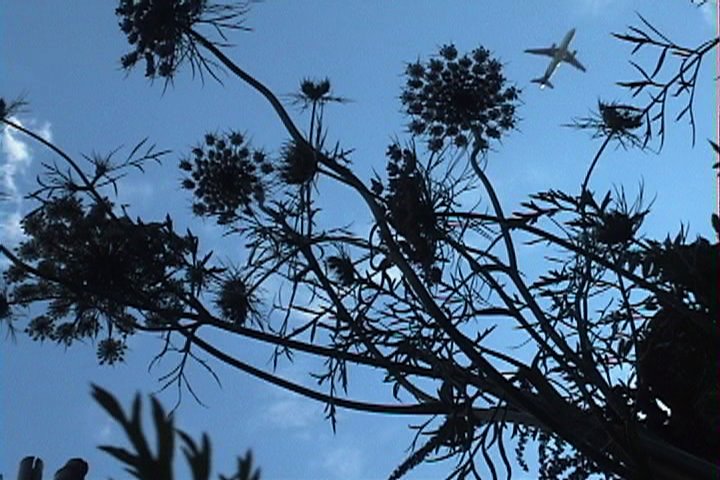 Lynne Sachs showed one of her latest films, Georgic for a Forgotten Planet, last night at ATA, a cultural icon here in San Francisco. The film, like Vergil's Georgic, is a lovely and meditatively poetic paean to agriculture, although, unlike Vergil, the film's focus is on the separation of our citified culture from the husbandry of the earth as well as the separation of our own persons from what surrounds us. I was struck in particular by a number of plaintive shots of the Moon over the city, hardly visible against the streetlights, ignored by those below, a forgotten deity.
 Many of her films center on ecology and our damage of the same and we saw a number of those as well. Also included on the program were the films of her partner Mark Street, including one of his more abstract works titled Winter Wheat, a beautiful bubbling hand-manipulated piece of 16mm art, which took on an environmental urgency in the context of the other films.
But the reason that Georgic is the cynosure of this bit is its use of my first CD in the soundtrack, most noticeably my manipulated music boxes. If memory serves, this is the one that begins the film.
Some of the others from Music of Love are used as well, and some moments of Hagalaz. I'm flattered of course, and happy these sounds have a new life. The actual box, holding the last few guitar picks of a previous life, sits on the piano behind me as I write.
Friday, January 30, 2009
Searching for Fast (formerly notes on the tape music concert on my birthday)
 First night of the SF Tape Music Festival tonight. My colleague Thom Blum premiered a fantastically beautiful and nuanced piece, a state of grace. Aaron Ximm, recent father and former director of my favorite concert series in San Francisco, presented a painfully lovely modification of recordings made of Southeast Asian orchestras.
 Overall, a lovely mix of modern fixed media works and some of the more famous works from the early days of electronic music, many from the first concert of musique concrète - the Concert du Bruits of 1958, my birthyear (and here today is my birthday). Sadly all of the old guard seem to have died in recent years: Pierre Schaeffer, György Ligeti, Vladimir Ussachevsky, but it was surprising to me how similar the old and new pieces were. The rhythms and the range of the sonic variations were quite alike, more amazing given the painstaking methods available in those heady early days: the razors and the tape and the wires and the bouncing and the fiddling with the oscillators, compared with the whiz-bang point and click technologies available to the sound-composer of today.
But what struck me the most was that the aforementioned rhythms, like the rhythms of the classical-to-modern instrumental music that preceded, fell into the range of speech rhythms, nothing happening too slowly or too quickly developing, all of medium tempi. It reminded me of a discussion in Gérard Grisey's composition seminar. It had been noticed that the tempo dimension had been woefully unexplored. But why was it that the European modern music of that time - the mid-80s - was pushing only towards a slower tempo? The harmonic rhythm of his music, like all the spectralists, was by its nature very slow, examining the intra-harmony of all the pitches of a single tone under a time-microscope. Why was no modern music fast? I answered immediately: because that would require a pulse, and pulses had been rejected by the modern musical establishment at the time. It took the music of the minimalists and maximalists and totalists to go back to fast.
When I was writing Little Girl and using bits of pieces of the minimalist language, I noticed the fact - and I wasn't the first, ok? - that passages of eighths could seem much faster than passages of sixteenths, and that the pulse depended on the perceptual rhythmic groupings or perceptual chunks of time. How we perceive these chunks are under the control of any good composer, but these issues stand out very quickly in patterned music, e.g., the Alberti-like arpeggios that attract so many of us. The problem with fast say, totally serialized music, is that without pattern or regular repeated rhythms, even as the notes whiz by ever faster, the brain keeps chunking bigger groups of them to bring the perceived tempo down into familiar territory. It has to be led by the hand into very fast tempi by the use of lots of patterned cues. House music does it, easily hitting 180 bpm, the distinction of genre sometimes falling almost exclusively to the tempo range, but within the limitations of extreme repetition and audiences under the influence of very particular drugs.
And, what is even more interesting about this speeded-up dance music is the concomitantly slow or even nonexistent harmonic rhythm. When writing my orchestral waltzes mentioned in recent posts, I realized that the harmonic rhythm of the famous old 19th century waltzes, e.g. those of the junior Strauss, was much slower than what I typically succumbed to in a waltz feel. Satie-influenced, I've tended to believe in the doctrine of one chord per measure, but that's clearly not the way the Kaiser liked it. But still, the Kaiser and I favor a harmonic rhythm that is within the normal range, that doesn't raise too many skirts up to allow us to see the brutish realities of nature beneath. I remember a composer friend being scolded back in college for too fast of a harmonic rhythm. That struck me strange back then and it still seems odd now. It's easy to make your harmonic rhythm slow - lots of music does that - but it's actually pretty hard to make it fast, and too fast? Well try it - it's not easy. At some point, the brain re-chunks the music to bring it back into the normal range. And, in the tape concert, you could hear an analogous timbral rhythm in all the pieces, old and new, again often falling into the same range.
One technology not so easily available to the old school concrète folks was the multi-speaker spatial diffusion on display, the performance aspect of the fixed media world that also gives us as the audience, sitting in the almost-dark, at least something to watch. The diffusion tended to coerce the primeval recordings into the same sonic world as those more recent. Sometimes, most noticeably for me in the Ussachevsky, it was a bit garish, pushing that piece in particular into a faster spatial rhythm that gave the whole thing a jazzed-up feel. But again, the spatial rhythms never seemed too fast. Even when there was a quick ping-pong-like panning, it was perceived as a gestalt, as a sound with a complex spatial quality, not leading us to tap our toes, not pulling us towards speed and all its dangers.
Subscribe to:
Posts (Atom)


 Posts
Posts


