Sunday, July 19, 2015
Erdős Number of 4
Sunday, February 16, 2014
The Easy Life
I'm sitting in our apartment in Firenze in the former Palazzo Baccio Valori looking out the window at the Duomo. The lights on the monuments have just come on as the sun has set, the last of the bells are dying out, and the mosquitos are now let loose in the city. In the days of the Medici, the mosquitos were fierce and malarial, but in the modern age they move slowly, engorged on drunken tourists. We sometimes find the opportunity to dissect them, not with scalpel but with shoe or paperback or oven mitt, and this is ok, the way of things, and with some touch-up paint we can remove their little lives from history, much as we ourselves will disappear one day, when our great-great or great-great-great grandchildren, cleaning the urns on the mantel, no longer remember which urn is which and whether this one is great granduncle Teddy and maybe they need to make some room for more hyper-photos of people they do remember, at which point one hopes that enough life force has endured in those remains to give them just the slightest jolt as they toss you out into the mulched hyper-roses causing them to trip and fall into the pond.
Like so many of those who wish not to be tossed into the hyper-roses, I have vainly attempted to leave a mark on the world. My CV goes on a bit, and although we are constantly reminded of those who have accomplished so very much more, I do take it out of the old box of clippings and read it from time to time, along with all the fading notices of my time on the stage, the limelight and the girls on shoulders of boys and the applause. I was doing this just the other day in fact, and came across Joshua Kosman's article on me from a few years back and found this bit:
At 50, he has the amiable demeanor of a practiced collaborator and the buzzing nervous energy of someone with a long history of getting twice as much done in a day as the rest of us.Is that true? I've always thought of myself as fundamentally lazy and fundamentally not so bright. When I was an underage boy at Caltech, freshly deflowered and still wet behind the ears, I met people whose brains seemed to be running at a speed I could not imagine, and I spent most of my time drinking and sleeping all day and skipping class, but I remember that my friend Billy B. was envious about how much I got done even with all the drinking and sleeping through class, so maybe he felt the same. And in my later years - in graduate school and in the working world - I've been pretty sure that I am in fact a fraud, just clever enough to hide my inadequacies and hoodwink everyone around me, the snake oil salesman in their midst, somehow able to knock something together that works, and as long as no one looks too closely for the shoddiness (and don't even talk to me about my doctoral thesis) one might miss it, but luckily I've been able to find jobs where such slipshod work is enough to get by, and fortunately I'm not building airplanes or pacemakers or nuclear bombs.
Of course I know of the inverse Dunning-Kruger effect, but just knowing that that effect doesn't help you - you yourself can't tell if you are an actually competent person who downplays their abilities or if you are simply mediocre.
But there is the other side, the looming shadow-side of the self-thought-to-be-incompetent Wold boy, the one who secretly thinks that he is smarter than everyone else, who wants everyone to know, who carries intellectual books about with covers displayed so that others can see, who does look through the aforementioned box and remembers that he did fight long and hard for those Scholar of the Year awards, printed on fake parchment, remembering too that when he was called up to the podium to receive the first one, his name was proceeded by "and now for the Freshman girls" and although he wasn't quite yet the cross dresser he would later become, his hair was well down his back and that did earn him some cheek-reddening catcalls from construction workers on his way to school. And then there are those moments when, expecting that well of course everyone knows this or understands that, he discovers with mind-splitting incredulity that people he assumed were as competent as he is actually don't understand some bit of mathematics so totally obvious and straightforward, or find Ulysses "too hard," or haven't read the vi or emacs manual and learned all the arcane details, or whatever else he can hold over everyone's head, even though some of accomplishments actually were kind of hard back when he faced them himself but seem so easy now in retrospect. And all of this happens in both aspects of his life, the science-y math-y engineering-y bits and the art-y music-y literature-y bits.
But even writing this now brings the fear on for the Wold boy, the fear that he is one of those people to whom Dunning-Kruger really does apply, who worries above everything, even that maybe he is worse than stupid, maybe he is actually delusional, as in delusions-of-grandeur delusional. So we'll set that aside for a time when the room isn't so dark and the candles aren't guttering.
What I really wanted to talk about here - and the reason for the photo of the totally gorgeous telescopes in the Galileo Museum above - is the epiphany I had the other day while walking through this beautiful city, which is that, even though I've come out in some ways, although in the article above there is this bit:
Wold is a little reticent about his sexual autobiography, despite the fact that his Web site identifies him as a composer, producer of operas, and "libertine." He volunteers only that after his divorce, he moved across the bay in part out of an attraction to San Francisco's gay scene - despite the fact that he is, by his own description, "queer but not gay."and finding this bit the other day made me wonder if I'd ever actually read the whole interview, as I didn't remember it at all, but as I was saying, even though I've come out in some ways, I tend to avoid coming out as an engineer/math guy to the art world and as an art/lit guy to the engineering world, thinking that somehow there is a stigma of un-seriousness about being one to the other, but my epiphany the other day was that there is of course no stigma, not the slightest at all. The Galileo Museum is filled with objects that are both gorgeously scientific and gorgeously artistic, and being here in goddamned Firenze makes one remember that we intellectual types used to gather to make decisions about all aspects of the world and that article one on the agendum list that afternoon might be do mathematical objects exist in a Platonic reality of their own and article two might be be shouldn't we create a whole new art form? Leonardo was given a commission one day to paint the adoration of the magi or whatever and then the next day hired to figure out better methods to slaughter the good citizens of Pisa and it didn't seem to matter to either commissioner about the other. So where did that change? Or is this perceived stigma just my own problem? Hey, that reminds me that I did in fact work on a weapons system once, a parallel-pipeline FFT processor inside the F-16 or maybe it was the -15 radar, being built by Westinghouse Electric Corp, and I had published a paper on fast parallel-pipeline FFT construction, so was the go to guy, and I needed some money because I was a poor graduate student and like everyone else whose hands are bloodied for some bit of money, I just had to wash them with a little bit stiffer brush when I got home in the evenings, and I wonder now if they still would have hired me if I had told them about the other stuff, the settings of the Antonin Artaud poems and the readings of the Kathy Acker books and suchlike.
Oh wait, that reminds me of the other bit that gnaws at me - the piece of paper that says whether you are capable of doing a job - a notion that is so obviously crazy that one wonders how it even got started. I remember years ago reading some nonsense by Charles Wuorinen (note I may be misremembering this and maybe it was someone else but whatever, it's my memory so there) about how Charles Ives couldn't be that good a composer because he didn't really have that much schooling. Hey, I have a PhD but the only reason I have it is because 1) one of my first girlfriends basically dared me to do it and 2) I didn't really like having a real job. Smart people can do smart things regardless of the particulars, and having the piece of paper doesn't even say that much anyway. I'll tell you the simple way to figure out whether someone is capable of doing something - ready? - have them actually do it. The best engineering/math work I did in graduate school wasn't even for my thesis, and almost none of what I do now was what I studied then - in art or the other.
And finally there is the last part of the engineering/art equation or should I say minuet, and the basis of the title of this essay: money. It's the weird and strange specter of the art world, a world in which no one has enough unless they inherited it from someone or they happened to be one of the lucky few that connected with the mass market, or they have a day job. Engineering gives me the easy life, and pays for this trip to Firenze, and gives me the support to do my art, and asks only that I work all the fucking time, day and night, never to see the beauty of summer, never knowing the joy of a day wasted without care.
Friday, November 27, 2009
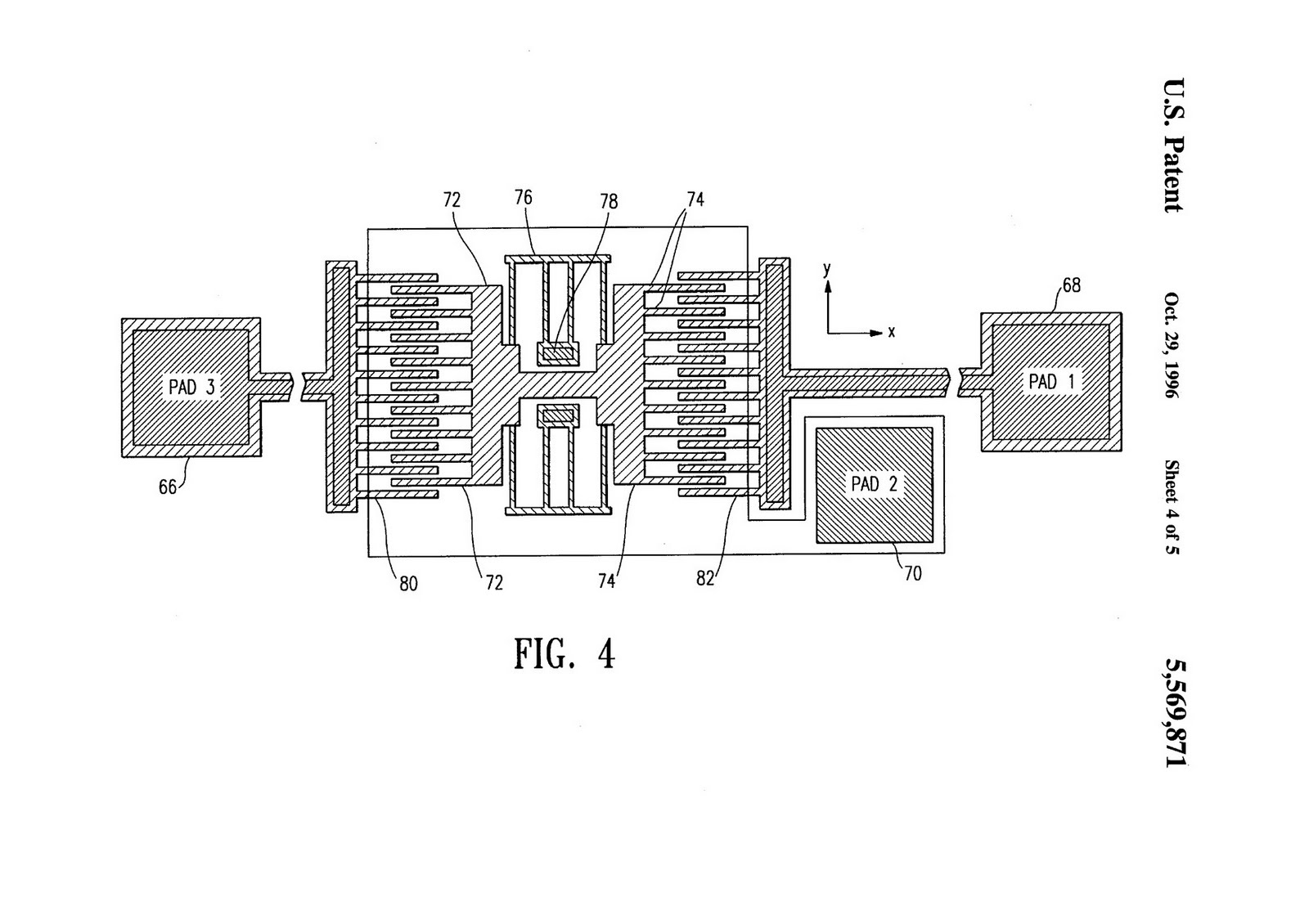
Patent Microresonators
Wednesday, August 12, 2009
Bletchley Park etc
The life that I haveIs all that I haveAnd the life that I haveIs yoursThe love that I haveOf the life that I haveIs yours and yours and yours.A sleep I shall haveA rest I shall haveYet death will be but a pauseFor the peace of my yearsIn the long green grassWill be yours and yours and yours.
Monday, August 4, 2008
Oscar Aszer Zelig Leneman
Even time has passed such that we, the belowmentioned, have gone on to our final remuneration or, as it were, our final judgement and, sitting at the hopefully rightmost hand of our omniscient and omnipresent maker, we will have to explain and make right to the throngéd celestial multitudes. Let us further note that the following is absolutely a work of fiction and that any similarities to persons living or dead is purely coincidental, etc.
Anywho, back in graduate school I fell in love (and let us be absolutely clear that this was a higher love - a chaste and perfect love) with a young man who, for want of a better sobriquet, we shall call Mark and who, one day many years later called me to attend the opening of Spawn, whereupon I waited in front of the Kabuki theater with the other unwashed until his limo arrived, spilling him, an assemblage of beautiful young things and a quantity of white powder onto the sidewalk, at which I, his heartbroken friend, was pushed into the gutter by his handlers and so onwards.
But, in my nervous and naive youth, Mark was a dream lover (platonic) and, while he was surely an harbinger of the many evil things to come, I drank deeply, ferociously, from the cup he offered. We were inseparable, sharing everything, making plans for our life together.
Mark was writing a thesis on antialiasing in computer graphics, at the time a fledgling field of study. He came to me one day after reading a paper by Yellot on the Poisson disk distribution of receptors in the eye and wondered if this seemingly haphazard array might have something to do with the lack of aliasing in the human visual system. We thought about it a bit; it made sense, since spectral aliases come from convolution in the frequency domain of the regularly spaced delta functions which are the transform of a regular sampling function. An irregular sampling function would clearly do something quite different, but what exactly? We fretted and suggested and made some mathematical attempts but Mark came across a paper by our savior, our Messiah, the Alpha and Omega man whose name fills the title of this entry: Oscar Aszer Zelig Leneman. Ah, what words, what ideas. We let them flow across us like new buttered honey over a sweet biscuit. In this paper, he laid it all out, a clear approach to determining the spectral noise of a wide variety of stochastic sampling patterns, including the Poisson disk but also many others. We saw how, by engineering the density function, one could improve the results, to spread the noise optimally to areas of minimal sensitivity of the eye, a clear indication of the Gnostic program, the mediocrity of the flawed Demiurgical God of the Old Testament compared to the higher consciousness of man. We found that a simple uniform jitter of the sampling point process by 50% of the mean sampling interval did extremely well. We thereupon danced an ecstatic gambol and wrote our first paper, Antialiasing through Stochastic Sampling, to be published and presented in SIGGRAPH '85 and Mark, in honor and gratitude, changed his middle name to that of our god.
However, as it turned out, another group at Pixar led by Rob Cook had been working on something similar and, as it also turned out, predated us but also, as it happened, had been in communication with Brian Barsky, Mark's ostensible research advisor who had advised them not to publish in SIGGRAPH '85 but rather in his journal, the Association for Computer Machinery's Transactions on Graphics which, he hoped, would replace SIGGRAPH as the Journal Of Record for the field, possibly detracting a bit from the brio and vivacity of the rough and tumble conference scene but lending the field a bit more of the staid orderliness that comes with a proper science. Unfortunately, the staid orderliness of TOG (as it was known to its friends) was chastened by the fact that its production was about a year behind schedule, meaning that their paper would come out so much later than ours as to be embarrassing. When the Pixar folks discovered our paper's imminent arrival - maybe because they were asked to referee, they 'smelled a rat' and assumed that Dr Barsky was 'fucking them over' to favor the advancement of his own soon-to-be newly minted PhD, a possibly not totally unreasonable position given the well-known dog-eat-dog nature of the academy, and they called him and may-or-may-not have explicitly accused him of said conspiracy. Mark and I, obviously, were delighted by the turn of events. A scrap, a brawl, a rumble between our society of distinguished scholars and the korporate brutes outside its containment shield. Hop la! And they were so concerned with it all! While we just saw it as a pleasant diversion. A bit of fun mathematics, a bit of fun programming, a chance to put little animal heads with exposed Brains into the text of our paper and our usual fantastic acknowledgement section with occult holocaust references and fake bibliography (e.g., Crash by J. G. Ballard), tickling the powers above.
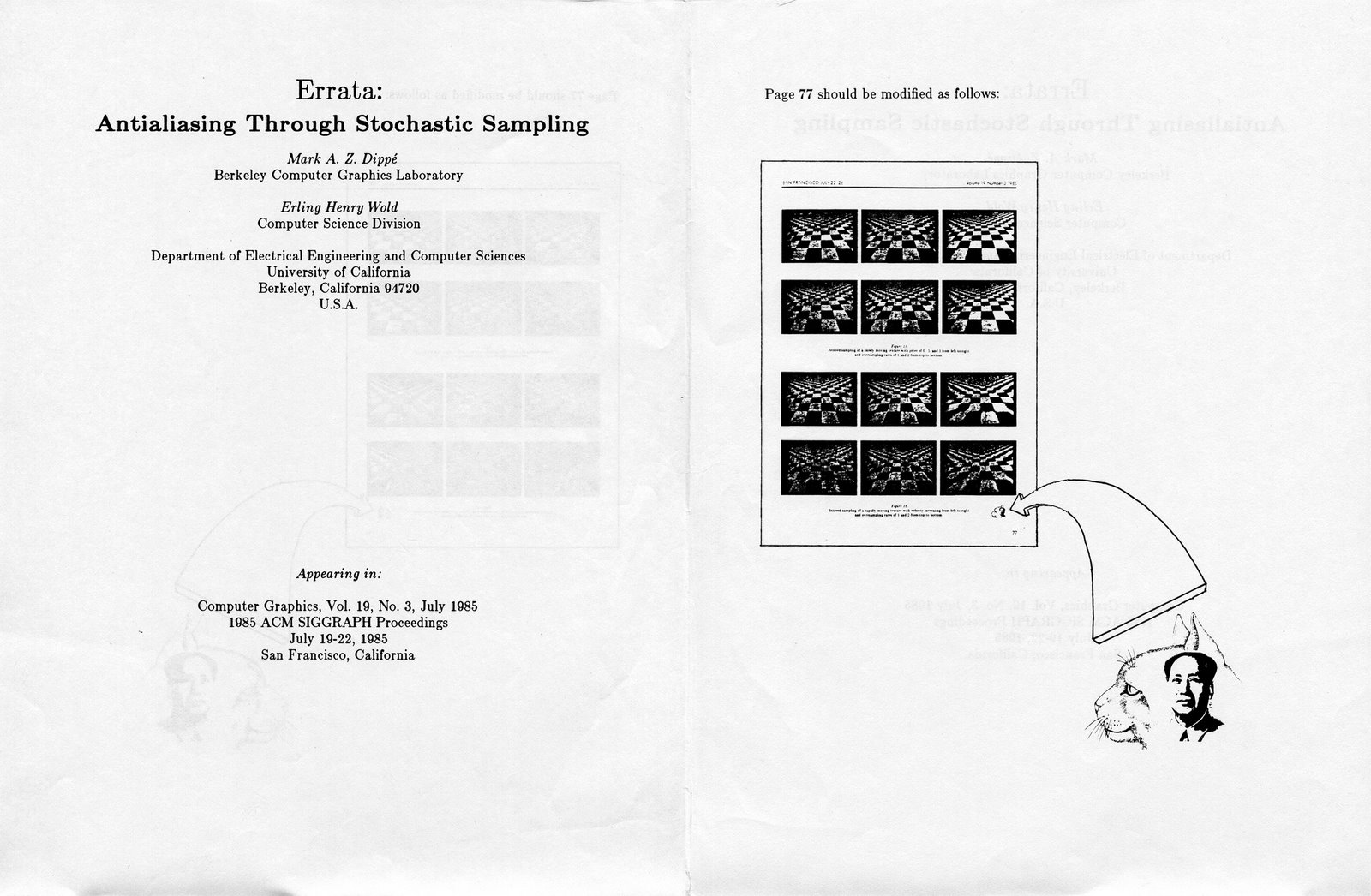
And, oh my oh my, those powers above censored one of the brains! To wit, the most beautiful cat brain on page 77 of the proceedings, our coup de théâtre, that which would launch us into the Pantheon of the great minds of our generation. Happy to have our own reason to be incensed, we prepared a volley and launched it against the ACM's so-called Special Interest Group. We printed up a great number of errata sheets, like so:
and passed them out amongst the multitudes of attendees, who dutifully took them and, ah joy of joys, dutifully looked up page 77 and placed them carefully inside, like the great Stalin's replacement of Beria in the Soviet encyclopedias with extended articles on the Bering Sea. We presented our paper to great acclaim, took our bows, and soon the Cook paper, Stochastic sampling in computer graphics, arrived in due course in the January '86 issue of TOG, his feathers having been smoothed by a contrite and ignorance-claiming (the simple truth) Dr "Brain" Barsky.
La la la. That could have been it, but we, suckled as we were on the sweet cream of de Sade, Survival Research Laboratories and the Kipper Kids dancing on broken glass, well, we couldn't just leave it alone, could we? And of course, we had in fact been asked, as the putative experts in the field, to referee the Cook paper, written before ours but oh so joyously presented for publication after, and maybe, just maybe, cleaned up a tiny tad. And we found problems with it. Hoo boy did we. It was hardly up to our fetishistic notions of proper academic-ness. How could it be? In our self-love and self-admiration, we had achieved the pinnacle and the rest of the world lay far below. While our phony bibliography was a work of the highest art, Cook's bibliography had the audacity to reference a Benjamin Franklin paper on magic squares, which they used as stochastic generators with no foundation, none of the mathematical underpinnings of our masterwork, only pictures which "looked good" (and they did look good at that.) We demanded that they reference our paper, being a seminal publication in the field, and we criticized and criticized and gave them low marks as we knew the paper would be published anyway. And wen it finally was a-borned, would we, could we, allow the dead horse to lie unbeaten? No, absolutely not, and we fired off an angry reply to the editor, a brilliantly worded rejoinder which led to a another rebuttal and the fun continued until we finally, our last bit of sperm spent across the face, fell back and slept, the deep and well-deserved sleep of the just and right and meek.
In the end, both papers have been cited quite a bit. We discovered quite happily that Oscar Leneman was a bit of a worldly fellow, having left the engineering profession after publishing the above pictured erotic illustrated fairy tale to deal in South Asian artifacts. Pixar got the patent on stochastic sampling, now expired, which we were once asked to help challenge in court, but declined, having gone on to better things: girls and drugs and Hollywood and the exciting world of The Opera and its ins and outs. Our math was used in textbooks as it was actually correct, but the weird Judeo-Islamo-Christian preoccupation with the one true God and the way He and His angels designed the eye in all its glory still seems to fascinate and lead people to the Poisson disk distribution even though it doesn't work so well and is in general harder to compute. Going up against God and His angels is of course difficult for mortal men, as hard as fighting City Hall, and doesn't really get one girls and drugs so in the end who cares?