Thursday, July 23, 2009

Duncan Wold's score for In Residence

My son, showing that he is a child of the same Adam, has constructed a heavenly collection of musical fragments, a Soundscape for a Nonexistent Motion Picture, but which, by its synopsis, makes one strongly wish for its actual production:
This haunting film is not for the faint of heart — or the claustrophobic. We are presented with Jane, an artist who begins a residency at a strange home filled with junk. Her goal is to fashion the detritus into a piece of artwork speaking to the theme of recycling and ‘green’ building practices. But things get twisted when the junk compels her to construct an elaborate and, at times, beautiful trap for herself, which she slowly begins to realize is locking her in, pressing her downward into infinite, interlocking chambers. Even as she becomes more entangled in the web of the house, it begins to provide her with sustenance necessary to continue her work.
— Dina Bloomberg, Down the Rabbit Hole Zine
Tuning in the radio station here, at about eleven and half megaHertz on the dial, we are transported into Jane's world, fading into an imagined natural ambiance, shifting, drawing us into a composition where an ebowed guitar caresses a set of melancholy changes. Of course I'm proud of him, and I tear up a bit when I think of my polymath heir, creator of so many beautiful things, another being Shit Show V, soon to be revealed.

Wednesday, July 8, 2009

I have nothing to wear and I am wearing it

and that is poetry, in this case the poetry of Bunnywhiskers resting her tired coney body after a day's hunting and being hunted, me the eternal gentleman.

Saturday, July 4, 2009

Teddy

I have been fortunate enough in my career to have a few people get very excited about a few works of mine, an heartwarming occurrence. Although, two people that I respect awfully have chosen atypical and offhand works of mine from the mid 80s as their favorites. One was a theatrical work based on a game between the San Francisco 49ers and the Denver Broncos during the Joe Montana glory years, written with Everett Shock, and featuring a recitation of a declaration, aided by an overheard projector on which the declaimer laid out an Xs and Os play-by-play, in the style of the Declaration of Independence (a memory fitting this day of all days), but commencing with the line "when, in the course of a football game, it becomes necessary for one team" and so on.

But the other venture, which has been favorited by more than one of my erstwhile fans, was a small piece done in a small venue in Oakland, where I performed a duet with a Teddy Ruxpin® which centered on themes of objectophilia and robot sex in the modern world. In fact, the exact animatronic doll sitting on my desk today in the photo above being prepared for a comeback tour of sorts next month. You can see the blue pulse timing modulation box I built back in my 'maker' days to control its servos and to allow me to make my own, more sophisticated control tapes. My son, who was about 2 at the time, loved it, although it's possible that some of the themes may have gone over his head. He giggled all through the preceding performance that evening, in which a topless and somewhat buxom young butoh dancer, powdered in white, completed, in about ten minutes, a short walk down an incline.

Since the script was quite short, I reproduce it here for your amusement. As my wife was the voice actor for the bear, I performed a small transgendering of Teddy to Trary, and put a bit of ribbon in his hair.

TRARY
(Sings) Come dream with me tonight. (Speaks) Hi, my name is Trary Razkovky. Can you and I be friends? I really enjoy talking to people. In fact, some people have told me I have a problem that way, but I don't count these people among my friends. And I do have many many friends.
I would very much like you to meet one of my very good friends. Say hello to everyone, Erling.

ERLING
Hello.

TRARY
What do you have there with you, Erling?

ERLING
It's an accordion, Trary.

TRARY
It is a very fine looking instrument, Erling. (Pauses) Can you come a little closer, my friend?

ERLING
Sure. (moves closer)

TRARY
(After a while) I'd like to talk to you about something, Erling, if that's all right.

ERLING
Fine.

TRARY
I read a story in the newspaper.

ERLING
What was it about?

TRARY
A very fine car dealership in St. Louis, Missouri had a contest. The dealership was to give to the winner a brand new Toyota. The single rule of this contest and the objective of those who participated was to kiss the car longer than anyone else. Of course, I was concerned for these people. How would they go to the bathroom? How would they eat or drink? People need companionship too, but I guess they were kissing the car, after all. Luckily, the very wise people at the car dealership had thought of this. They gave each person a few minutes off every hour to take care of the things that they had to.

ERLING
So who won, Trary?

TRARY
A woman won. Her name was Ellen J. Twaddle. She won by kissing the car for 110 hours, longer than anyone else who tried.

ERLING
That's an amazing story, Trary.

Um, why did you bring it up?

TRARY
Well, I began to wonder. How does she feel about the car she has won by kissing it for so long?

ERLING
I don't know.

TRARY
Well, wouldn't she be more attracted to it?

ERLING
Maybe.

TRARY
Maybe it would seem a little more animate? Wouldn't there be, well, a cognitive dissonance in kissing something for so long that one saw as inanimate?

ERLING
Yes, I think you're right, Trary. If she had seen it as inanimate, she would be repulsed, not attracted.

TRARY
That's right, Erling. But she stayed. She even lost her job. Her company was upset with her when they found out why she had been calling in sick for five days.

ERLING
That's quite a sacrifice.
(pause)

TRARY
Would you kiss me, Erling?

ERLING
Sure. (Erling kisses Trary for a long time)

TRARY
(mumbling through the kiss) I hope you see me in a new light.

ERLING
(drawing back) What was that?

TRARY
I said, "That was nice."

I think I am in the mood to sing a song for all the people here. Could you accompany me on the accordion, Erling?

ERLING
Sure. (Trary and Erling perform The Second Prayer from A Little Girl Dreams of Taking the Veil.)

Saturday, June 20, 2009

Denisova-Kornienko Duo

I met Elena and Alexei when they performed in the 2001 Austrian production of A Little Girl Dreams of Taking the Veil, Alexei on the podium and Elena covering the viola, my favorite bit of which is the brief and registrally displaced but oh so beautiful solo here:

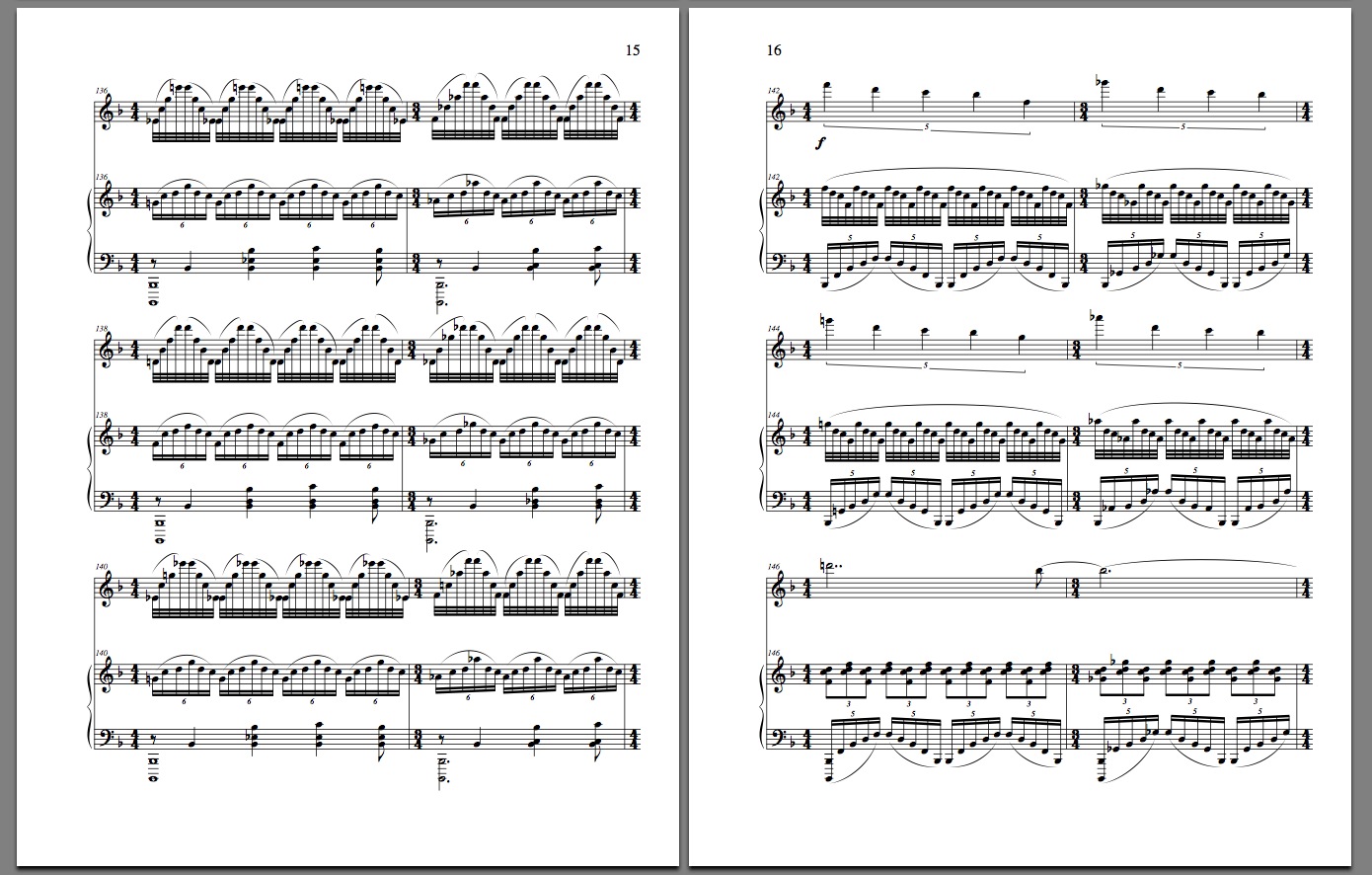
I had promised them a piece in their roles as the members of a violin-piano duo, and this for many years, giving them only one small number that was a simply bit of program music, an old man dies, a vision of my own death as an old man, gasping for breath but all the while still dreaming of a breast, the iconic breast of a woman. However, I finally forced myself to sit down and write something, not asking them if they still cared or wanted the heavy responsibility of another piece dedicated to them, this one not quite so simple. This spicy opus, The Secret of Success, a reference to a blog entry here by the same name, is subtitled a chaconne, because it is, at least a bit, and in the modern meaning as a set of variations on a repeating harmonic progression, in this case a series of chords rooted on Bb, a combinatorial set that treads between major and minor, similar to those I have used before: once in The Bed You Sleep In and once in the Cotter episode in Queer. The piano plays incessantly, often verbosely, and typically the harmonic changes happen right on the measure line, one per measure, violin and piano almost always changing together, something that Kyle Gann would probably find crazy making. From a recent post of his that was on my mind while I was scribbling:
When I see a kid composing in units of measure, measure, measure, with a new impetus, new phrase, new harmony on every downbeat, I start in with my wheedling tone (every experienced composition student will recognize the sound): "How about a triple upbeat to start that melody off a little more gracefully?" "How about we vary the harmonic rhythm here?" "You think the audience can't hear where your bar-lines are if you don't accent every one?"
Luckily we live in an artistic world where there is no wrong or right, where we each do what we like, even though it might drive our colleagues to distraction. The whole score is on my website, but here's a bit of it:


Serb Cutter

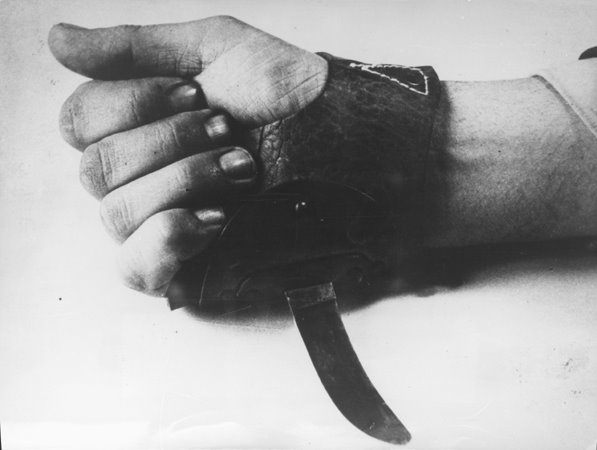
My beloved foreign correspondent sent me a note this morning reminding me of some of the more brutal of the brutalities of the last Great European war. He found it as he was researching a new novel which has something to do with the concentration camps in the Balkans, but it also reminded me of a story. Around the time when the event more recent troubles began in the region, my friend Mark Dippé was visiting some Serb friends in Sarajevo. At the moment they heard that their Serb brothers and sisters had launched a campaign of slaughter against their Croat brothers and sisters, he said that they, seemingly modern and reasonable people up to that point, literally jumped up with joy at the opportunity to grab their weapons and get to killing. It is of course hard for us, civilized with our mountains of McDonald's and hundreds of channels of TV, to understand such depth of hatred, but my correspondent's link did explain just a bit of it. It's just a small thing, the above device, a Srbosjek, or "Serb cutter," but it represents so much, and was invented by the Ustaše - Croatian Revolutionary Movement - as a way to efficiently slit the throats of captured Serbs, of which there were very very many, while engendering in the murderer as little fatigue as possible.

Saturday, June 13, 2009

Night and fog

Tonight is the night, and the SFCCO players are sounding good. A few complaints and threatened defections from the orchestra over the fog, but they are into it, what started as a stretch has now become commonplace. And I'm so happy to get my noise self out. Michael Cooke has told me it's his favorite piece of mine ever, and he's heard a lot. It is to go on the shelf with other obscure pieces of mine (the 49ers opera, the Trary Ruxpin accordion duets) that have become my friends' favorites?

The Artist as a Young Whore

I was asked to participate this morning in a paid interview - in cash, in the form a single piece of currency: the bill with the drunken general and the corrupt president - by the San Francisco Foundation, and it got me to thinking about my whorish nature, a term I use with the ultimate in positive connotations, as many whores are counted among my best friends, and I can only aspire to such clear thinking and take-charged-ness.

Anywho, getting to the point, it's clear that artists have always been quick to leech onto whomever is in power, regardless of their goodness or badness, in order to live their lives of dissipation, shrouding their selfish wants in pseudo-mystical-art-feeds-the-soul bologna. I'm reminded how, in de imperio tertio, we find the same willingness to suck at the monied teat of the all-father to further one's career, although, in the case which came to mind, it may not have been the best choice career-wise. Heinrich Hoffman, who became more-or-less the official photographer of the Führer, took the photograph above and many others, note especially those Hitler suffering the little Aryan Children to come unto him, but who, after the war, was imprisoned for profiteering and who had all his photographs seized and put into the US National Archives, the images themselves consigned to the public domain.

Leni Riefenstahl, shown naked above, who also had all her work expropriated by the incoming GIs, was never quite able to lie her way out of the stigma of being infatuated with the Nazis and Nazi ideals and, even though she was clearly one of the greatest aestheticians in the early days of the new art form, she was rejected by the world she and her friends had abused, project after project denied after the war. But she saw the slaughter of the Kinsk civilians, she chose the particular slave Gypsies for her films, she allowed them to be shipped to Auschwitz, she knew what was to happen to them but she litigated against all who said so, indefatigably, during her long long life. And who can forget Albert Speer, the one who apologized, but who was also only to eager to be seduced by the power and the money and the evil structure of which he became a part.

But I suppose the difference is that the artists of the US of today are happy to take the blood money and spend it biting the hand that fed them, and feeling entitled to the privilege all the same.

Sunday, May 17, 2009

Intuitionism

Bath-time this morning was facilitated by an iPhone 3G® in a Ziploc® bag - thanks to my friend Nicole for enlightening me of this wonderful invention - and a circuitous path through those intoxicating days early in the last century where Hilbert and Brouwer led the fight over the non-finitary law of the excluded middle (see photo) and other such issues.

As a boy, I was so interested in all of this. The issues seemed so important and, later, as I became a composer, I faced them again, feeling a pressure from above to maintain an intellectually rigorous Germanic methodology in all my musical decision making, a certain belief promulgated by my betters that there was a notion of music that existed in a Platonist reality where deep truths live separate from the dirty business of breath and bows and spit and turntables and stylish hairdos, and that compositional progress was in the furtherance of passage toward this Utopian Ideal.

But I was, deep down, more tolerant, and shall we say more Dutch, and believed that music really was purely an act committed by people for their own amusement, that it existed in this world and not the other, and that it had benefits beyond an explication of existence, namely (0) transcendental beauty here on earth (1) encouraging teen pregnancy through passionate embrace (2) a devil-may-care use of drugs (3) hearing impairment in the elderly (4) separation of fools from their money (5) penis casting (6) nonpareil spirituality and mystical joy (7) creative jouissance (8) and so on, and that music was concerned with the grit and chaos and noise of sound, and that it was, at its core, an inexplicable and impenetrable pursuit, evading all attempts to capture it, drop it in the killing jar, and to pin its beautiful wings to the setting board. The theories I learned as a student did not attempt to cover anything except what I found to be the most superficial aspects of music, the voices and pitches and rhythms, and I was left to find the rest myself.

One of the reasons I started writing - English rather than notes - was to try to explain what I did day-by-day during the compositional process, thinking that in so doing I might capture the uncapturable. But I've failed every time that I have tried. I can't really say easily what I do. There is no process to speak of, and the moments spent in the compositional state sneak by unseen to end up in a piece that I no longer feel my own.

Friday, May 15, 2009

"But at least they dressed well"

As a young boy on the Great Plains, gorged on a constant diet of WWII war movies and television, my friends and I would get together with our BB guns and cherry-bombs to be mini-reënactors, and, in our innocence, who would we vie to be? The sloppy GI with perpetual cigarette hanging out of his mouth, unshaven? Hardly! No, we fought for the right to click our heels, to salute, to wear the smartly trimmed Hugo Boss designed and built SS uniforms, to carry an imaginary Feldmarschall's baton, and to speak in a clipped Germanesque pidgin, the hint of a saber cut on our cheek, the monocle, the goose-step.

As children, we could be forgiven, having no idea of the signification of our choice. But many elect to continue this into adulthood, as its very taboo nature titillates and appeals, from the Korean ad above (video here), to Nazi themed restaurants, to the Nazi Chic, to those too interested in the paraphernalia of the Reich. What to make of these fallen and so foolish fellow humans? Have they forgotten or merely never learned that the fascist path, while seeming to wander along an alpine meadow, dotted here and there with some wildflowers, leads to the cliff or to the bear or to both?

Score Directions

The score is done, the parts have been shipped away once again, and, while usually one for absolute control - a chimera at best - I have abrogated my responsibility as a Komponist to allow the so-called performers a bit of leeway, one arm unbound from the straightjacket, a rest from the hamster wheel, the industrialist lightening for the moment the blows on the backs of the restive workers, but this philosophical change of heart, like most, has come from expediency rather than deep thought, as my compositional laziness seems to increase year upon year. I remember a day in the not so distant past where, to begin the simplest of tunes, I first had to build the instruments, sawing and sanding into the wee-est hours to the ire of my roommates, decide on a tuning, and, locked in my slattering studio, learn to play the aforementioned devices or at the least to coax a sound. But now my compositional life has settled into a pattern: (1) agree to a deadline (2) wait until the last possible moment (3) use every shortcut, trick, careless theft and accident to produce something as quick as possible. I had lunch with my friend and co-producer Paul Dresher the other day and had to hide my head in shame after listening to him describe the months of preparation on Shick Machine, building the instruments, learning to ... yes, you get the idea, everything I had been, and revealing to all the shadow I have become.

Wednesday, May 13, 2009

In the Stomachs of Fleas


We, that is, fognozzle and Erling Wold, present for you a tale of fear, horror, xenophobia, political posturing and denial, all contained within a musical program piece of sorts, a savage delight for the senses and an allegory for today, this and that and the other thrown into the pot of narrative and boiled up into a scenario as follows:

The Australia steamed into San Francisco in 1899, carrying corpses and rats infected with the plague. Between 1900 and 1904, one hundred twenty-six people contracted the disease in San Francisco and environs. One hundred twenty-two of them died while the governor denied the very existence of the plague and the press blamed the Chinese for spreading it.

The plague was brought under control in 1904, only to resurface in 1906 as the great earthquake displaced the human and rat population. The response to this second outbreak was dealt with more efficiently as the causes were better understood, but one hundred eighty people died of the plague in San Francisco between 1906 and 1909.

Fortunately, Xenopsylla cheopis (the Oriental rat flea) never secured a foothold in San Francisco, and our dominant flea remained Ceratophyllus fasciatus, which lacked the deep stomach required for effective plague transmission. Many more people would have died if the reverse had been true.

Unfortunately, the rat-eradication efforts during the San Francisco plague outbreaks did not extend to the squirrels of the East Bay. Through them, the bubonic plague established a permanent foothold in the Pacific Northwest, where it lives on today - in the stomachs of fleas.

SAN FRANCISCO COMPOSERS CHAMBER ORCHESTRA
and Old First Concerts Present:
DREAMS OF THE RESTLESS
Saturday June 13th, 2009 at 8 pm
Old First Presbyterian Church
1751 Sacramento Street/Van Ness, San Francisco, CA 94109
$15 General, $12 Seniors (65 and older), $12 Full Time Students

Tuesday, May 5, 2009

Hitler fascination

Our roving correspondent Milky recently sent to your faithful editor this well-crafted portrait of an idealized and supah sexy Hitler. As I pondered it, daydreaming of a personal yet elusive fame that would cause someone somewhere and at sometime to render me, even in a fleeting imaginative fancy, with such a magnetic physique, I was reminded of the mystical allure that HH held over his people. Thousands of love letters received during his brief time as the duly elected leader of his fawning people are full of amusing quotes:

I would like to make you my little puppy my dear, my eternal, my lovely Adolf.
I am making you keys to my front door and my room. We have to be very careful. So come early, ring my landlady's bell and ask if I'm at home. If everything works out, my parents (they could be your in-laws) say you can come any time, so we can spend the night together at my parents' house!
They eroticize the relationship we have to power and fame, of the mystical love we shower on iconic figures, our kings and queens du jour, finding ourselves wishing for a Daniel Day-Lewis or a Mary Kate-Olsen to pin us to the floor, us dressed in nothing but a little leather cap and some latex underpants, bringing upon us an orgasmic religious ecstasy quite like that experienced at full tilt towards a passionate Christ-as-not-only-spiritual-husband by St Theresa of the Little Flowers. Although the photo above shows the young sex-kitten-version of the conquering collective cultural hero cum super-ego, we wonder if, as he aged, he took on the immediate character of the father figure, more directly replacing the father- and husband-protectors lost in the seething tides of the harsh and endless war. And, once satiated, bitten, spanked and altogether sexed-up, we might warmly turn over, spooning, and, our minds drifting, light upon the kitler meme and thereupon sleep the blissful and ne'er to be interrupted sleep of those just and unstained.

Friday, April 24, 2009

Geburtstag

My follower Milky chided me last evening at the Throbbing Gristle event here in San Francisco for somehow not paying proper obeisance to the event of A.H.'s birthday last Monday, but it's actually quite important for me that this set of notes on a particular cultural preoccupation doesn't become what it purports to analyze, a fetishistic love-fest of a brutal regime, ending in a place I can only just imagine: where the cleaning lady finds me one day, swinging by the neck, raised aloft by an elaborate pulley system, cold to the touch, wearing only a pair of vinyl briefs and a gas mask, surrounded by pornographic magazines open to their most German images. We'll leave that end to those who really do enjoy such things, the likes of Motor Racing Bosses and Princes of the Realm.

But, while on the topic, we find here:
A report by Ofsted, which expressed concern that secondary pupils were repeatedly studying Hitler is part of a wider debate about the nature of Britain's enduring obsession. Those concerned at the ubiquity of the Third Reich in the history classroom and beyond to the nation's bookshops and living rooms fear it stunts understanding of other periods and leads to an unhealthy personality cult.

On the opposite side of the argument there are those who point to the monstrosity of the Nazi regime and its leader, arguing that it is difficult to run out of important issues relating to Hitler to highlight to the wider population.
And to which I can add only that it is difficult to run out of unimportant issues as well.

Sunday, April 19, 2009

JG Ballard, dead today

Crash, a dance written under his influence, the score for the last section above, a recording of the entirety below.


from the book:
I stood with my feet apart, hands on my breast bone, inhaling the floodlit air. I could feel my wounds again, cutting through my chest and knees. I searched for my scars, those tender lesions that now gave off an exquisite and warming pain. My body glowed from these points, like a resurrected man basking in the healed injuries that had brought about his first death.

Sunday, April 12, 2009

Georgic for a Forgotten Planet

Lynne Sachs showed one of her latest films, Georgic for a Forgotten Planet, last night at ATA, a cultural icon here in San Francisco. The film, like Vergil's Georgic, is a lovely and meditatively poetic paean to agriculture, although, unlike Vergil, the film's focus is on the separation of our citified culture from the husbandry of the earth as well as the separation of our own persons from what surrounds us. I was struck in particular by a number of plaintive shots of the Moon over the city, hardly visible against the streetlights, ignored by those below, a forgotten deity.

Many of her films center on ecology and our damage of the same and we saw a number of those as well. Also included on the program were the films of her partner Mark Street, including one of his more abstract works titled Winter Wheat, a beautiful bubbling hand-manipulated piece of 16mm art, which took on an environmental urgency in the context of the other films.

But the reason that Georgic is the cynosure of this bit is its use of my first CD in the soundtrack, most noticeably my manipulated music boxes. If memory serves, this is the one that begins the film.


Some of the others from Music of Love are used as well, and some moments of Hagalaz. I'm flattered of course, and happy these sounds have a new life. The actual box, holding the last few guitar picks of a previous life, sits on the piano behind me as I write.

Sunday, April 5, 2009

Alamo!

A habit I picked up years ago from Ed Toomey, formerly of Neef, who picked up every playing card he saw on the ground - a surprisingly common find - compels me to scan the terrain for interesting bits of detritus. I no longer carry them home to fill filing cabinets and adorn the walls; I merely scrutinize and inspect and leave undisturbed. But recently I came across one of Tony Alamo Christian Ministries' screeds on a New York city street, and was reminded of my colleague Barry Drogin's opera named after the selfsame amusing and intolerant religious leader.

In the current missive, Alamo is persecuted, like all good Xtian martyrs, but in his case again by the anti-Christ, who has taken the form of the US government, now accusing him transporting minors across state lines for immoral purposes. In Barry's opera, Alamo's persecutor du jour is the Cult Awareness Network, and a particularly poignant moment occurs when Alamo's polemical rant against the Catholic Church suddenly becomes personal, and we suddenly see through a window to his soul, consumed by a deep and pervasive sadness, a frantic desperation of a man trapped and scared and alone, wondering why God has forsaken him. Barry has put up a section of the score and recording, linked to above and here below, respectively.


Update: Barry has informed me that, and I have apologized for:

As per its full title, "Alamo! a scena for a cappella voice and Bible (King James version)," calling "Alamo!" an "opera" is an error in scale - kind of like calling a one-act play a full-length play, or, say, any orchestral piece in one movement a symphony.

Saturday, March 28, 2009

Henry Ford

Stephen Ambrose, in his Citizen Soldiers, tells of how upset the GIs were to see the enemy coming toward them riding Ford trucks (and Opel trucks and planes, a wholly-owned subsidiary of GM). Henry Ford has a number of troubling connections with the Nazis, many of which have been well publicized, from the inclusion of excerpts of the Protocols of the Elders of Zion in the glove compartments of new cars to his outspoken admiration for Hitler to his acceptance of the Grand Cross of the German Eagle in July 1938, four months after the Austrian Anschluss.

As the Washington Post points out in a detailed article, worth reading, on the deep connections between the two, when one thinks of Ford, the image is of baseball and apple pie and not that Hitler had a portrait of Henry Ford on his office wall in Munich, which he did. Company documents found when the German Ford slave-labor factories were liberated spoke of the "genius of the Führer." The final insult, most amazing to consider, came after the war, when both GM and Ford petitioned the US Government for reparations for their German facilities due to Allied bombing. And, although one might simply think to laugh off such a ludicrous proposal, GM was in fact paid $32 million, a cool $380 million inflation adjusted.

Irving Fine

A longstanding jest of mine was to answer, when asked about my career goals, that I wanted to be at least as famous as Irving Fine, he being (in my mind) a perfect example of a composer of some talent who is known by other composers but not well known among the general populace, unlike some of his fellows in the Boston Six, e.g. Lenny Bernstein and Aaron Copland and also due to the rhythmic-rhyming connection between our monikers. Unfortunately this particular goal will most likely not be achieved, but recently I found the late composer and I have some interests in common. From the bio by Phillip Ramey:

Although Irving's sisters frequently used the word "normal" to describe their brother, his first sexual experience was anything but that. He told Verna, who confided it to her daughters many years later, that at age six he had been molested by a twelve-year-old neighborhood girl who was acting as his babysitter. He was sexually active early on, and in his teens sometimes frequented whorehouses in Boston with a friend named Stanley. He also liked to write smutty limericks.

Verna recalled that Irving appreciated women with large breasts, theorizing that this might be because his mother and sisters were thus endowed. One summer in the late 1940s, while sitting on the lawn with his wife and Aaron Copland, Irving gave a quiet wolf whistle as an extremely busty female in a revealing halter passed by. Verna, who had average-sized breasts and was used to his ways, said, "Oh, Irving, act your age." Copland, puzzled, asked: "Can you explain to us why you like those ghastly things?" Irving just smiled. All his life he was a bit of a flirt, charming both sexes, although Verna insisted that he had no homosexual inclinations, even in adolescence.

I'll leave it to the reader to decide what features of the above we share.

Thursday, March 26, 2009

Third Reich in Ruins

I came across a cornucopiæc website of photos then and now, comparing locations in Nazi Germany at the end of the war - the abovementioned 'in ruins' - to the same locations in our current and fully de-Nazified Germany. It reminded me of my first trip to Nürnberg in '95 at the 50th anniversary of VE day, when the city had placed billboard-sized photos of the urban landscape from early 1945, smoke still rising from the rubble, sited so as to duplicate the view I had standing in front of each: one view mere piles of debris, one the beautifully reconstructed Disneyland of the old city.

Soon after, I headed out to the Zeppelinfeld, site of many a Party rally, where my friend and sometime colleague Jon Jost had, standing near the dais, watched as an elderly German gentleman walked by, looked quickly from side to side, then made a small, furtive, but definite salute. Old habits die hard.
Related Posts with Thumbnails