Friday, November 27, 2009

Patent Microresonators

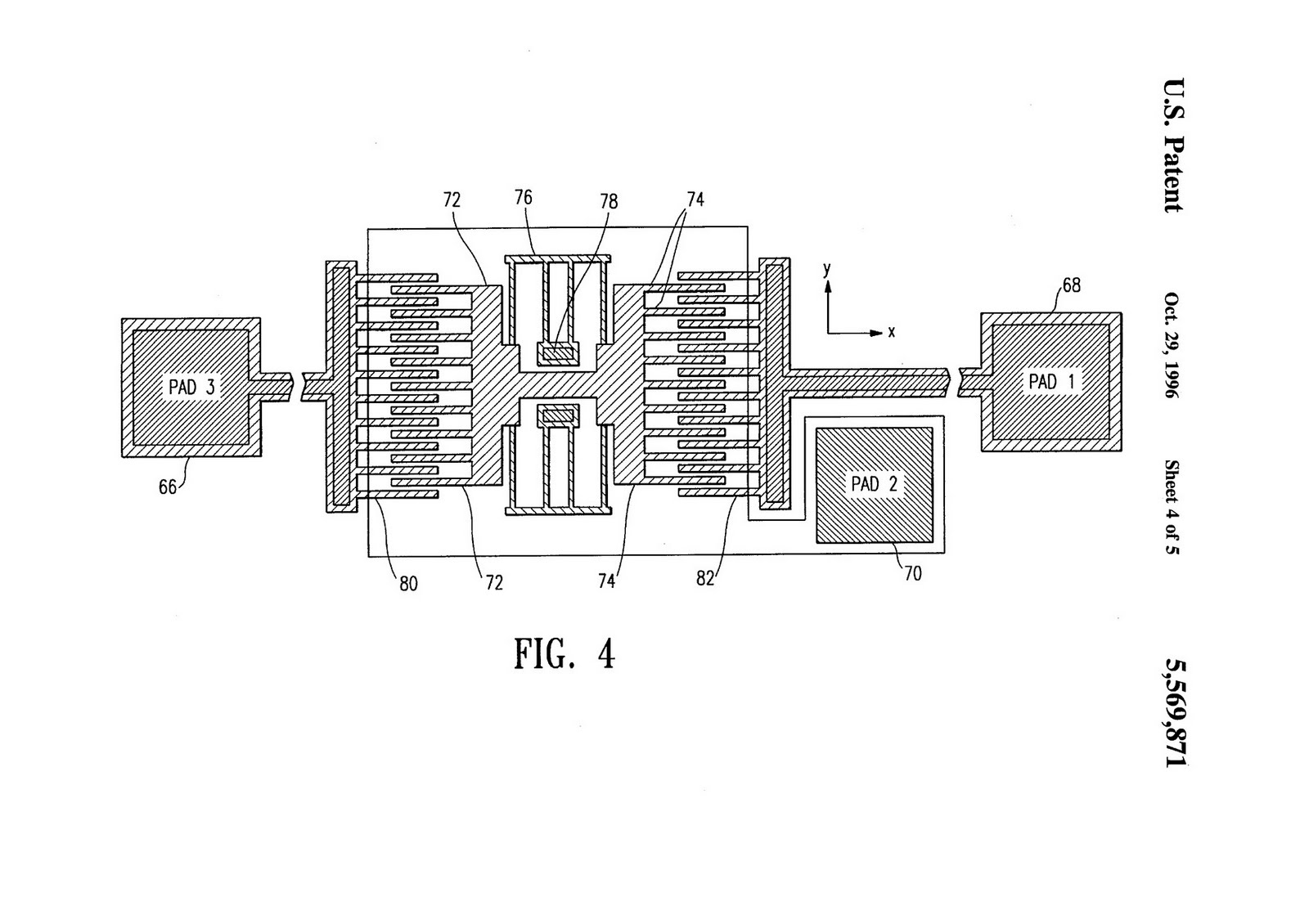
Happened to receive a note from a fellow traveler along the Engineering path, querying about some work done by me and some friends for Yamaha Music Technologies USA back in the days when Japan was in its tech ascendency. Like a number of other bits of the development of the future of music we did back then, our involvement was by the most part a brainstorming exercise, and a bit before its time, in both a good and bad way, a beautiful fantasy about the way things ought to be, but not so much about the way they really are. The figure below is from a patent discussing the a synthesizer that worked by taking the chipmunk sounds of the nano-world and pitch-shifting them down into the range of human hearing - or dog or bird hearing if such was your audience. It's crazy of course and probably wouldn't even work, but patents are no longer about crating up your better stream-driven wristwatch and taking the long coach ride to the US patent office to show them that it really works. That ended a long time ago, when the real patent system that dealt with real objects was replaced by an intellectual property wrestling ring & roulette table & bathroom scale where companies get together to fight over the vaguest of notions. But this device is what intrigued my colleague, who seems to be building something in the physical world which may actually vibrate and buzz.
Some of the bits and pieces we patented were more feasible, and some were even constructed. The picture at the top right shows a quite reasonable XYZ pitch roll yaw-based musical controller from another expired patent, long predating the Wii and its relatives. But Yamaha was out of the controller business, having sold only a few tens of thousands of some earlier attempts, and really was out of the far future business anyway by the time we came along, so little was realized, a few things finding their way into high-end karaoke machines, downloading updates by satellite.

Thursday, November 26, 2009

Greater America

Had dinner with my dear friend and librettist Jacobus Byssus Zanomensis and his lovely and talented wife V_M_ last night. As usual, talk turned to the German Question and how close our American Empire is keeling towards fascist imperialist disaster. On their last trip to the banks of the Meuse, one of his good German friends reminded him of the second stanza of the German National Hymn, which during the Great Hole of Modern Germany History was more or less the only stanza, topped off with a bit of this and that about shooting dead the enemies of the SA, but the section of interest runs as follows:
Von der Maas bis an die Memel,
Von der Etsch bis an den Belt.
meaning that the borders of the true Germany run from the Meuse River (more or less OK) to the Memel River (which, ahem, is way past Poland) to the Adige River (which would give Germany a nice warm water port in the Adriatic) to the strait of the Little Belt (which might require slaughtering a few troublesome people to the North who voted the wrong way in the Schleswig Plebiscites).

Of course, the concept of a border is a bit quaint in these days where the skies are filled with drones piloted by young brainwashed boys with close haircuts enforcing the limitless extent of the American Empire, part of a troubling stew into which we pour a bit of joblessness, hopelessness, rampant Fundamentalist and Patriotic pseudo religion, served up hot with Hellfire missiles, not to mention the heavy trod of the shock troops of the capitalist hordes, kevlar replaced by power tie.

Sunday, November 15, 2009

Dresher's Schick Machine


I drove out to the far distant countryside last week, past the manor houses of the 80 corridor, to see Paul Dresher's Schick Machine. As usual, I was in a bit of a funk, but by the end the piece had completely drawn me in. Steven Schick is a masterful percussionist, one of those who I'm sure can elicit a masterful performance out of any old bit of junk, but in this work his talent is allowed to flit across a variety of one-off noise and tone machines, packed onto the relatively small stage. A number of instrument makers were involved in the project, including Paul himself, but also Dan Schmidt, from whom I studied Javanese Music so many years ago, and Matt Heckert of SRL fame. Mr. Heckert's instrument was one of my favorites, just because of its seeming dangerousness, spinning chaotically, almost out-of-control, reminding me of the bowling-ball cannon shooting at the spectators at the first SRL show I saw way back when. But out of this jumble came some beautiful and quite big music, aided by Alex Stahl's loopers which allowed Paul to build up some massive orchestral weaves.

There is a bit of a story: the man who has lost his name and given himself over to his plans for a world-changing machine, the Schick machine, and, as it is a crux of the piece, I won't give away what this machine really is. But he is trapped there, inside himself, inside the assemblage of sound, constantly distracted, and those moments of distraction, where he stops to play, are the true center of the piece.

Thursday, November 5, 2009

Requiring higher education to comprehend

I recently received a request for submissions for a contemporary music composition concert, which happens to be taking place in the city of Eagle Rock, California, where I once studied the craft. In it was this light bit of manifesto:
The theme of this concert is music, literature, and art that evoke in the listener some aspect of the human emotional experience (i.e., love/pain/sorrow/fear/madness/ laughter/faith/hope/etc.). The key is that this music needs to be emotionally expressive, relatable, and readily accessible to the average listener (this of course doesn’t mean that the music necessarily needs to be programmatic). Avant-garde, atonal, experimental music, or compositions that require higher education to comprehend it are simply not appropriate for the theme of this concert.
I was incensed of course, on finding myself transported to a mirror world where not only left was right but up was down, where all that I knew and loved and up with which I grew was no longer true or meet or right or salutary and that my previous notion, that the music I had listened to from my childhood and thought relatable, expressive and more was actually not so. I trashed the email in a huff, but then, later, I untrashed it, and read and read and dissected it, dwelling on it, working myself into a fit. I googled the composers, the venue, every major noun in it, and brought forth the firehose of data from the net, fascinated.

Was anything learned? Probably nothing of value, but I did stop at some intriguing waypoints. One of the composers had a link to bring up a UI where one could listen to his works, which were divided into categories and from there, subcategories, e.g.: Action/Adventure, Asian, Atmospheric, Ballet, Comedy, ... through the alphabet to Whimsical. In the Asian category: Into the Mists of Asia, where we find the subdescription: From the mists of Asian forest, a hero appears to reunite the Shaolin warriors. In another: Frost Fills the Enchanted Woods, where: Entering an enchanted grove, Aerlyn looks around at the frost that is draped across the wood. Listening, I found a sure hand at the synthesized orchestra tiller, and music which did indeed well match the bromidic descriptions, reminding me of when, working on a Henry Rosenthal production, he showed me the batch of nearly identical cassettes which had arrived through the post after the production was announced in Variety or the Hollywood Reporter or wherever, each bearing on the small label the composer's name and a listing of the contents: (1) action (2) romance (3) ...

Wednesday, November 4, 2009

The Art Curator as Artist

At the Solomon R. Guggenheim a few days ago, wandering, fiddling with the iPhone, stepping into an annex gallery with an instantiation of the work to the right, surround by customers of the enterprise who, walking too close, were shooed away by the guard, lest they befoul the befouled floor, and, stepping back, looking at the work: a power cable to a bulb of light, once ensconced in a block of frozen ink, now lying at the bottom of a dry black lake, meandering to a puddle against the far wall, struggling a bit to find explication, note the text written by the curator and move quickly to it, presented on the white gallery wall in a carefully chosen and carefully kerned font, spending more time observing it than the forms on the floor, and so do we. Do they find what they are looking for? Let's check. Some quotes, not quite as beautifully presented but nonetheless here they are:
Kitty Kraus (b. 1976, Heidelberg, Germany) ... works in a spare, elegiac vocabulary of monochrome forms ... possess an internal volatility that can prompt their gradual fragmentation or sudden collapse ... The trajectory of dissolution at the heart of Kraus’s work ... a young artist defining her career at the beginning of the 21st century—a time of profound questioning and global crises—Kraus rehearses the trend towards degradation and chaos known as entropy, finding a mournful beauty in the literal and symbolic failure of form.
Probably the curator meant to say something about nature's trend toward increasing entropy, but still, that is a minor point. The writing is lovely, meaningless, mournfully beautiful itself. If I could write half so well I would die this instant just to be sure of my ascension into heaven. Like the new-music program note, it is the work, it is more interesting than the work, the writer is the artist, the writer is the giver of justification to the art-industrial complex for the money they have laid out to purchase that which they don't understand in and of itself.

Monday, November 2, 2009

Silk purse makes sow's ear more ridiculous

Just back from New York City, in a bit of a snarky mood. I love the city and the people and buildings and the park and the overwhelming cultural onslaught, but sometimes find the uptown-midtown-downtown-oh-and-the-rest-of-the-world-but-maybe-Europe's-OK point of view, especially in the music scene, a bit off-putting. We other-coasters do get our dander up about it, but what can we do but sit in our own beautiful city, listening to the other West Coast composers like Partch and Stravinsky and Riley and Milhaud. But my friend and sometimes operatic colleague Laura Bohn dragged us to the Met (the opera one that is) for a performance of Berlioz's La Damnation de Faust, which was touted last year for its interactive video elements, while I was still living in the aftermath of Mordake, so my interests were more than usually piqued. I have to say the sheen is quite beautiful, aided by a perfect projection system applied at the scale of spectacle, reminiscent of the feel of the golden age of stage magic, where storms at sea and horse races were reënacted with gales of wind and rain and treadmills built into the floor, even though this technology is so much cleaner and software-driven. However, the piece underlying all this, this almost-opera, more designed for the concert stage than the opera stage, but that being no real excuse either, is a stinkpile. I may be too kind in that description. Better would be to call it a stinking pile, packaged in a production so clearly expensive and fanciful and dandiful and technologically overwhelming that the whole mess stunk just a bit more to high heaven than it would have if just left to slowly die on its own.

A bit from the libretto:

Has! Has!
(The demons carry Mephistopheles in triumph.)
Tradioun Marexil firtrudinxé burrudixé.
Fory my dinkorlitz.
O mérikariu O midara caraibo lakinda,
mérondor dinkorlitz.
Tradioun marexil,
Tradioun burrudix?
Trudinxé caraibo.
Fir omévixé mérondor.
Mit aysko, mérondor, mit aysko! Oh!
(The demons dance around Mephistopheles.)
Diff! Diff! mérondor, mérondor aysko!
Has! Has! Satan.
Has! Has! Belphégor,
Has! Has! Méphisto,
Has! Has! Kroïx!
Diff! Diff! Astaroth,
Diff! Diff! Belzébuth, Belphégor, Astaroth, Méphisto!
Sat, sat rayk irkimour.
Has! Has! Méphisto!
Has! Has! Irimiru karabrao!

Proof once again that composers are not great judges of texts (see Beethoven's Ninth Symphony), and probably shouldn't help with their own libretti. Although this is a minor work in the Grand Opera canon, many of the most famous have pretty poor libretti. It's hard to imagine a major highbrow theater with as enormous a budget for talent and equipment constantly dusting off the most middling of the plays of the 19th century year after year and spending such enormous sums covering them in layers of fluff so no one pays too close attention to what lies underneath. Experiences such as this make me understand why so many of my through-composed-music-theater-people-who-put-notes-together colleagues avoid the big O word and separate themselves as much as possible from the big O world.

But H. Berlioz's own very posthumous website has an interesting description of his journey writing the piece and his travails in producing it, which I have to admit endeared me to him a bit and made me feel that he and I share some experience of the world, from his Memoirs:

But writing the work was nothing, I had to get it heard, and this is where my problems and disappointments began. Copying the orchestral and vocal parts cost me a fortune; then the numerous rehearsals which I required from the players and the exorbitant fee of 1600 francs which I had to pay for the hire of the hall of the Opéra-Comique, the only hall available to me at the time, committed me to an enterprise which was bound to ruin me. But I went ahead, comforted by a specious reasoning which anyone in my position would have made. "When I performed for the first time Romeo and Juliet at the Conservatoire, I said to myself, such was the eagerness of the public to come and hear it that tickets had to be issued for the corridors to accommodate the overflow of the audience in the hall; and despite the huge costs of the performance I made a small profit. Since this time my reputation among the public has grown, the echo of my successes abroad has bestowed on it an authority in France that it did not have before; the subject of Faust is as famous as that of Romeo, it is generally believed that I find it congenial and that I must have treated it well. Everything therefore encourages the belief that there will be great interest in hearing the new work, which is on a grander scale and more varied in tone than its predecessors, and that at least I should cover the expenses I am incurring…" Vain hope! Years had passed since the first performance of Romeo and Juliet, during which the indifference of the Parisian public for everything to do with arts and literature had progressed beyond belief. At that time already public interest had waned, particularly when a musical work was involved, and there was no desire to go and spend the day (I was unable to give my concerts in the evening) in the hall of the Opéra-Comique, which the fashionable public does not frequent in any case. It was late November (1846), it was snowing, the weather was dreadful; I did not have a popular singer for the part of Marguerite; as for Roger, who sang Faust, and Herman Léon, who took the part of Mephistopheles, they could be heard every day in the same theatre, and they were not fashionable either. The result was that I performed Faust twice before a half-empty hall. The concert-going public of Paris, which is supposed to be interested in music, quietly stayed at home, showing as little interest in my new score as if I had been the most obscure student from the Conservatoire; the audience at those two performances at the Opéra-Comique was no larger than if the most trivial opera in its repertory was being performed.

Nothing in my artistic career hurt me more deeply than this unexpected indifference. It was a painful discovery, but it was at least salutary, in that I learnt from it, and from then on I have not gambled even twenty francs on the popularity of my music with the Parisian public.

photo by Ken Howard for the Metropolitan Opera.

Monday, October 19, 2009

to those who are of god's chosen


I've embarked on a new opera project, even though I was feeling like I was a bit fagged out after the difficulties of the last, but once again hath the candle singd the moath, and I find myself in familiar territory, exploring the viscous friction of sense and nonsense at the boundaries of religion. It all started when I ventured to see a bit of a new Deborah Slater piece at the Traveling Jewish Theater and watched some of my most favorite dancers move gorgeously across the stage. Later, outside, Lynne and Deborah and I were talking, the Medea story came up and Lynne asked if we remembered how, a few years back, a woman threw her three children in the bay. Of course we did and, for memory's sake, here is the news item:
A 23-year-old woman who said she was hearing voices stripped her three small children naked Wednesday and threw them off a San Francisco fishing pier into the bay, authorities said. - San Francisco Chronicle, October 20, 2005
In fact, I remembered it very well, because Lynne and I happened across the makeshift memorial a few days after it occurred: flowers, stuffed animals, notes, photos, candles; all left in a vain attempt to palliate the horror of the crime. The story rolled around in my head for many days after that discussion, and I ended up buying a small notebook and some pens on a visit to Lynne's family

and I started writing something and had some very clear images of the look of it and that my dancer friends would be acting out the parts, maybe singers off stage, don't know, but when I started writing, I immediately mixed together the mother's thoughts and mine so that, in the end, there is definitely more of me than of her in it, but I started from the point that God and the mother really were talking and, like Abraham and Isaac, God really did tell her to kill her children, and that there is something compelling about her certainty, a religious certainty that many people crave. The text consists mostly of her internal monologue, but God speaks, and the children appear as well. She speaks like me, the version of me that graces many of these blog entries: a bit supercilious, a few too many five dollar words, but of course it really is me, my religious upbringing (although the mother was quite religious herself), my fascination with the non-rational, the ecstatic, my fear of insanity, my fear of a lack of ability to discern what is real and what is not.

Sunday, October 18, 2009

Of nieces

I was eight years old when I first became an uncle, in this case to a niece, the scion of my brother and his wife, themselves begotten of so and so, the seemingly infinite regress of humanity, and I felt suddenly so much older, rushed into a maturity for which I was not quite ready. One of my first memories of the little tyke is a scene that would evoke a sense of responsibility in any parent: her standing still in the doorway to my bathroom, not quite making it to the goal, an outpouring of urochromic fluid rushing from under her skirt, not sure to go forward or back but stuck in place. But as she got to be an actual kid, I was more of a big brother than a parent, looked-up-to in that way, required to tease and frolic and rassle and horse about as kids do, a play preparation for one's true transition to adulthood through the wrestling which creates us all.

Two years after I achieved this coming-of-age, I discovered what, at that time, was called modern music, through the vehicle of Stanley Kubrick's 2001, and was taken up by it. Although Ligeti sued, and rightly so, as his music was irreparably damaged, turned to kitsch (as he pointed out), it led me to all his other music, to the music of his colleagues and others, burning much of my paper route money over the years on vinyl and leading me to my chosen profession. And, as I don't want to be misunderstood, I want to say that I loved the movie too. In fact, I went back to see it again and again, and each of Kubrick's films over the years held sway over me during their reign, and each was a revelation. I remember my poor preacher father, forced to escort me to A Clockwork Orange and, as we were late to the theater, walking in at the moment of the first rape, followed soon after by the dancing Jesus scene, but as I was so earnest and excited, he stayed with me, watching it all, even allowing me to stay to see the beginning again so I would not miss a moment. My original artistic desires, in fact, veered toward film, and that interest in the great film auteur and his gesamtkunstwerks is surely why I've chosen music-theater, a live synthesis of all the arts, akin to movies, cheaper and more ephemeral.

When I mentioned to a friend that I was working on a new piece, they asked whether it dealt with the Nazis. It's a sensible question given my interest, an interest that I also shared with Kubrick, as he tried a number of times to develop movies about the war and about the Holocaust, deciding eventually that the latter was uncapturable, and all this even more interesting given that his wife, Christiane, whose artworks appear in a number of his films, and whom he met while filming Paths of Glory (she plays the German girl who sings at the end and reduces the soldiers to tears), was born Christiane Susanne Harlan, the niece of Veit Harlan, most beloved of Joseph Goebbels, the maker of the infamous and notorious anti-Semitic propaganda vehicle Jud Süß. An aside from theauteurs.com website:
The pornographic element is apparent early on, when a cheering woman at the Duke's inaugural parade loses her top, to the Duke's leering satisfaction. One is reminded of all the women who bared their breasts at Hitler, a strange phenomenon hinting at the hidden psychosexual nature of fascism.
And this one, the most famous of them all, the younger Schicklgruber, carried his romantic fascination with his niece, the even younger Geli Raubal, much further, and so many stories have been floated about his complicity in her apparent suicide that it is hard to discriminate fact from fact. It is true that she was found dead in her room, locked from the inside, shot through the lung by his gun, a Walther, that she had been dead since the previous day; but it is not so clear that she was arguing with Hitler, that she was pregnant by a Jewish art teacher in Linz, that he was jealous, angry; but it again is clear that he was devastated by the death, that he threatened suicide, that he stopped eating animal flesh forever after, that he was in love.

Saturday, September 26, 2009

Sweet Encumbrance

Continuing with the treacly investigation of romance and its elations, its euphoric pleasures, begun with Two Orchestral Waltzes for Lynne, the current work, Sweet Encumbrance, makes manifest, in sound, the joyous warmth, the sweet iron fetters and the small panics which flow from hogtying oneself together with one's chosen helpmeet and companion. In this piece, it is demonstrated in some detail how much one can gain in life simply by giving up one's philandering, and, while still given license to strut and flirt and still authorized to play the dandy, one must now, for the foreseeable future, festoon one's costume with the leash and collar and electronic ankle bracelet, sometimes visible but most often invisible, like the line that one might be enticed to cross save for the memories of the previous attempts' resultant truncheoning and electric shocks. But let us not dwell on such past pains, but please to look to that bright future world illumined by the brightest and whitest of most pure light where, joined in glory and set upon one's throne just to the right of the Empress, in a new Sagrada Familia, happily holding court, happily holding the hand of the one most beloved.

Sunday, September 20, 2009

Missa fictus Missa ficta

Jay Cloidt and I have been editing together the two nights' recordings of the Missa. It's tremendously thrilling to create such a fiction, something that never was, weaving the different performances, different microphones, different audiences together into one. We've added a few synthetic overlays where a few notes were missing, even recreating one whole section of the postlude. We've discovered once again the joy of reverb in absolving the recording of a great many sins confessed to us under the harsh scrutiny of his monitors, reverb that Jay had foresworn ever since hearing Blood Sugar Sex Magik.

One interesting set of audio interjections comes from a large belled clock in the sanctuary, which goes off from time to time during the recording, especially during the Sanctus, a highly synchronistic event, as the use of bells during the Sanctus goes back almost a millenium. Bells and the Bible go hand-in-hand, like love and glove, and the union produces such poetic gems as those found in Exodus 28:
And beneath upon the hem of it thou shalt make pomegranates of blue, and of purple, and of scarlet, round about the hem thereof; and bells of gold between them round about:

A golden bell and a pomegranate, a golden bell and a pomegranate, upon the hem of the robe round about.

And it shall be upon Aaron to minister: and his sound shall be heard when he goeth in unto the holy place before the LORD, and when he cometh out, that he die not.

Saturday, September 19, 2009

Teddy's biff

My cross-dressing Teddy has a new best friend, seen here in her finery, harnessed safe and secure in the bosom of fellow pulse modulator and amateur Ruxpin engineer Mike, with whom I've been corresponding about the ins and outs of our little friend and his/her sensitivity to radio interference. I had planned to take my act to Burning Man a few weeks back to help investigate the Doors of Perception with the various misfits freaks and weirdos of which I am proud to call myself a member, but work in all its aspects has been impeding my fun lately. This must stop of course, and the prevailing winds are beginning to change, to blow to leeward, so soon maybe Teddy and I can appear in public again together. Meanwhile, li'l red above will have to take our place in the world.

Wednesday, August 19, 2009

Tabla lessons with Harihar Rao, with a side trip to Richard Feynman

One day in tabla class - I studied on the side back in my scientific days at CalTech - some progressive-minded classmates and I, looking for a bit of spice and a bit tired of the (while often interestingly subdivided but still) powers-of-2 meters, goaded our teacher, Harihar Rao (top right), into amusing us with some rhythmic fireworks. Like all Westerners, we were always looking for something new and more exciting than what he was actually teaching us, never really willing to spend the time to learn the details of anything, like dancers seeming to hold their partners close but really looking past, scouting the next liaison across the room. But he had been teaching gringos like us for many years and so was used to this blasphemy and, with a weary acceptance, proceeded to teach us a somewhat complex 7 beat pattern. We then tried, a bit shakily, to keep this going, as steady as we could, as he straddled it with an 11 beat pattern, his beat effortlessly 11/7ths faster. It was a sweaty and joyous bit of concentration, collapsing and coming back together as we tried vainly to hold the two opposing rhythms in our head, to achieve what he could seemingly without thinking.

For the few years I studied with Harihar, I couldn't walk anywhere without tabla rhythms appearing over the pulse of my step. It was an obsession, a compulsion. I would practice the patterns as I walked, like all drummers I have known since, making approximations of the sounds with my body, trying to fly each pattern against 3 beats, 4 beats, and 5 and 6 and on. The important thing - or what seemed so at the time - was to be able to perform it consistently while shifting one's concentration from one pulse to the other, flickering between views as with the Necker cube. Relative prime rhythms were of course the only ones that were interesting, like the relative primes that defined the intervals of which I was just becoming aware, and these rhythmic practices spilled out into my pianism, forcing me to play scales in polyrhythms, to add or subtract a beat or two or three to each measure of the left or right hand parts of just about anything to squeeze or expand them just a bit, a pleasant flurry of notes not quite lining up, like the middle bit of the first of the op. 28 Chopin préludes where the right hand switches from 6 to 5. [A note to the reader trying this at home: better is to move the right or left hand up or down a bit as well, a fifth or a third or whatever, and then, even better, to just stop playing other people's music as it's easier on the stereo anyway.]

I was lucky enough to attend CalTech when Richard Feynman was still teaching Physics X, and my friends and I would hang out there too, asking questions about the Moon and the blue sky and rainbows and gravitation and electron spin and DNA and the structure of the eye, learning more about science and its cousins in the barest refractions of light in the few smallest drops distilled from the great man's essences than in all of our more formal studies. The class wasn't really a class at all, but an informal seminar, held in the basement somewhere, maybe Lauritsen, where the students would ask questions about anything, attempting and failing to stump the great man, and where Feynman would always cut through to the heart of each issue, bringing an oh-so-pleasant shock of illumination and intuition.

CalTech was a strange and insular place, a tremendous opportunity for those who were prepared to take advantage of it, suicidally difficult for others, stocked with children who had been locked away, sequestered from society from birth by the nature of their interests and their antisocial smarty-pants disposition. But, even in that rarified place, where Nobel Laureates were dime-a-dozen, Feynman was an icon who floated a bit above the rest. When he showed up to our tabla class one day, we were suitably star-struck and tongue tied, unable to respond to his easy manner. His bongo playing was well-known to us, and well as some of his other idiosyncrasies - one I remember well is when he showed up at a meeting of the CalTech Christian students simply to point out what idiots they were for believing against all facts and logic - but in the end the instrument was beyond him, and he an old dog trying to learn a few last tricks, the sounds too subtle and he too impatient to coax them out of the hide.

Tuesday, August 18, 2009

This year's CDs

The compact disc of my Missa, although wholly encapsulating a sad and dying medium of auditory exchange, is at least visually luminous and beguiling thanks to Karen and should be available quite soon, as soon as I can bring myself to go through all the recordings of both performances in some detail and make a final determination of what is the best and what is not. The chalice awaits the thick nectar of the reverb-heavy-laden music decanted, then held to the lips to succor those in spiritual need. Although I have attempted to interest a few of the typical classical music vendors in the product, it will be a vanity press item, made simply for the delight of my fans and so that I can continue to gaze longingly at my own reflection.

The Mordake CD, on the other hand, is mixed and packaged and has obtained the all-important record deal, only now awaiting approval from a thousand bureaucrats, dressed each identically in their identical indigo Mao costumery, soon to be unfettered, alive and on its own in the uncaring world.

Thursday, August 13, 2009

Bunnywhiskers once again

My dear friend Bunnywhiskers has moved her radio show to a new time and a new location and has asked me to ennoble her and her program by appearing, tonight, the 12th of August, 2009, two days past the Perseid peak, on FCC Free Radio at 107.3 on your FM dial here in San Francisco, or streaming online at the address you just passed over. We will talk of many things, surely including music and love and grace, and read excerpts from favored books and maybe the libretto from my upcoming production, possibly even giving away a free CD. All is possible. For those of you coming across this entry in the future, there may be a link to a recording of the show here.

Wednesday, August 12, 2009

Bletchley Park etc

As a former mathematician and reputed engineer, I've shared the recent nerdish interest in the true idea that World War II was really won by the boy and girl geeks who prodded and cajoled roomfuls of vacuum tubes and who lovingly sharpened their No. 2 pencils and who, on their long walks home, flirted and kissed furtively against romantic revival gingerbreaded walls, and that we Anglo-Americans, by our braininess alone, knew all the Axis powers' plans and played the war like a great chess game, not through the efforts of the poor filthy pawns who slogged through the mud and death and blood to capture and hold bits of land, captives of that distasteful space.

The reality is somewhere in between of course, although I did always wonder why it took so long for the engineers' roles to be understood. The truth was quite slow to arrive, and not until the 70s did the British government allow publication of Bletchley Park's breaking of the Enigma codes, for many reasons, my favorite of which is the fact that the Brits had sold the rotor machines to their former colonies throughout the world and hoped to continue to read all their diplomatic traffic. The secret business is a set of wheels within wheels, and there is great fascination in the work of statisticians deciding which bits of intelligence to follow and which to ignore, which will show the enemy too much knowledge of our knowledge and which can be safely hidden, possibly in other obfuscating and pointless missions, and who will be allowed to be killed by enemy attack, and who will be saved.

Outside of the rarified air of Bletchley Park there were also other, lower tech operations, some chronicled in the fascinating book Between Silk and Cyanide by Leo Marks, who tells stories of encryptions in the field, used by operatives behind enemy lines, some using bits of one-time pad sewed into bits of silk parachute material, others using memorized poems, the most famous of which is his own romance The Life That I Have, perhaps made more poignant by the context, where Nazi handlers may have beaten this poem and others like it from those they captured, turning them as agents to work against the land and people they loved:
The life that I have
Is all that I have
And the life that I have
Is yours

The love that I have
Of the life that I have
Is yours and yours and yours.

A sleep I shall have
A rest I shall have
Yet death will be but a pause
For the peace of my years
In the long green grass
Will be yours and yours and yours.

Tuesday, August 11, 2009

The youth


from Conversations with Igor Stravinsky, late '57:
I have all around me the spectacle of composers who, after their generation has had its decade of influence and fashion, seal themselves off from further development and from the next generation. Of course, it requires greater effort to learn from one's juniors, and their manners are not invariably good. ... The very people who have done the breaking through are themselves often the first to try to put a scab on their achievement. What fear tells them to cry halt? What security do they seek, and how can it be secure if it is limited? How can they forget that they once fought against what they have become?
I have to admit that it is v. difficult for me to learn from my juniors. My typical reaction to the artistic successes of freshly minted composers is envy and jealousy tempered only by rage, depression and frustration, and although, in my case, I really have very little that I am fighting for, except my own self-aggrandizement, as I am an eclectic and polyamorous lover of styles and ideas and threads of artistic development, it's hard for me to get past the pettiness that so pervades my soul. But in deference to the idol of my youth, I resolve to try.

And I was intrigued to recently discover the brief affair between the young Igor and Coco Chanel, now a motion picture, see above.

Saturday, August 1, 2009

More on Teddy


Since some have asked, here's what I know about reverse engineering the original Teddy Ruxpin®. The original bear used normal compact audio cassettes, but with an opening along the top, where the metal tape indicator tab was later located. This way it could detect the difference between its own cassettes and commercial audio tapes, which would play out the speaker but not control the servos. The Ruxpin cassettes were recorded with a cloyingly mawkish story and music on one of the stereo tracks, the kind of music you can never get out of your head no matter how many emetics you ingest, and a control track comprised of a series of audio-level pulses on the other.

Pictured at the top is a detail of two quasi-periods of the control track, consisting of a set of nine positive-going pulses. Each pulse is about .25 msec wide, actually .27 for the 'blue box' I built so many years ago, and the time between pulses is what controls the servos. That is, the time between pulse 0 and pulse 1 in each group of nine controls one servo, and the distance between pulse 1 and pulse 2 controls the next, and so on. The time between pulses from a fully open to a fully closed servo varies from about 1.25 msec to 2 msec, measuring from leading edge to leading edge. The leading edge of pulse 0 of next group of nine is about 6.5 seconds from the leading edge of the last pulse of the previous group of nine. The total period of the groups is not fixed - you can hear the overall pitch change as they move. My main bear is one of the two servo variety, and for that animal the interval from pulse 1 to pulse 2 controls the eyes and from pulse 2 to pulse 3 controls the mouth. Later bears had a separate control for upper and lower jaw, and if you hook Teddy to Teddy's friend Grubby®, a pleasantly disgusting and seemingly out of scale and of a different cartoon aesthetic big grub-like creature, you will find that the other pulse to pulse modulations come into play to control him as well.

Originally I sent the control signal in using a CD to cassette adaptor and then recorded actual cassettes, but as I've resurrected the project in more recent days I decided to do some surgery (note crime-scene-like photo above) and bypass the heads on the crappy built-in cassette player. I attached a mini phone jack directly past the play heads and it seems to work to send the signal in from a dime-a-dozen mp3 player. One has to be a bit careful of the levels - too high or too low on the control track and the bear becomes subject to a variety of muscle spasms or alternately is sent into a catatonic state. Also, running the low-level wires out of the bear makes it subject to radio interference, and cell phones held close to the bear can also elicit the abovementioned palsies. I went a little further and hooked up battery powered amp/speaker combination inside since the built in speaker is also pretty bad. It's meant to be heard by a small child sitting in a quiet room alone with the somewhat scary bear toy and is not quite up to entertaining a packed opera house.


Thursday, July 23, 2009

Duncan Wold's score for In Residence

My son, showing that he is a child of the same Adam, has constructed a heavenly collection of musical fragments, a Soundscape for a Nonexistent Motion Picture, but which, by its synopsis, makes one strongly wish for its actual production:
This haunting film is not for the faint of heart — or the claustrophobic. We are presented with Jane, an artist who begins a residency at a strange home filled with junk. Her goal is to fashion the detritus into a piece of artwork speaking to the theme of recycling and ‘green’ building practices. But things get twisted when the junk compels her to construct an elaborate and, at times, beautiful trap for herself, which she slowly begins to realize is locking her in, pressing her downward into infinite, interlocking chambers. Even as she becomes more entangled in the web of the house, it begins to provide her with sustenance necessary to continue her work.
— Dina Bloomberg, Down the Rabbit Hole Zine
Tuning in the radio station here, at about eleven and half megaHertz on the dial, we are transported into Jane's world, fading into an imagined natural ambiance, shifting, drawing us into a composition where an ebowed guitar caresses a set of melancholy changes. Of course I'm proud of him, and I tear up a bit when I think of my polymath heir, creator of so many beautiful things, another being Shit Show V, soon to be revealed.

Wednesday, July 8, 2009

I have nothing to wear and I am wearing it

and that is poetry, in this case the poetry of Bunnywhiskers resting her tired coney body after a day's hunting and being hunted, me the eternal gentleman.

Saturday, July 4, 2009

Teddy

I have been fortunate enough in my career to have a few people get very excited about a few works of mine, an heartwarming occurrence. Although, two people that I respect awfully have chosen atypical and offhand works of mine from the mid 80s as their favorites. One was a theatrical work based on a game between the San Francisco 49ers and the Denver Broncos during the Joe Montana glory years, written with Everett Shock, and featuring a recitation of a declaration, aided by an overheard projector on which the declaimer laid out an Xs and Os play-by-play, in the style of the Declaration of Independence (a memory fitting this day of all days), but commencing with the line "when, in the course of a football game, it becomes necessary for one team" and so on.

But the other venture, which has been favorited by more than one of my erstwhile fans, was a small piece done in a small venue in Oakland, where I performed a duet with a Teddy Ruxpin® which centered on themes of objectophilia and robot sex in the modern world. In fact, the exact animatronic doll sitting on my desk today in the photo above being prepared for a comeback tour of sorts next month. You can see the blue pulse timing modulation box I built back in my 'maker' days to control its servos and to allow me to make my own, more sophisticated control tapes. My son, who was about 2 at the time, loved it, although it's possible that some of the themes may have gone over his head. He giggled all through the preceding performance that evening, in which a topless and somewhat buxom young butoh dancer, powdered in white, completed, in about ten minutes, a short walk down an incline.

Since the script was quite short, I reproduce it here for your amusement. As my wife was the voice actor for the bear, I performed a small transgendering of Teddy to Trary, and put a bit of ribbon in his hair.

TRARY
(Sings) Come dream with me tonight. (Speaks) Hi, my name is Trary Razkovky. Can you and I be friends? I really enjoy talking to people. In fact, some people have told me I have a problem that way, but I don't count these people among my friends. And I do have many many friends.
I would very much like you to meet one of my very good friends. Say hello to everyone, Erling.

ERLING
Hello.

TRARY
What do you have there with you, Erling?

ERLING
It's an accordion, Trary.

TRARY
It is a very fine looking instrument, Erling. (Pauses) Can you come a little closer, my friend?

ERLING
Sure. (moves closer)

TRARY
(After a while) I'd like to talk to you about something, Erling, if that's all right.

ERLING
Fine.

TRARY
I read a story in the newspaper.

ERLING
What was it about?

TRARY
A very fine car dealership in St. Louis, Missouri had a contest. The dealership was to give to the winner a brand new Toyota. The single rule of this contest and the objective of those who participated was to kiss the car longer than anyone else. Of course, I was concerned for these people. How would they go to the bathroom? How would they eat or drink? People need companionship too, but I guess they were kissing the car, after all. Luckily, the very wise people at the car dealership had thought of this. They gave each person a few minutes off every hour to take care of the things that they had to.

ERLING
So who won, Trary?

TRARY
A woman won. Her name was Ellen J. Twaddle. She won by kissing the car for 110 hours, longer than anyone else who tried.

ERLING
That's an amazing story, Trary.

Um, why did you bring it up?

TRARY
Well, I began to wonder. How does she feel about the car she has won by kissing it for so long?

ERLING
I don't know.

TRARY
Well, wouldn't she be more attracted to it?

ERLING
Maybe.

TRARY
Maybe it would seem a little more animate? Wouldn't there be, well, a cognitive dissonance in kissing something for so long that one saw as inanimate?

ERLING
Yes, I think you're right, Trary. If she had seen it as inanimate, she would be repulsed, not attracted.

TRARY
That's right, Erling. But she stayed. She even lost her job. Her company was upset with her when they found out why she had been calling in sick for five days.

ERLING
That's quite a sacrifice.
(pause)

TRARY
Would you kiss me, Erling?

ERLING
Sure. (Erling kisses Trary for a long time)

TRARY
(mumbling through the kiss) I hope you see me in a new light.

ERLING
(drawing back) What was that?

TRARY
I said, "That was nice."

I think I am in the mood to sing a song for all the people here. Could you accompany me on the accordion, Erling?

ERLING
Sure. (Trary and Erling perform The Second Prayer from A Little Girl Dreams of Taking the Veil.)
Related Posts with Thumbnails